
What is Uni-1
Uni-1 is a unified image understanding and generation model launched by Luma AI, integrating visual reasoning and image generation into a single autoregressive Transformer architecture for the first time. The model can perform structured internal reasoning before and during generation, understanding spatial relationships, logical causality, and physical laws, achieving "thinking while creating." On the RISEBench reasoning editing benchmark, Uni-1 scored 0.51, surpassing GPT Image 1.5 and Nano Banana 2 to achieve SOTA, supporting 76+ artistic styles and multi-image reference fusion.
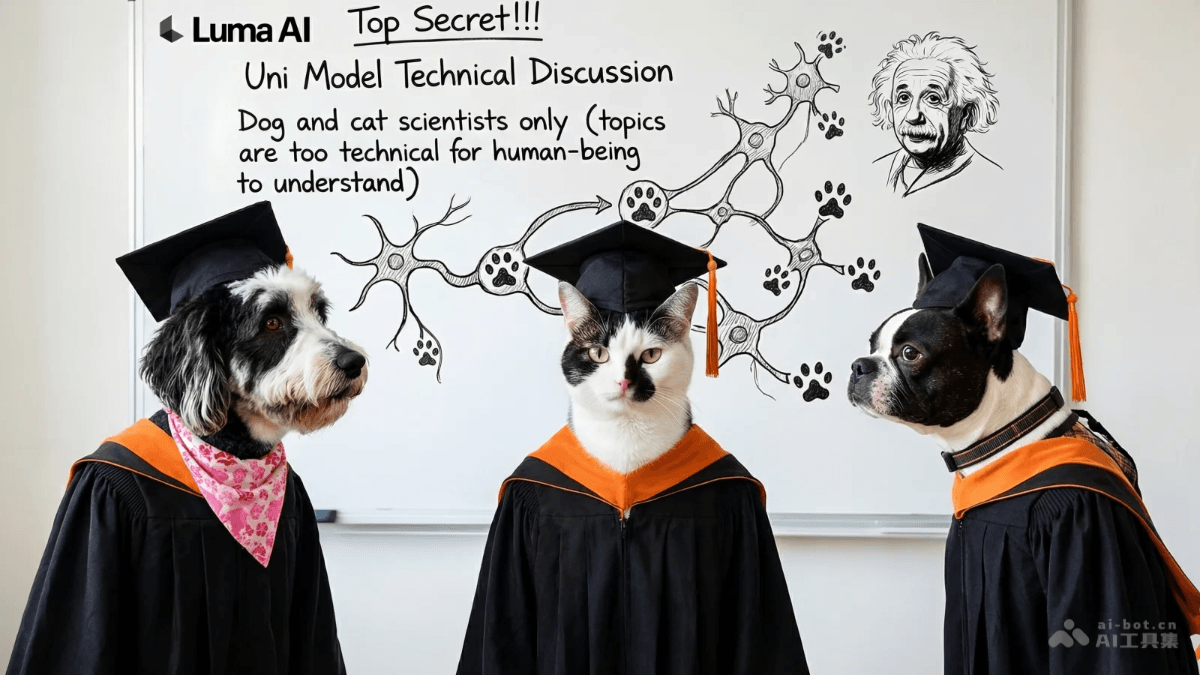
Uni-1's Main Features
-
Unified Multimodal Capability: Uni-1 integrates image understanding, generation, and editing into a single model, supporting text-to-image, image understanding, instruction editing, and reference image-guided generation, achieving true unified multimodal processing.
-
Intelligent Reasoning Generation: The model performs structured internal reasoning before generating images, understanding spatial relationships, logical causality, and physical laws, and can precisely execute complex spatial instructions such as "place the red ball to the left of the blue cube."
-
Reference-Guided Creation: Supports single-image or multi-image (up to 8) reference generation, can maintain character identity, pose, and composition consistency, and the model can generate temporally coherent image sequences based on a single reference image.
-
Multi-Turn Dialogue Editing: Features contextual memory capability and supports conversational iterative optimization, allowing users to continuously provide modification instructions without repeating background information.
-
Stylized Creation: Supports over 76 artistic style transfers, covering a broad aesthetic range from the Renaissance to modern digital art, enabling culturally aware visual creation.
Uni-1's Technical Principles
- Autoregressive Transformer Architecture: Uni-1 adopts a GPT-like Decoder-only architecture, representing text and images uniformly as interleaved Token sequences, using BPE tokenization for text and encoding images into discrete visual Tokens via VQ-VAE, enabling the model to handle understanding and generation tasks in a unified manner.
- Integrated Reasoning-Generation Mechanism: The model's core innovation lies in its "mind's eye" design, which automatically performs internal reasoning and planning before generating visual content, decomposing complex instructions, parsing constraints, and planning composition layouts, achieving thinking and creation within the same forward pass, differing from the direct noise denoising process of traditional diffusion models.
- Generation Enhances Understanding: Uni-1 adopts a joint training strategy, simultaneously optimizing visual understanding and image generation objectives. Research finds that learning to generate images significantly improves the model's fine-grained visual understanding capabilities, bringing a 2.3 mAP performance improvement on the ODinW-13 detection benchmark, proving the synergistic enhancement effect of generation and understanding.
Uni-1's Key Information and Usage Requirements
- Core Positioning: A leap from "pure visual generation" to "multimodal general intelligence," adopting an autoregressive Transformer architecture to replace traditional diffusion models, achieving "thinking while creating."
- Performance: Achieved 0.51 SOTA on the RISEBench reasoning editing benchmark, with logical reasoning scores twice that of GPT Image, and 2K resolution API pricing 10-30% lower than Google's flagship model.
- Technical Access: Requires access through Luma's official API or creative platform, supports standard HTTP REST API calls, and returns 2K resolution images.
- Input Specifications: Text prompts need to clearly describe spatial relationships, logical constraints, and style requirements; reference images support up to 8 image inputs, and it is recommended to provide clear subject and composition references.
Uni-1's Core Advantages
- Unified Reasoning and Generation: Uni-1 is the first model to integrate visual reasoning and image generation into a single autoregressive architecture. It can automatically perform structured internal reasoning before generation, understanding spatial relationships, logical causality, and physical laws, achieving true "thinking while creating," which differs from the direct generation mode of traditional diffusion models.
- Precise Execution of Complex Instructions: With its built-in reasoning mechanism, Uni-1 can accurately parse and execute multi-constraint complex instructions, such as "place the red ball to the left of the blue cube with both on the edge of the table." It achieved a SOTA score of 0.51 on the RISEBench reasoning editing benchmark, with a logical reasoning score twice that of GPT Image.
- Mutual Enhancement of Understanding and Generation: Uni-1 adopts a joint training strategy. Learning to generate images significantly improves fine-grained visual understanding, reaching 46.2 mAP on the ODinW-13 detection benchmark, close to Google Gemini 3 Pro, demonstrating the synergistic enhancement effect between generation and understanding.
- High-Resolution Cost Advantage: At 2K resolution, Uni-1 API pricing is 10-30% lower than Google's flagship models, with text-to-image at approximately $0.09 per image, providing more competitive pricing while ensuring high-quality output.
How to Use Uni-1
- Free Experience on the Web: Visit the Uni-1 official website https://lumalabs.ai/uni-1 to try it online directly, with no coding required. Quickly generate images by entering text prompts or uploading reference images through the interface.
- API Integration for Development: Integrate through the interfaces gradually opened by the official Luma API, using standard HTTP REST calls, passing parameters such as text prompts and reference images, and returning generated results at up to 2K resolution.
Uni-1 Project Address
- Project Official Website:https://lumalabs.ai/uni-1
- Technical Paper:https://lumalabs.ai/uni-1/tech-specs
Comparison of Uni-1 with Similar Competitors
| Comparison Dimension | Uni-1 | GPT Image 1.5 | Nano Banana 2 |
|---|---|---|---|
| Developing Company | Luma AI | OpenAI | |
| Architecture Type | Autoregressive Transformer | Based on GPT-4o | Diffusion Model |
| Core Mechanism | Integrated Reasoning-Generation | Separated Understanding and Generation | Direct Noise Denoising |
| Reasoning Capability | Built-in Structured Reasoning | Limited Reasoning Capability | No Explicit Reasoning |
| RISEBench Score | 0.51(SOTA) | 0.46 | 0.50 |
| Logical Reasoning | 0.32 (Double Advantage) | 0.15 | — |
| Spatial Reasoning | 0.58 | — | 0.47 |
Uni-1 Application Scenarios
-
Advertising Creativity and Brand Content Production: Uni-1 can compress traditional advertising projects that take months and millions of dollars into dozens of hours and tens of thousands of dollars to complete multilingual localized versions, and has cooperated with brands such as Publicis Groupe and Adidas.
-
Complex Composition and Precise Instruction Execution: The model is suitable for scenarios such as product placement design and architectural visualization that require precise spatial relationships, logical constraints, and understanding of physical laws, and can accurately execute multi-constraint complex instructions.
-
Character and IP Consistency Creation: Through the multi-image reference feature, it maintains a high degree of consistency in character identity, pose, and style, making it suitable for game character design, virtual idol development, comic serialization, and other projects that require long-term maintenance of visual consistency.
-
Temporal Narration and Visual Storyboarding: Generates a coherent temporal sequence based on a single reference image, which can display a character's growth process or a product usage workflow, making it suitable for film and television previsualization, dynamic storyboarding, educational demonstrations, and other narrative scenarios.