
What is Toonflow
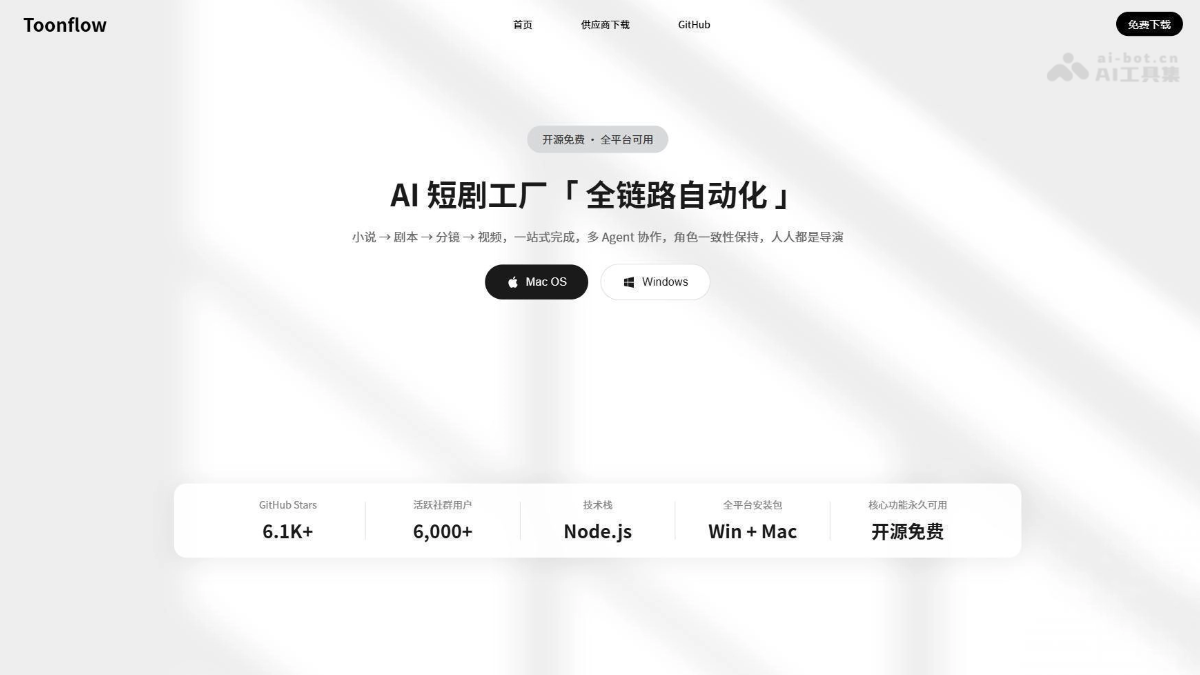
Toonflow is an open-source one-stop AI short drama creation tool that automatically transforms novels and scripts into structured scripts, intelligent storyboards, character visuals, and animated videos through multi-agent collaboration, realizing full-process AI automated production from novel → script → storyboard → video. The tool supports cross-platform desktop deployment on Windows, macOS, and Linux, with data stored entirely locally, helping creators produce visual content in batches at low cost.
Main Features of Toonflow
-
AI Screenwriting: Multi-agent collaboration automatically breaks down novels/ideas into scenes, dialogue, and pacing, outputting in standard script format.
-
Intelligent Storyboarding: Automatically generates precise storyboard scripts, including complete descriptions of shot size, composition, light direction, and camera movement.
-
Character Consistency Maintenance: Establishes a character appearance database to maintain high consistency of character appearance, clothing, and props across scenes and shots.
-
AI Batch Image Generation: Deeply integrates mainstream image models such as Nano Banana, GPT Image 2, Kling, Jimeng, and Hailuo, supporting batch generation.
-
Video Composition Output: Automatically completes voiceover, subtitles, and editing; the final video can be published directly, supporting both vertical 9:16 and horizontal 16:9 formats.
-
Infinite Canvas Workbench: Freely arrange scripts, characters, storyboards, assets, and video nodes in an infinite-canvas-like format, supporting parallel production.
-
Three-Layer Agent Collaboration System: The decision layer, execution layer, and supervision layer work together, covering task decomposition, content generation, quality review, and revision feedback.
-
Persistent Agent Memory: A cross-session memory system based on local ONNX vector retrieval, supporting semantic recall to ensure continuity across multiple rounds of creation.
-
Programmable Provider System: Supports writing TypeScript provider logic directly in the settings center with immediate effect, without modifying source code or restarting.
-
Chapter Event Graph-Driven Adaptation: Automatically extracts and structurally stores events from original chapters; script adaptation accurately retrieves context according to the event graph.
Technical Principles of Toonflow
- Multi-Agent Collaboration Architecture: Toonflow adopts a three-layer agent collaboration system, divided into the decision layer, execution layer, and supervision layer. The director agent coordinates the overall narrative rhythm and task priorities; the screenwriter agent is responsible for transforming novels into standard scripts and optimizing dramatic conflict; the storyboard agent generates precise storyboard descriptions including shot size, composition, lighting, and camera movement; the consistency agent establishes a character appearance database to keep character features stable across scenes; the quality inspection agent automatically reviews plot logic loopholes and character contradictions; the voiceover agent matches character voices and generates multi-character speech synthesis scripts. Each agent collaborates in parallel based on the Vercel AI SDK and communicates in real time through Socket.IO, simulating the division of labor of a real film and television production team.
- Persistent Memory and Context Maintenance: The system has a built-in cross-session memory system based on local ONNX vector retrieval, using @huggingface/transformers for local embedding inference. This memory system supports short-term message caching, long-term summary compression, and semantic recall, ensuring that character settings, plot direction, and style preferences are not lost across multiple rounds of creation, achieving continuous narrative across chapters.
- Chapter Event Graph-Driven Adaptation: To address the issue of information loss in long novel adaptations, Toonflow automatically extracts chapter-level events from the source material and builds a structured event graph. During script adaptation, the system precisely retrieves relevant context fragments based on the event graph rather than feeding the entire text at once, thereby maintaining high fidelity between the adapted script and the original plot while controlling Token consumption.
How to Use Toonflow
- Download and Install: Go to the GitHub Releases page to download the installation package for your system, then launch the application after installation.
- Configure Models: In the Settings Center, configure the API providers for text, image, and video models.
- Create a Project: Log in with the default account (admin / admin123), create a new project, and import the original novel or creative text.
- Extract Events: Run chapter event extraction to automatically build an event graph of the original work, providing precise context for subsequent adaptation.
- AI Screenwriter: Enter ScriptAgent to generate the story skeleton, adaptation strategy, and structured script, with support for multiple rounds of iterative optimization.
- Storyboard Production: Switch to ProductionAgent to organize storyboard nodes on an infinite canvas and batch-generate character and scene asset images.
- Video Generation: Fine-tune storyboard images node by node, generate video clips, automatically complete voiceover, subtitles, and editing, and export the final video.
Toonflow's Core Advantages
-
Fully Automated Workflow: One-stop completion from text to final video, with no need to switch between multiple tools, boosting creative efficiency by 10x+.
-
Multi-Agent Collaboration: Agents for directing, screenwriting, storyboarding, consistency, quality control, voiceover, and more collaborate in parallel, delivering output quality far beyond direct generation by a single LLM.
-
Character Anchoring System: Solves the most critical "character face-swapping" problem in AI short dramas, maintaining a high degree of consistency in character appearance across scenes.
-
Model-Agnostic Architecture: Not tied to any single platform, supporting free integration with mainstream image/video models as well as locally deployed models.
-
All Data Stored Locally: All data is stored locally and does not pass through any third-party servers, ensuring privacy and security.
-
Batch Factory Efficiency: Supports batch conversion of an entire novel, automatically plans pacing density, and allows one person to run a complete production line.
Toonflow's Comparison with Similar Competitors
| Comparison Dimension | Toonflow | Descript |
|---|---|---|
| Product Positioning | Open-source full-link industrialized production system for AI short dramas | Audio and video editing and content creation platform |
| Core Workflow | Novel/Creative Idea → Script → Storyboard → Characters → Video | Recording/Script → Editing → Subtitles → Publishing |
| Target Users | AI short drama creators, MCNs, web novel adaptation teams, film and television teams | Podcasters, YouTubers, marketers, trainers |
| AI Screenwriting Capability | ✅ Multi-Agent collaboration, automatically breaking down scenes/dialogue/pacing, supporting adaptation driven by a chapter event graph | ❌ No native scriptwriting functionality |
| Character Consistency | ✅ Character anchoring system, maintaining high consistency of character appearance/costumes/props across scenes | ❌ No character management or visual consistency control |
| Smart Storyboarding | ✅ Automatically generates professional storyboard scripts including shot types, composition, lighting, and camera movement | ❌ No storyboarding feature, only simple image and text arrangement |
| AI Video Generation | ✅ Integrates with models such as Kling, Seedance, and Nano Banana to generate video assets directly from text | ⚠️ Only supports simple AI background generation, does not directly generate AI video footage |
| Audio AI Capabilities | ⚠️ Voiceover Agent + TTS multi-role speech synthesis | ✅ Extremely strong: Studio Sound noise reduction, Overdub voice cloning, automatic transcription |
| Editing Interaction Paradigm | Node-based infinite canvas + structured script editing | Text-driven editing (edit audio and video like editing Word) |
| Open Source License | Apache-2.0 (fully open source) | ❌ Closed-source commercial software |
| Deployment Method | Local desktop + Docker self-hosting + cloud | Pure cloud SaaS |
Toonflow Application Scenarios
-
Short Video Content Creation: Quickly generate AI short dramas adapted for platforms such as Douyin, Kuaishou, Bilibili, and YouTube.
-
Novel-to-Screen Adaptation Experiments: Automatically adapt web novels into visualized short dramas, validating IP adaptation potential.
-
AI Literary Adaptation Tool: Provides literary creators with automated adaptation capabilities from text to video.
-
Script Development and Rapid Prototyping: Film and television teams quickly generate script prototypes and storyboard previews, reducing upfront trial-and-error costs.
-
Video Asset Generation: Batch-generate creative assets such as character design sheets, scene concept art, and video clips.