
What is TIPSv2
TIPSv2 is a multimodal model introduced by Google DeepMind. Through three major innovations—iBOT++, Head-only EMA, and multi-granularity text augmentation—the model solves the challenge of precise alignment between dense image patches and text embeddings. The model covers 86M to 1.1B parameters and achieves SOTA on 9 tasks and 20 datasets, with zero-shot semantic segmentation being particularly outstanding. Currently, the model weights, code, and HuggingFace online Demo have been fully open-sourced.
TIPSv2's Main Features
-
Zero-Shot Semantic Segmentation: Without training, it can precisely segment object boundaries in images through text descriptions.
-
Image-Text Retrieval: Supports bidirectional cross-modal retrieval of image-to-text search and text-to-image search.
-
Zero-Shot Image Classification: Directly achieves classification tasks such as ImageNet through text embedding matching.
-
Depth and Normal Vector Prediction: Uses Patch-level features to estimate scene geometry information.
-
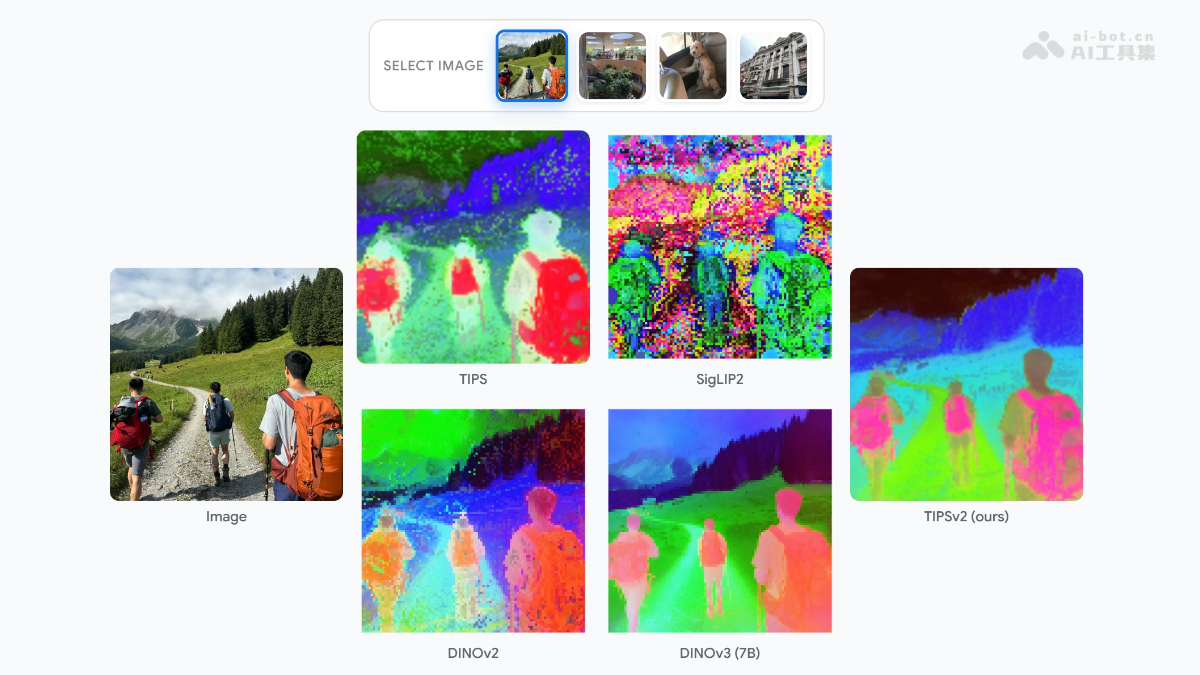
Feature Visualization: Upload an image to explore PCA feature maps of Patch embeddings and intuitively understand the model's perception.
TIPSv2's Technical Principles
-
iBOT++: Extends the Patch-level self-distillation loss to all tokens (including visible tokens), forcing the student model to align with all Patch representations of the teacher model, improving ADE150 zero-shot segmentation by +14.1 mIoU.
-
Head-only EMA: Applies EMA only to the projection head, reducing training parameters by 42% and significantly lowering memory overhead.
-
Multi-Granularity Text Augmentation: Uses PaliGemma to generate dense local captions and Gemini Flash to generate global in-depth descriptions, randomly alternating between them during training to improve robustness.
-
Joint Training of Contrastive Learning and Self-Supervised Learning: Simultaneously receives text supervision signals and self-supervision signals, unlocking the dense image-text alignment capability of the underlying network.
TIPSv2's Key Information and Usage Requirements
- R&D Team: Google DeepMind, with corresponding authors Bingyi Cao, Koert Chen, and André Araujo.
- Open-Source Scope: Model weights (4 specifications from 86M to 1.1B), dual-framework code for PyTorch and JAX/Scenic, HuggingFace online Demo, and Colab Notebook are fully open.
- Runtime Environment: Python 3.11, supporting PyTorch or JAX/Scenic backends.
- Dependency Installation: Requires installation of core libraries such as torch, torchvision, tensorflow_text, and scikit-learn.
TIPSv2's Core Advantages
-
SOTA in Patch-Text Alignment: Zero-shot segmentation leads comprehensively on four major benchmarks including ADE150 and PASCAL VOC. Without complex post-processing protocols, directly maximizing cosine similarity achieves higher mIoU.
-
Extreme Parameter Efficiency: The Head-only EMA strategy saves 42% of training memory, and small models can surpass larger teacher models on dense alignment tasks through distillation.
-
Extremely High Training Cost-Effectiveness: TIPSv2-g uses fewer parameters and less data to beat PE-core, which has 56% more parameters and 47 times more data, on 3/5 evaluations; TIPSv2-L beats DINOv3-L, which uses 6 times the parameters and 15 times the data, on 4/6 evaluations.
-
Versatility Covering Three Major Dimensions: Simultaneously excels in dense alignment (segmentation), global alignment (retrieval/classification), and pure vision tasks (depth/normal vectors), with balanced performance across 9 tasks and 20 datasets.
-
Clear Feature Semantics: PCA visualization shows that its Patch embeddings are smoother than those of SigLIP2 and DINOv3, with object boundaries and semantic details preserved more completely.
TIPSv2 project address
- Project website:https://gdm-tipsv2.github.io/
- GitHub repository:https://github.com/google-deepmind/tips
- HuggingFace model hub:https://huggingface.co/collections/google/tipsv2
- arXiv technical paper:https://arxiv.org/pdf/2604.12012
Comparison of TIPSv2 with similar competitors
| Dimension | TIPSv2 | DINOv3 | SILC |
|---|---|---|---|
| Institution | Google DeepMind | Meta | Multi-institution |
| Core mechanism | iBOT++ + contrastive learning + multi-granularity Caption | Purely self-supervised (DINO + iBOT) | Contrastive learning + masked language |
| Text supervision | Multi-granularity synthetic Caption | None | Single granularity |
| Zero-shot segmentation | Direct cosine similarity, no post-processing required | Requires sliding window protocol assistance | Depends on the TCL sliding window protocol |
| Parameter efficiency | High(Head-only EMA saves 42% memory) | Low (full-model EMA, large data volume) | Medium |
| Patch-text alignment | SOTA | Weak (no text alignment) | Relatively strong but requires a complex protocol |
Application scenarios of TIPSv2
-
Autonomous driving: Use zero-shot segmentation and depth estimation to understand road scenes in real time, identify obstacles and drivable areas, without retraining for new categories.
-
E-commerce and content moderation: Through bidirectional image-text retrieval, enable text-to-image search and image-to-text search, supporting product recommendations and identification of violating content.
-
Medical imaging analysis: Doctors can locate lesion areas through text descriptions, greatly reducing the annotation and training costs for professional medical images.
-
Robotic visual navigation: After receiving natural language instructions, robots perform fine-grained visual localization and grasping operations on specific objects in the environment.
-
Scientific research and model interpretability: Explore the semantic structure of Patch embeddings through PCA feature visualization, gaining deeper understanding of the perception mechanisms of vision-language models.