
What is DINOv3
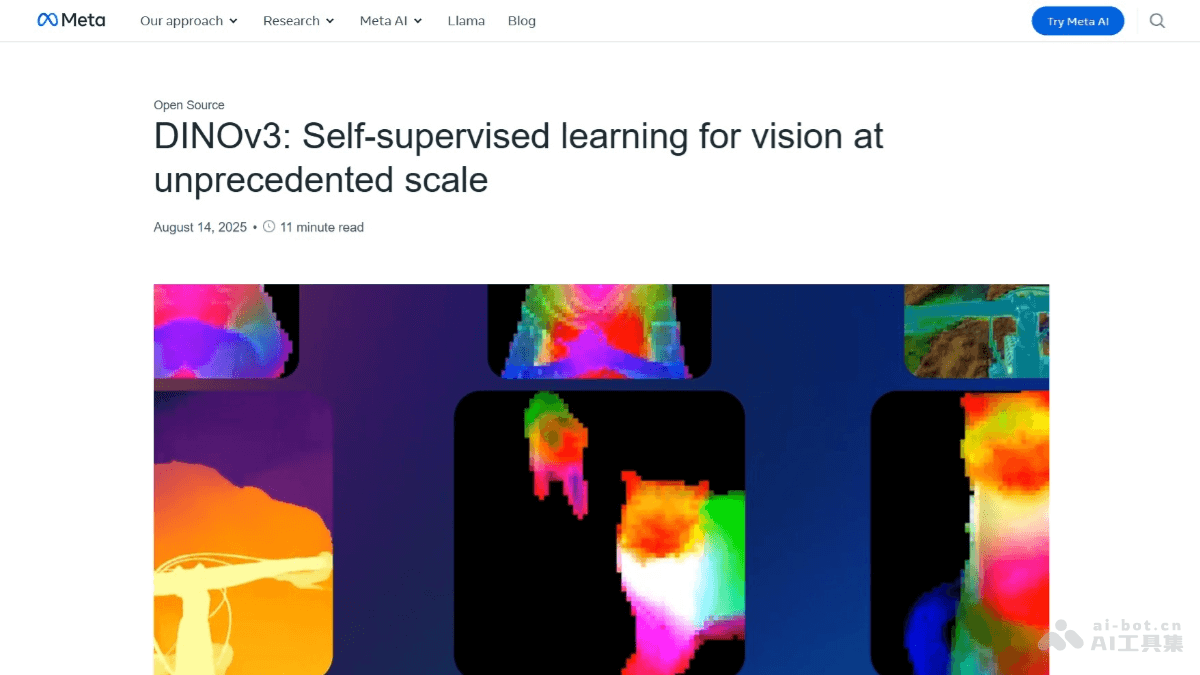
DINOv3 is a general-purpose,SOTA -grade vision foundation model introduced by Meta. The model is trained on unlabeled data to generate high-quality, high-resolution visual features, suitable for multiple tasks such as image classification, semantic segmentation, and object detection. DINOv3 has 7 billion parameters and is trained on 1.7 billion images, comprehensively surpassing weakly supervised models in performance, and the model supports multiple model variants to adapt to different computational needs. DINOv3 open-sources its training code and pretrained models, providing strong support for computer vision research and application development.
DINOv3's Main Features
- High-Resolution Visual Feature Extraction: Generates high-resolution visual features, supporting fine-grained image parsing and various visual tasks.
- Multi-Task Support Without Fine-Tuning: A single forward pass can simultaneously support multiple downstream tasks without fine-tuning, significantly reducing inference costs.
- Broad Applicability: Applicable to multiple domains such as web images, satellite images, and medical images, supporting scenarios with scarce annotations.
- Diverse Model Variants: Provides multiple model variants (such as ViT-B, ViT-L, and ConvNeXt architectures), adapting to different computational resource needs.
DINOv3's Technical Principles
- Self-Supervised Learning (SSL): Uses self-supervised learning techniques to train the model without labeled data. Through contrastive learning, the model learns general visual features from large amounts of unlabeled images. This greatly reduces the cost and time of data preparation while improving the model's generalization ability.
- Gram Anchoring Strategy: Introduces the Gram Anchoring strategy, effectively alleviating the collapse problem of dense features, generating clearer and more semantically consistent feature maps, enabling the model to perform better in high-resolution image tasks.
- Rotary Position Embedding (RoPE): Uses rotary position embedding (RoPE) to avoid the limitations of fixed position encoding, naturally adapting to inputs of different resolutions and making the model more flexible and efficient when processing images of different scales.
- Model Distillation: Based on model distillation techniques, transfers the knowledge of large models (such as ViT-7B) to smaller model variants (such as ViT-B and ViT-L). It retains the performance of large models, improves deployment efficiency, and adapts to different computational resource needs.
DINOv3's Project Address
- Project Website:https://ai.meta.com/blog/dinov3-self-supervised-vision-model/
- HuggingFace Model Library:https://huggingface.co/docs/transformers/main/en/model_doc/dinov3
- Technical Paper:https://ai.meta.com/research/publications/dinov3/
DINOv3's Application Scenarios
- Environmental Monitoring: Used to analyze satellite images, monitor deforestation, land use changes, etc., supporting environmental research and conservation efforts.
- Medical Imaging Diagnosis: In the field of medical imaging, processes large amounts of unlabeled data, assisting tasks such as pathology and endoscopy, improving diagnostic efficiency.
- Autonomous Driving: With powerful object detection and semantic segmentation capabilities, helps autonomous driving systems more accurately recognize road scenes and obstacles.
- Retail and Logistics: Used to monitor retail store inventory, analyze customer behavior, and identify and classify goods in logistics centers.
- Disaster Response: After a disaster occurs, quickly analyzes satellite and drone images, assesses affected areas, and provides support for rescue operations.