
What is SWE-1
SWE-1 isWindsurfthe team's first software engineering AI model series, optimized for the entire software development process, covering code generation, testing, debugging, information lookup, and other development stages, improving development efficiency and user experience. SWE-1 includes three models: SWE-1's performance is close to Claude 3.5 Sonnet, SWE-1-lite is a smaller alternative model with better quality, and SWE-1-mini is an extremely small and fast model. The three models target different user groups. The self-developed models allow Windsurf to better meet developer needs, forming a unique technical barrier and product experience.
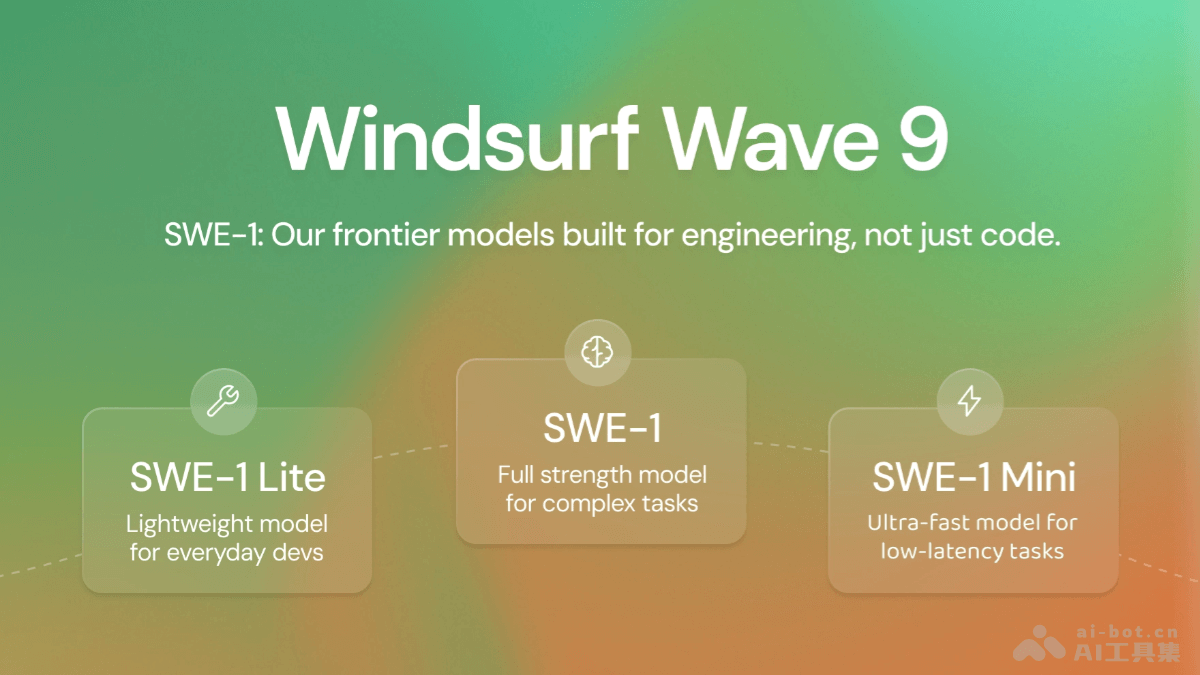
SWE-1 model family
- SWE-1: Reasoning ability close to Claude 3.5 Sonnet's tool experience, while serving at a lower cost. During the promotion period, all paid users can use it for free.
- SWE-1-lite: A high-quality lightweight model that replaces Cascade Base, available for unlimited use by all users (including free users).
- SWE-1-mini: An extremely fast-responding small model, providing Windsurf Tab support for all users (including free users).
Main features of SWE-1
- Process awareness: Understands multiple states and contexts in software development, supports continuous task advancement in complex scenarios, such as human-AI collaboration, task interruption and resumption, etc.
- Code generation and optimization: Generates high-quality code, provides code optimization suggestions, and improves development efficiency.
- Testing and debugging assistance: Helps developers generate test cases and locate debugging issues, reducing testing and debugging time.
- Documentation generation and understanding: Automatically generates code documentation, helping developers quickly understand code functionality and structure.
- Task planning and management: Assists developers in planning and managing development tasks, providing task progress tracking and reminders.
Technical principles of SWE-1
- Shared timeline: Based on a shared timeline, it implements "Flow Awareness", that is, the AI's real-time perception of and response to user operations. It allows the AI to intervene at any stage of user operations.
- Flow Awareness: Integrates various functions in the Windsurf Editor (such as code editing, terminal output, clipboard content, etc.) into a shared timeline, perceives user operations in real time, and adjusts its behavior accordingly.
- Training method: Based on a brand-new data model, specifically optimized for the complexity and long-term tasks of software engineering. The model can handle incomplete states and ambiguous results, simulating the real software development process. SWE-1's training process focuses on code correctness, and emphasizes task completeness and the achievement of long-term goals. Based on a large amount of actual development data and user feedback, it continuously optimizes its behavior to better adapt to different development scenarios.
Official evaluation of SWE-1
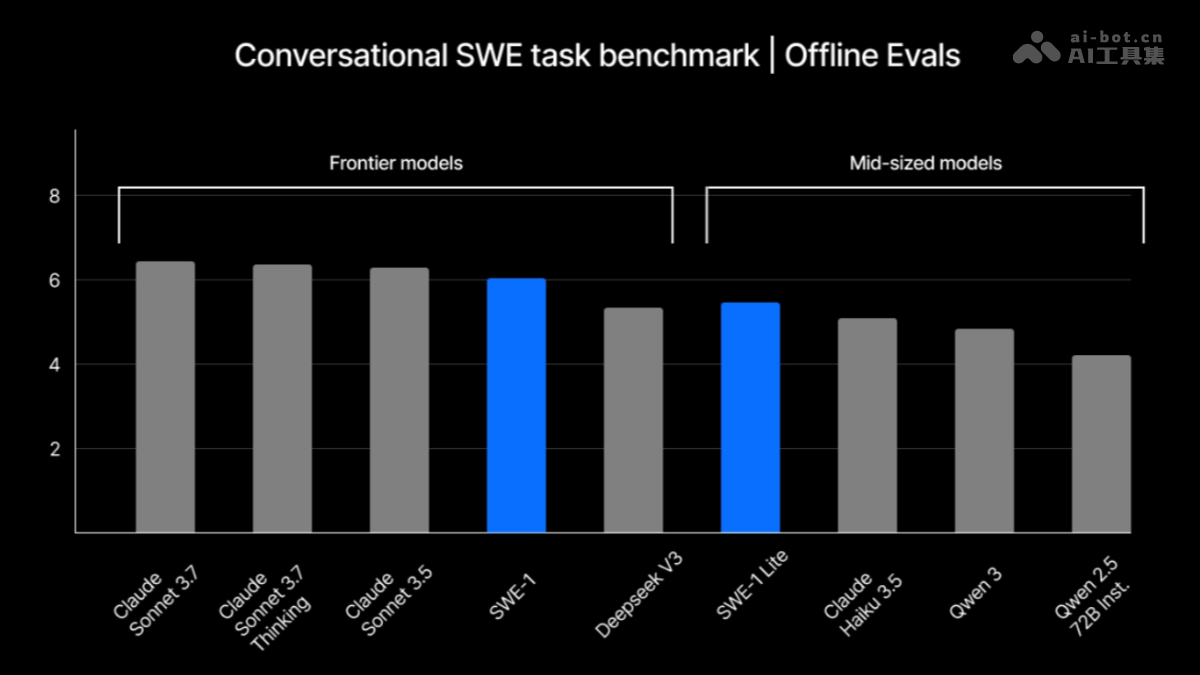
- Evaluation method: The Windsurf team compared SWE-1 with Anthropic series models and leading open-source coding models such as Deepseek and Qwen, conducting offline evaluations (such as conversational tasks and end-to-end tasks) and real-user blind tests.
- Evaluation results: SWE-1 has reached or approached the industry's cutting-edge level on metrics such as "lines of code adopted by users" and "model contribution rate". Many users reported that AI suggestions were accurate and improved development efficiency.
SWE-1 project address
- Project official website:https://windsurf.com/blog/windsurf-wave-9-swe-1
Application scenarios of SWE-1
- Code generation and optimization: Quickly generate high-quality code and provide optimization suggestions.
- Testing and debugging assistance: Generate test cases and assist in locating debugging issues.
- Automatic documentation generation: Generate detailed documentation based on code for easier understanding and maintenance.
- Task planning and management: Assist in planning tasks, tracking progress, and improving project management efficiency.
- Human-machine collaborative development: Support team collaboration and enable smooth human-computer interaction.