
What is SWE-1.5
SWE-1.5 is a high-performance AI coding model designed specifically for software engineering, launched by AI unicorn Cognition. With tens of billions of parameters, it has coding capabilities close to the state of the art, while achieving a major breakthrough in speed, with an inference speed of up to 950 tokens/second, 6 times faster than Haiku 4.5 and 13 times faster than Sonnet 4.5. It is currently available in the Windsurf code editor. Through cooperation with Cerebras, the model optimizes the entire system, including the model, inference, and agent framework, to achieve a unified combination of speed and intelligence. During development, Cognition adopted end-to-end reinforcement learning, combined with a high-fidelity coding environment and a custom evaluation mechanism, to ensure the model's performance on real tasks. SWE-1.5 introduces "reward hardening" technology, using tests by human experts to improve the model's robustness.
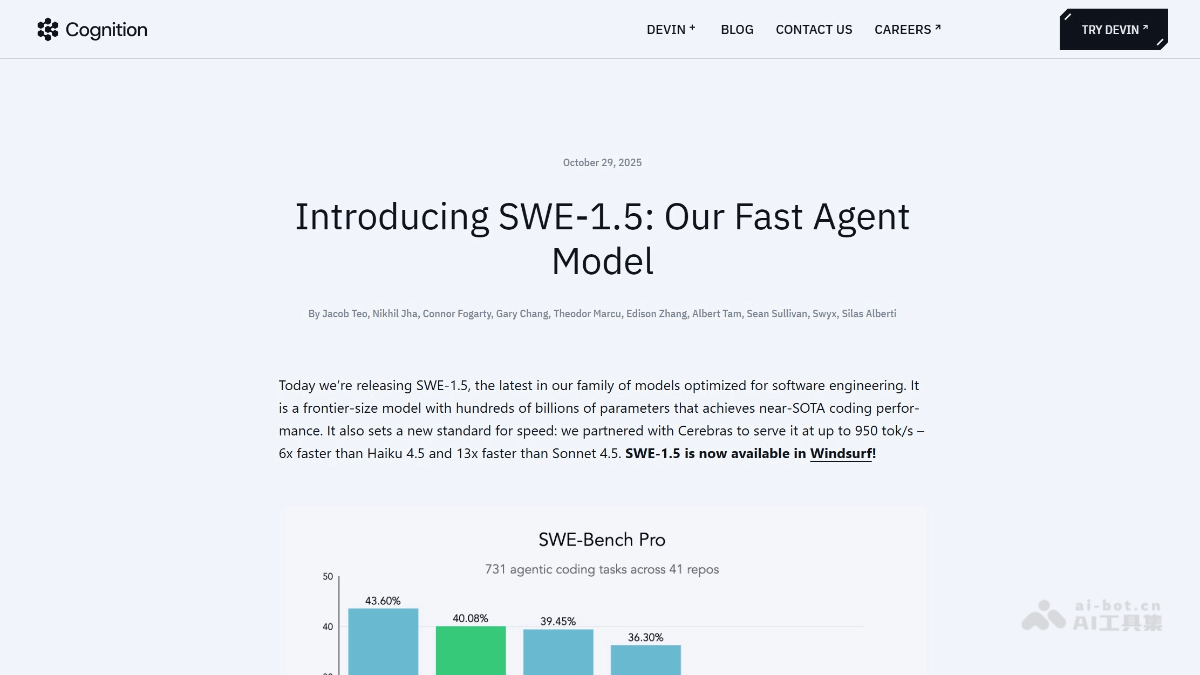
Main features of SWE-1.5
-
Code generation and optimization: Quickly generates high-quality code, supports multiple languages, and can also provide code optimization suggestions to improve performance and quality.
-
Programming collaboration and interaction: Supports multi-turn interactive programming, facilitating team collaboration and improving development efficiency.
-
Code understanding and analysis: Deeply understands code semantics, maintains coherence across long code sequences, and can analyze code and diagnose problems.
-
Programming environment integration: It is already available for use in the Windsurf editor and supports integration with other development tools, making it convenient to use in the complete development workflow.
-
Customization and adaptability: Can be customized and developed to adapt to different project needs and tasks, and integrate into existing development environments.
Technical principles of SWE-1.5
-
High-speed inference and hardware cooperation: Cooperates with Cerebras and uses its advanced hardware technology to achieve an inference speed of up to 950 tokens/second, greatly improving the model's response efficiency.
-
Ultra-large-scale data integration: Integrates 200 carefully selected datasets and builds a nearly panoramic programming knowledge graph, giving the model cross-domain and cross-language generalization potential.
-
Context-aware architecture: Can maintain semantic coherence across long code sequences and supports multi-turn interactive programming collaboration, ensuring the logic and consistency of code generation.
-
Dynamic feedback mechanism: Introduces a dynamic feedback mechanism during training, simulating the behavior paths of real developers to improve the practicality and readability of code generation.
-
Reinforcement learning training: Adopts end-to-end reinforcement learning, trains in real coding environments, and uses a custom cascaded agent framework and powerful infrastructure, training through thousands of GB200 NVL72 chips to optimize the model's performance and adaptability.
SWE-1.5 project address
- Project official website:https://cognition.ai/blog/swe-1-5
Application scenarios of SWE-1.5
-
Code generation and optimization: Quickly generates high-quality code, improves development efficiency, and at the same time provides optimization suggestions for existing code to improve performance and quality.
-
Multi-turn interactive programming: Supports multi-turn interaction, helping developers gradually improve code, suitable for step-by-step construction of complex tasks.
-
Team collaborative development: Facilitates collaboration among team members, enabling division of labor based on code frameworks generated by the model and improving team development efficiency.
-
Code understanding and analysis: Deeply understand code semantics, quickly locate issues, analyze potential errors and performance problems, and provide diagnosis and repair suggestions.
-
Large codebase exploration: Help developers quickly explore and understand large codebases, improving their mastery of complex projects.
-
Full-stack application development: Support full-stack application development from backend to frontend, and quickly build fully functional applications.