
What is SuitAgent
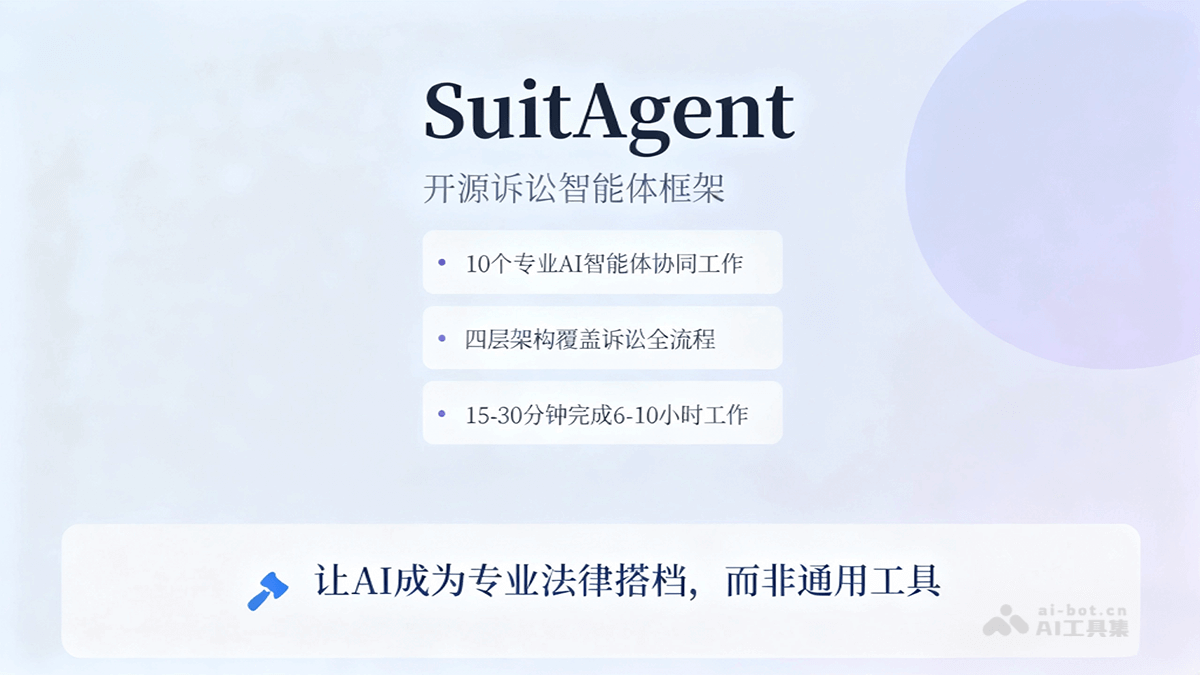
SuitAgent is based on Claude Code architecture-basedAI legallitigation agent, collaborating with 10 specialized AI Agents to break down complex litigation cases into multiple independently executable workflows, achieving efficient generation of legal documents. The framework adopts a four-layer architecture design, covering the entire process from pre-litigation analysis to judgment enforcement, supporting one-click startup, flexible combination, and standardized output. By intelligently identifying document types and scenarios, SuitAgent can automatically complete document analysis, evidence review, strategy formulation, document drafting, and other work, greatly improving lawyers' work efficiency. It is an innovative tool in the field of legal services.
Main Features of SuitAgent
-
Document Analysis and Parsing: Through the DocAnalyzer agent, automatically parse various legal documents (such as complaints, judgments, court hearing transcripts, etc.), extract key information, and support multiple formats such as PDF, Word, and images.
-
Evidence Analysis: The EvidenceAnalyzer agent deeply analyzes evidence materials, evaluates authenticity and probative force, generates cross-examination opinions, and provides suggestions for supplementary evidence.
-
Issue Identification: The IssueIdentifier agent accurately identifies the disputed issues in a case, automatically associates relevant legal provisions, and provides a basis for subsequent analysis.
-
Legal Research: The Researcher agent interprets legal provisions and searches cases, provides suggestions for legal application, and supports the depth and breadth of legal research.
-
Litigation Strategy Formulation: The Strategist agent formulates litigation strategies based on case analysis results, conducts SWOT analysis and risk assessment, and provides strategic recommendations.
-
Legal Document Generation: The Writer agent generates various legal documents based on analysis results, such as complaints, statements of defense, attorney's statements, etc., ensuring standardized format and professional content.
-
Case Reports and Summaries: The Reporter and Summarizer agents respectively generate structured case reports and concise summaries, helping to quickly understand the full picture of a case.
-
Schedule Planning and Reminders: The Scheduler agent manages statutory deadlines and case timelines, providing work-hour statistics and reminders for important deadlines.
-
Quality Review: The Reviewer agent checks the quality of all outputs, examines information accuracy, logic, and completeness, and provides improvement suggestions.
-
Automated Workflow Orchestration: Based on the uploaded document type and scenario, automatically selects the best workflow combination, completes complex tasks with one click, and greatly improves efficiency.
Technical Principles of SuitAgent
- Multi-Agent Collaboration: SuitAgent is composed of 10 specialized AI agents, each responsible for specific tasks such as document analysis, evidence review, legal research, document generation, etc. The agents work collaboratively to complete complex legal analysis and document generation tasks.
- Layered Architecture: SuitAgent adopts a four-layer architecture design, dividing agents by function into the input layer, analysis layer, output layer, and support layer. The layered design has the following advantages:
- Clear Responsibilities: Each layer focuses on specific tasks, avoiding functional overlap.
- Loose Coupling: Layers interact through standard interfaces, facilitating maintenance and extension.
- Flexible Combination: Specific levels of agents can be enabled according to needs, supporting incremental updates.
- Easy to Understand: The clear hierarchical structure helps users quickly understand how the system works.
- Context Inheritance and Dynamic Update: SuitAgent maintains independent context information for each case, storing basic case information, points of dispute, legal research results, etc. in separate files. When new documents are uploaded, the system automatically inherits previous analysis results and performs incremental updates on the existing basis, avoiding duplicate work.
- Automated Workflow Orchestration: SuitAgent can automatically identify and select the best workflow combination based on the uploaded document type and usage scenario. For example: upon receiving a complaint, it automatically starts the full process from document analysis to answer generation, automatically executes evidence analysis and cross-examination opinion generation, and automatically adjusts litigation strategy and generates a court hearing summary.
- Context Engineering with Claude Code: SuitAgent is developed based on the Claude Code architecture, using its context engineering capabilities to decompose legal tasks into multiple subtasks, with each agent returning only the final result to the main agent. The main agent makes decisions and judgments based on the results, ensuring the unity and coherence of the legal task context.
- Quality Assurance Mechanism: SuitAgent embeds a verification mechanism in each agent, conducting comprehensive quality review of all outputs through the Reviewer agent. The system checks the accuracy of information extraction, the logic of evidence analysis, the accuracy of legal citation, etc., provides quality ratings and improvement suggestions, and ensures the high quality and consistency of outputs.
- Flexible Model Configuration and Switching: SuitAgent supports multiple domestic large models (such as Zhipu AI, Moonshot AI, MiniMax, etc.). Users can configure different models according to their needs and quickly switch through tools (such as cc-switch), adapting to different usage scenarios and performance requirements.
SuitAgentd Project Address
- GitHub Repository:https://github.com/cat-xierluo/SuitAgent
SuitAgentd Application Scenarios
-
Receiving a Complaint (Defendant's Response): SuitAgent automatically parses the complaint, identifies the points of dispute, conducts legal research, formulates a response strategy, drafts the answer, and generates a complete case analysis report, helping lawyers quickly prepare their response work.
-
Cross-Examination of New Evidence: The system can analyze new evidence, evaluate its probative value and relevance, generate a professional cross-examination opinion, provide suggestions for supplementary evidence, and help lawyers efficiently complete cross-examination work.
-
Post-Trial Strategy Adjustment: SuitAgent analyzes the court hearing transcript, compares changes in evidence, adjusts litigation strategy, and generates a court hearing summary and strategy adjustment suggestions.
-
Plaintiff's Filing (Complete Filing Process): From case material analysis to identification of points of dispute, and then to generation of the complaint and evidence list, SuitAgent provides full-process support to ensure filing preparation is sufficient.
-
Pre-Litigation Consultation (Issuing a Service Plan): SuitAgent quickly identifies needs based on client communication records, formulates and generates a legal service plan and summary, helping lawyers respond efficiently to consultations.