
What is StepAudio 2.5 TTS
StepAudio 2.5 TTS is a Contextual TTS (context-awarespeech synthesismodel) launched by StepFun, introducing context understanding capability into the entire speech generation workflow for the first time. Through dual-level control consisting of Global Context, which sets the overall tone of the entire passage, and Inline Context, which precisely controls emotion and pauses sentence by sentence, combined with Zero-shot voice cloning that requires only a 3-second reference audio, it replaces traditional tags with natural language descriptions, upgrading AI from "reading text" to "performing text".
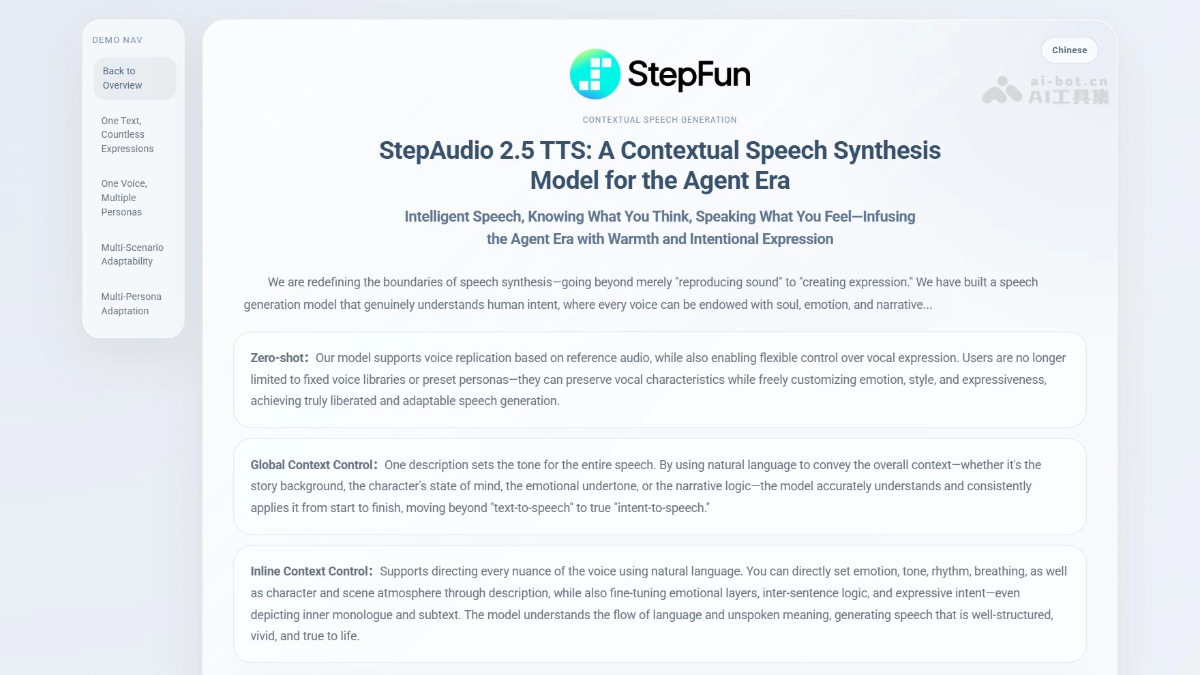
Main features of StepAudio 2.5 TTS
-
Global Context Control: Supports describing the emotional tone, character state, and scene atmosphere of the entire speech in natural language (such as "restrained sadness, no crying tone, slight trembling"), making the expression more unified and coherent.
-
Inline Context Control: Use parentheses in the text
()to insert in-sentence instructions, precisely controlling details such as emotion, tone, rhythm, pauses, breathing feel, and stress changes sentence by sentence; the content in parentheses serves only as instructions and will not be read aloud. -
Zero-shot Voice Cloning: Only 3 seconds of reference audio is needed to clone the target voice, and the cloned voice fully inherits the Global and Inline Context control capabilities, without being limited by a fixed voice library.
-
Non-streaming Speech Synthesis: Through the
POST /v1/audio/speechinterface, synthesize a complete audio file in one go, prioritizing audio quality, suitable for scenarios that are not sensitive to latency. -
Streaming Speech Synthesis: Through
WebSocket /v1/realtime/audioachieve low-latency streaming return, suitable for dialogue and real-time playback scenarios. -
Cloning Preview: Through the
/v1/audio/voices/previewinterface, quickly preview the synthesis effect of the reference audio, only synthesis fees are charged, and no formal voice asset is created. -
Context Control for All Voices: Both cloned voices and original voices can flexibly adjust emotion, style, and expression through natural language instructions, achieving a performance effect of "same voice, different feel".
How to use StepAudio 2.5 TTS
- Obtain Access: Visit the StepFun Open Platform https://platform.stepfun.com/docs/zh/guides/models/stepaudio-2.5-tts注册账号,在控制台获取 API Key。
- Choose an Access Method:
- Online Experience: Directly visit the Experience Center https://www.stepfun.com/studio/audio or the Demo pagehttps://stepaudiollm.github.io/step-audio-2.5-tts/ to try it out.
- API Calls: Choose the non-streaming (audio quality priority) or streaming (low latency) interface according to the scenario
- Write Context Instructions:
- Set
instruction(Global Context): Describe the overall tone of the entire passage in natural language, such as "the voice is extremely tense, fast and choppy, with an obvious sense of suppression" - Edit
inputtext (Inline Context): Insert parentheses into sentence segments that need fine control.()Annotate emotion and pauses, such as "(lowering voice) Hey... look at my phone. (short intake of breath)"
- Set
- Call the API
- Non-streaming: Send a POST request to
https://api.stepfun.com/v1/audio/speechwith the model, voice, input, and instruction parameters - Streaming: Connect to WebSocket
wss://api.stepfun.com/v1/realtime/audio, first sendtts.createto establish a session, then viatts.text.deltapush the text stream with parenthesized instructions
- Non-streaming: Send a POST request to
- Voice Cloning (Optional): If you need to clone a voice, prepare at least 3 seconds of reference audio of the target voice, call
/v1/audio/voices/previewto preview the effect, and after confirmation create the official voice asset.
Key information and usage requirements for StepAudio 2.5 TTS
- Model Basics
-
The model type is Contextual TTS (context-aware speech synthesis), which implements vocal performance based on natural language understanding, supporting dual-level control of global context (overall tone of the entire passage) and inline context (details within sentences)
-
The maximum single input is 1000 characters, and instruction (natural language guidance for global context) is limited to 200 characters
-
- Pricing Standards
-
Context-aware text-to-speech: 5.8 yuan / 10,000 characters
-
Voice cloning / generation: 9.9 yuan / voice (the preview API only charges synthesis fees; official cloning is charged immediately upon success)
-
- Integration Methods
-
Non-streaming speech synthesis: POST /v1/audio/speech, synthesizes the complete audio file in one go
-
Streaming speech synthesis: WebSocket /v1/realtime/audio, low-latency streaming return suitable for dialogue scenarios
-
Cloning preview: POST /v1/audio/voices/preview, quick preview without creating an official voice asset
-
- Usage Restrictions
-
Inline context control uses parentheses
()to wrap instructions; the content inside the parentheses is treated only as instructions and will not be read aloud directly -
Zero-shot voice cloning requires only 3 seconds of reference audio; the cloned voice fully inherits the context control capability
-
Now fully launched on the StepFun Open Platform and Step Plan, and can be called directly via API or experienced online
-
Core advantages of StepAudio 2.5 TTS
-
Natural language replaces the tag system: Abandoning traditional fixed tags such as "sad/angry", it supports precise tone-setting with compound natural language descriptions such as "restrained sadness, no crying tone, slight trembling", greatly lowering the control threshold.
-
Dual-level precise context control: Global Context controls the emotional tone and character state of the entire passage, while Inline Context uses
()parentheses to fine-tune rhythm, pauses, and breathiness sentence by sentence, achieving three-dimensional voice directing from macro to micro. -
Zero-shot fully controllable cloning: Only 3 seconds of reference audio is needed to clone any voice, and the cloned voice fully inherits context control capabilities, breaking through the limitations of fixed voice libraries, so the same voice can perform multiple emotional styles.
-
Performance-grade vocal quality: Comprehensive upgrades in prosody dimensions such as pauses, stress, and tone shifts, with underlying vocal quality upgraded, saying goodbye to the "plastic feel" and "AI flavor" of traditional TTS, achieving a真人 performance effect where "every word has drama."
-
Low barrier to entry, high flexibility: No professional audio knowledge required; complex emotional expression can be controlled by "stating your needs," while supporting both non-streaming (high audio quality) and streaming (low latency) modes, adapting to everything from content creation to real-time conversation.
Comparison of StepAudio 2.5 TTS with similar competitors
| Dimension | StepAudio 2.5 TTS | ElevenLabs | Fish Audio |
|---|---|---|---|
| Pricing standard | 5.8 yuan per 10,000 characters (about $0.08 per 1,000 characters) | Flash: ~$0.06 per 1,000 characters; Multilingual v2: ~$0.12-0.18 per 1,000 characters (about 0.87-1.3 yuan per 1,000 characters) | ~$15 per million characters (about $0.015 per 1,000 characters, 0.11 yuan per 1,000 characters) |
| Free quota | Specific policies need to be checked on the official website | 10,000 characters per month (Free plan) | 500 characters per request, 7 minutes of S1 generation per month |
| Voice cloning | Zero-shot, 3 seconds of audio, 9.9 yuan per voice, supports full context control | Instant Clone (available upon payment) + Professional Voice Clone (high fidelity, starting from Creator plan) | Supports voice cloning, available starting from Plus plan |
| Context control | Two-tier control: Global Context (global tone) + Inline Context (in-sentence parenthetical instructions) | Based on SSML tags, speed/style control, v3 model supports emotional expression | Basic parameter adjustment (speed, emotion, etc.) |
| Latency performance | Supports non-streaming (audio quality first) and WebSocket streaming (low latency) | Flash v2.5: ~75ms;Turbo v2.5: ~250-300ms | Standard generation speed (Free), enhanced speed (Plus+) |
| Language support | Mainly optimized for Chinese, supports multiple languages | 29+ languages, deep multilingual optimization | Multilingual support |
| Input limits | 1,000 characters per request, instruction limit 200 characters | Up to 10,000 characters per request (API) | Free: 500 characters per request; Plus: 15,000 characters per request; Pro: 30,000 characters per request |
| Core advantages | Natural language descriptions replace tags, performance-grade emotional control, precise two-tier context regulation | Industry-leading voice naturalness (9.5/10), rich emotional expression, complete ecosystem | Lowest price, open-source models available, high cost-effectiveness |
| Applicable scenarios | Film and television dubbing, audiobooks, game characters, Chinese content creation | Audiobooks, podcasts, international multilingual content, real-time conversational AI | Large-scale programmatic generation, budget-sensitive projects, developers |
Application scenarios of StepAudio 2.5 TTS
-
Film, television, and animation dubbing: Through global context setting to establish the character's emotional tone and in-text context to finely adjust tone and pauses, it achieves professional-grade character dubbing, making character voices more layered and realistic.
-
Audiobook and podcast production: By leveraging dual-level context control capabilities to give different characters unique voice personas, it creates immersive multi-person audio content and lowers the barrier to professional audio production.
-
Game voice generation: It builds complete voice character profiles for game characters, enabling comprehensive customization from voiceprint to persona, so that NPCs have vivid expressions that match the scene atmosphere.
-
Intelligent voice assistants: With the low-latency characteristics of streaming speech synthesis, it gives intelligent customer service and AI assistants natural conversational capabilities, and supports real-time context adjustment to match user emotions.
-
Advertising and marketing content: Through Zero-shot voice cloning, it quickly clones brand-specific timbres, and combined with context control generates marketing audio materials with a consistent style and rich emotion.