
What is Step Image Edit 2
Step Image Edit 2 is a new-generation lightweight image generation and editing model launched by StepFun, with only 3.5B parameters, capable of surpassing 12B-20B class open-source large models in actual performance. The model takes 0.5-2 seconds for a single image generation, focusing on extremely fast response and high-quality output. The model covers image generation and editing, supports Chinese and English rendering, local editing, visual reasoning, subject consistency preservation, and style transfer, and can be applied to scenarios such as IP creation, poster design, comic generation, portrait beautification, travel photo editing, and portrait photo generation.
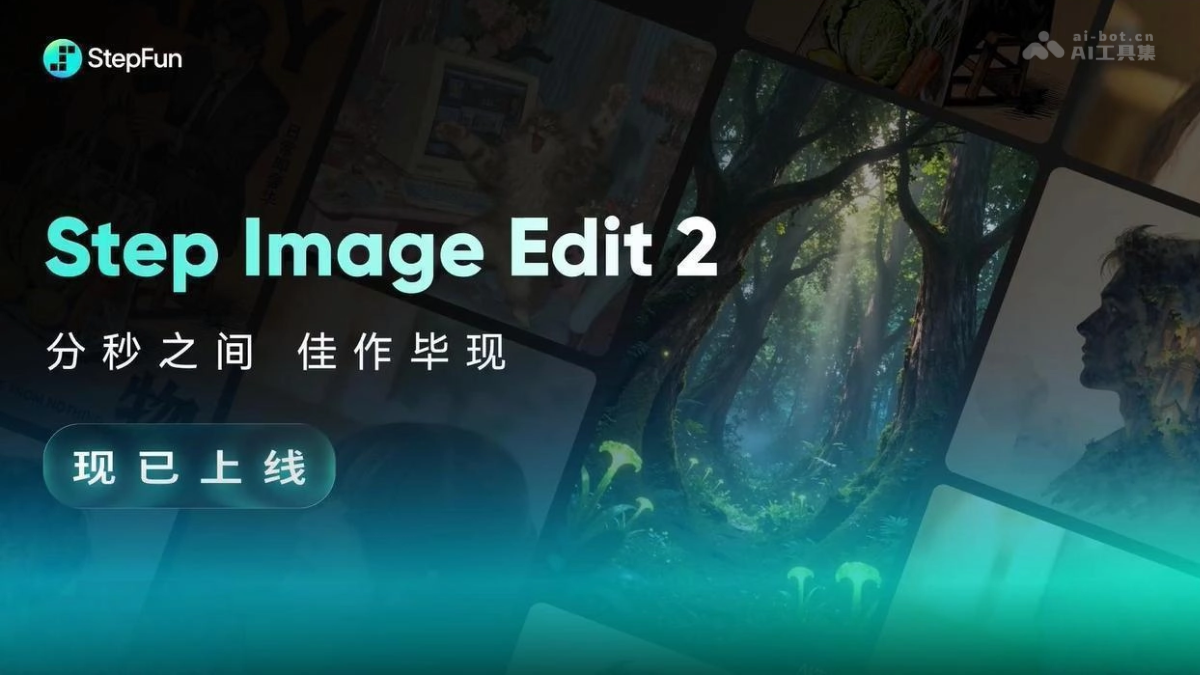
Main features of Step Image Edit 2
-
Image generation: Quickly generate high-quality images based on text descriptions, with a single image generation taking only 0.5-2 seconds.
-
Image editing: Supports operations such as local editing, subject replacement, and style transfer on existing images.
-
Chinese and English rendering: Specially optimized for text editing scenarios, capable of accurately generating and modifying Chinese and English content in images.
-
Local repainting: Supports fine-grained modification of specific areas of an image while keeping non-edited areas unchanged.
-
Visual reasoning: Possesses the ability to understand relationships among image contents and perform reasonable editing reasoning.
-
Subject consistency: Maintains stable subject features during multi-round editing or style transfer.
-
Style transfer: Applies a specified artistic style to an image or local area.
Technical principles of Step Image Edit 2
- Multi-expert driven self-evolving learning: Adopts a two-stage training framework of "separate exploration, centralized aggregation". Multiple subdivided task expert branches are derived from the base model to capture high-quality editing trajectories in complex high-noise data; through iterative self-distillation, expert knowledge is aggregated back into the base model, breaking through the capability ceiling without increasing parameter scale, enabling a lightweight model to approach the performance of large models.
- Distribution-Aligned Reinforcement Learning (DARL): Redefines the reinforcement learning objective as aligning the model output distribution with a reference distribution, rather than relying on traditional single-point reward signals. By using the distribution gap between the model's overall output and the reference output as a dense reward, it avoids evaluation bias from a small number of samples, making complex task training more stable and generalization ability stronger.
- Breakthroughs in data quality and scale: Invested over 50 million scale of specialized training data, integrating three sources: real-scenario mining, targeted synthesis, and high-quality open-source data. In response to text editing difficulties, a self-developed typesetting system generated 20 million specialized data entries, and a three-level quality control system of "agent automatic cleaning - large model global evaluation - manual fine screening" was built.
How to use Step Image Edit 2
-
Visit the StepFun open platform: Visit the StepFun open platform https://platform.stepfun.com/docs/zh/guides/models/step-image-edit-2。
-
Obtain API access: Register and log in to the platform account to obtain API call permissions for Step Image Edit 2.
-
Call the image generation/editing interface: According to the documentation guidelines, pass text prompts or images to be edited and editing instructions through the API.
-
View the Step Plan integration solution: Visit https://platform.stepfun.com/docs/zh/step-plan/integrations/image-api to learn more detailed integration methods.
Key information and usage requirements of Step Image Edit 2
-
Development team: StepFun
-
Model Scale: 3.5B parameters (lightweight)
-
Generation Speed: 0.5-2 seconds per image generation
-
Launch Platforms: StepFun Open Platform, Step Plan
-
Limited-Time Free Period: April 29 - May 5, 2026
-
Academic Ranking: Ranked first overall among lightweight image editing models on KRIS-Bench
-
Usage Threshold: Requires registering a StepFun Open Platform account to obtain API access
-
Supported Languages: Chinese and English prompts and text rendering within images
Core Advantages of Step Image Edit 2
-
Cross-Scale Performance: 3.5B parameters achieve editing results surpassing 12B-20B class open-source large models.
-
Ultra-Fast Response: Single image generation takes 0.5-2 seconds, meeting real-time interaction needs.
-
Specialized Text Editing Enhancement: A self-developed typography system generates 20 million text editing data entries, solving the industry's text rendering challenges.
-
Training Mechanism Innovation: Combines multi-expert self-evolution learning with distribution-matching reinforcement learning to achieve non-linear capability leaps.
-
Data Quality Assurance: A three-level quality control system ensures high standards for training data, with generated results closely matching real needs.
Comparison of Step Image Edit 2 with Similar Competitors
| Comparison Dimension | Step Image Edit 2 | JoyAI-Image-Edit | Qwen-Image-Edit-2511 |
|---|---|---|---|
| Development Team | StepFun | JD | Alibaba Tongyi |
| Model Scale | 3.5B (lightweight) | Approximately 12B-20B class | Approximately 12B-20B class |
| KRIS-Bench Total Score | 66.16 (first) | 63.44 | 62.03 |
| Generation Speed | 0.5-2 seconds | Not specified | Not specified |
| Core Positioning | Ultra-fast lightweight editing | E-commerce image editing | General-purpose image editing |
| Text Rendering | Specialized enhancement (20 million data entries) | Supported | Supported |
| Training Innovation | Multi-expert self-evolution + DARL | Not disclosed | Not disclosed |
Core Advantages of Step Image Edit 2
-
IP Creation: The model can quickly generate character concept art and scene setting images, support multi-round stylization adjustments and subject consistency preservation, accelerating the visual development process for anime, games, and other IP assets.
-
Poster Design: Generate commercial posters in one click based on marketing copy, accurately render Chinese and English titles and slogans, support local element replacement and style transfer, lowering the barrier to professional design.
-
Comic Generation: Mass-produce manga storyboards and character designs, maintain stable main features such as character appearance and clothing across multiple edits, and improve the production efficiency of serialized content.
-
Portrait retouching: Perform local fine-tuning on photos such as intelligent skin smoothing, makeup addition, background replacement, or passerby removal to achieve studio-quality post-processing retouching effects.
-
Travel photo editing: Automatically recognize and replace the sky, remove clutter, and adjust the overall color tone and lighting to quickly upgrade ordinary travel snapshots into high-quality cinematic shots.