
What Is Stand-In
Stand-In is a lightweightvideo generationframework launched by the Tencent WeChat Vision Team, focusing on generating identity-preserving videos. By training 1% of the base model parameters, the framework can generate high-fidelity, identity-consistent videos. It is plug-and-play and can be easily integrated into existing text-to-video (T2V) models. Stand-In supports a variety of application scenarios, including identity-preserving text-to-video generation, non-human subject video generation, stylized video generation, videoface swapping, and pose-guided video generation, offering advantages such as high efficiency, flexibility, and strong scalability.
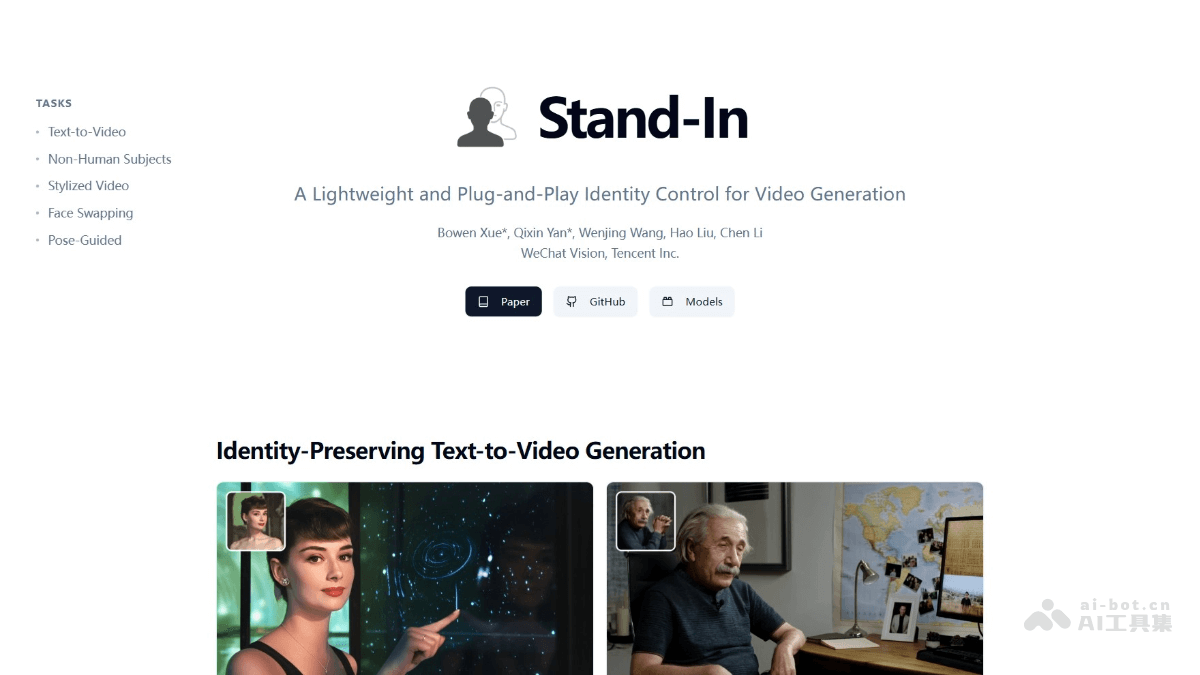
Main Features of Stand-In
-
Identity-Preserving Text-to-Video Generation: Based on text descriptions and reference images, generate videos with an identity consistent with the reference image, ensuring that the person's features remain highly consistent throughout the video.
-
Non-Human Subject-Preserving Video Generation: The framework can generate videos of non-human subjects such as cartoon characters and objects while maintaining the coherence of the subject's features.
-
Identity-Preserving Stylized Video Generation: While preserving the person's identity features, apply a specific artistic style, such as oil painting or anime style, to the generated video to achieve a stylized effect.
-
Video Face Swapping: Replace the face of a person in a video with the face from a reference image, achieving high-fidelity face replacement while maintaining the video's naturalness and coherence.
-
Pose-Guided Video Generation: Based on an input pose sequence, generate videos of a person in the corresponding poses, achieving precise pose control and generation.
Technical Principles of Stand-In
- Conditional Image Branch: Introduce a conditional image branch into a pretrained video generation model. Use a pretrained VAE (Variational Autoencoder) to encode the reference image into the same latent space as the video, extracting rich facial features.
- Restricted Self-Attention Mechanism: Achieve identity control through a restricted self-attention mechanism, enabling video features to effectively reference identity information from the reference image while maintaining the independence of the reference image. Use Conditional Position Mapping to distinguish image and video features, ensuring the accuracy and efficiency of information exchange.
- Low-Rank Adaptation (LoRA): Use Low-Rank Adaptation (LoRA) in the conditional image branch to enhance the model's ability to utilize identity information while maintaining the model's lightweight design. LoRA only fine-tunes the QKV projections of the conditional image, avoiding the introduction of too many training parameters.
- KV Cache: The timestep of the reference image is fixed at zero, and the Key and Value matrices remain unchanged during the diffusion denoising process. Cache these matrices during inference to accelerate computation.
- Lightweight Design: Stand-In trains about 1% additional parameters, significantly reducing training costs and computational resource consumption, enabling Stand-In to be easily integrated into existing text-to-video (T2V) models with a high degree of scalability and compatibility.
Stand-In Project Address
- Project Official Website:https://www.stand-in.tech/
- GitHub Repository:https://github.com/WeChatCV/Stand-In
- HuggingFace Model Library:https://huggingface.co/BowenXue/Stand-In
- arXiv Technical Paper:https://arxiv.org/pdf/2508.07901
Application Scenarios of Stand-In
- Virtual Character Generation: Create virtual characters for films, TV series, and animations, ensuring identity consistency of the characters across different scenes.
- Visual effects compositing: In visual effects production, quickly generate virtual characters with identities consistent with real actors, reducing the complexity of post-production compositing.
- Personalized advertising: Generate personalized advertising videos based on reference images provided by users, improving the appeal of advertisements and user engagement.
- Virtual spokesperson: Create virtual spokespersons for use in brand promotion and product publicity, ensuring consistency and coherence of the brand image.
- Character customization: Players generate in-game characters based on their own appearance, enhancing the game's sense of immersion and personalized experience.