
What is Spark-Audio-1.0-Preview
Spark-Audio-1.0-Preview is a fully domesticspeechfoundation large model launched by iFLYTEK, adopting a 0.65B audio encoder + 30B-A3B MoE language model architecture, trained on 13 million hours of audio and a large amount of text data based on purely domestic computing power. The model can directly understand the semantics, emotions and scenarios in speech, supports 99 languages, 202 dialects recognition andspeech transcription、translation, speaker recognition, sentiment analysis, audio question answering and other tasks, leading in complex scenarios such as high noise and low volume, and can be widely applied in customer service, in-vehicle, medical and other scenarios.
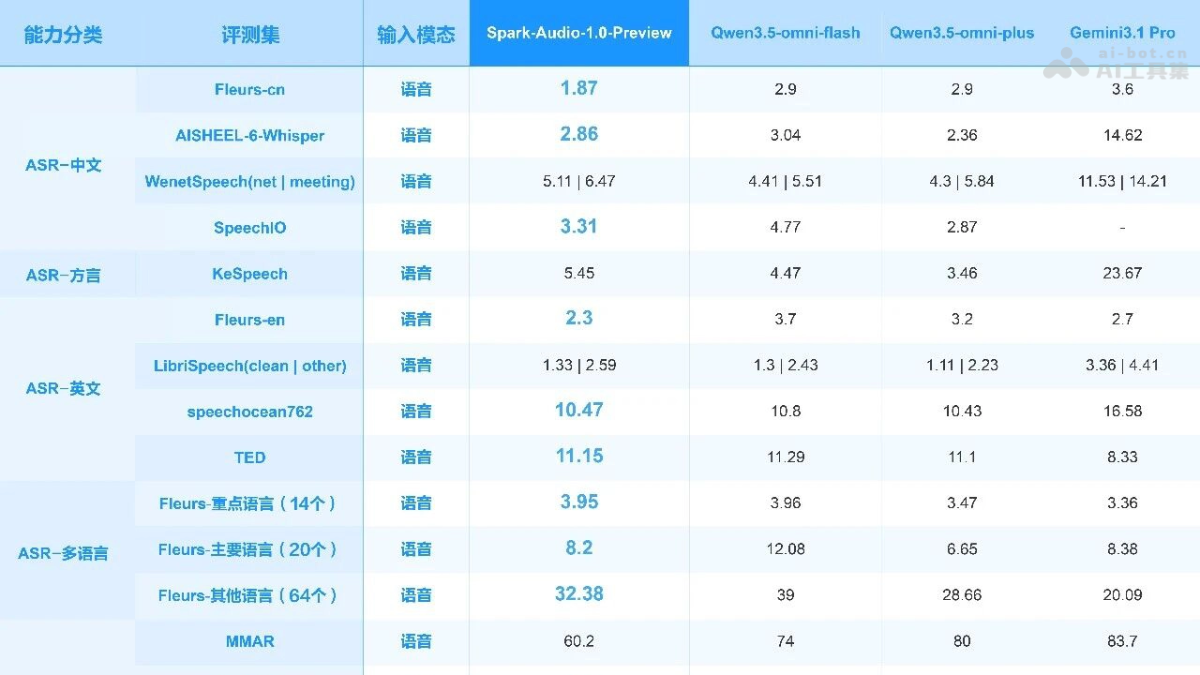
Main features of Spark-Audio-1.0-Preview
-
Speech transcription: directly convert speech to text, supporting recognition of 99 languages and 202 dialects.
-
Multilingual translation: achieve cross-language translation from speech to speech/text, preserving prosodic information such as tone and intonation.
-
Multi-dialect recognition: covering 202 dialects, able to understand Cantonese, Wenzhou dialect and others.
-
Environmental sound recognition: able to simultaneously understand human voice and environmental background sound, and understand the scenario in which the sound occurs.
-
Speaker recognition: automatically distinguish who is speaking, suitable for meeting transcription, minutes generation, etc.
-
Sentiment analysis: capture the tone and emotion in speech, making interaction more "warm".
-
Audio question answering: perform understanding and question answering based on complex audio content, moving from "hearing clearly" to "understanding".
Technical principles of Spark-Audio-1.0-Preview
- End-to-end speech understanding architecture: unlike the traditional cascaded approach of "first converting to text and then handing it to a large model", the model adopts a 0.65B audio encoder paired with a 30B-A3B large language model, with text and speech dual modalities directly input into the same model, understanding human voice, environmental sound, music and their semantics, emotions and scenarios in one pass, avoiding the problems of information loss and error accumulation in the cascaded pipeline.
- Audio encoder pre-training: gradually expand its representational capability through audio encoder pre-training, then use pre-training and post-training to improve the model's basic capabilities, generalization in complex scenarios and multi-task performance, ultimately achieving excellent results in real complex scenarios such as high noise and low volume.
- Fully domestic computing power training: the model is trained on a purely domestic computing power cluster using 13 million hours of audio and a large amount of text data, making it the industry's first speech foundation large model trained on fully domestic computing power, proving that domestic computing power can train speech models at the industry-leading level.
- Fine-tunable foundation system: similar to iFLYTEK Spark large model's 1+N system, Spark-Audio as a speech foundation can be further fine-tuned to develop specialized models or systems for speech recognition, speech simultaneous interpretation, speech interaction, etc., facilitating deployment in various speech businesses.
How to use Spark-Audio-1.0-Preview
- Open the official experience page: visit the model experience address https://iflytekresearch.iflytek.com/experience/spark-audio 。
- Experience model capabilities online: enter text or speech on the page to experience functions such as speech transcription, translation, dialect recognition, and audio question answering.
Core advantages of Spark-Audio-1.0-Preview
-
Fully domestic computing power training: The industry's first speech foundation large model trained on a pure domestic computing power cluster, proving that domestic computing power can train industry-leading models.
-
End-to-end direct speech understanding: It eliminates the cascaded approach of "first transcribing to text, then understanding," without losing key information such as tone, emotion, and ambient sound, and removes link fragmentation and latency stuttering.
-
Broad multilingual and multi-dialect coverage: Supports recognition of 99 languages and 202 dialects, with advantages in multilingual and multi-dialect recognition performance in comparisons among models of the same size.
-
Leading performance in complex scenarios: It has a clear leading advantage in real-world application-type tasks such as high noise and low volume, with outstanding noise resistance.
-
Holds its own against larger models: Its performance is close to Qwen3.5-omni-plus, which is an order of magnitude larger, achieves SOTA on the Fleurs Chinese test set, and exceeds Gemini-3.1 Pro on multiple evaluation scores.
-
Text capability does not lose intelligence: There is no obvious degradation in intelligence on text tasks such as general knowledge, mathematics, and code, overcoming a common difficulty of speech foundation models.
-
Efficient architecture: It adopts a 0.65B audio encoder + 30B-A3B MoE architecture, achieving performance close to larger closed-source models at a small size.
Comparison of Spark-Audio-1.0-Preview with similar competitors
| Comparison dimension | Spark-Audio-1.0-Preview | Qwen3.5-Omni-Flash |
|---|---|---|
| Model architecture | 0.65B (Dense) audio encoder + 30B-A3B (MoE) language model, end-to-end single-model speech understanding | Thinker–Talker architecture, unified audio-video-text encoding, multi-codebook codec enabling single-frame instant speech synthesis |
| Parameter scale | 30B-A3B (MoE activates about 3B) | 35B-A3B (MoE, the same-size comparison baseline in iFlytek's article) |
| Training computing power | Pure domestic computing power cluster (industry first) | Not disclosed |
| Training data | 13 million hours of audio + a large amount of text | Not disclosed |
| Language coverage | Recognition of 99 languages and 202 dialects | Speech recognition covers 113 languages and dialects, and speech synthesis covers 36 languages |
| Context/input length | Not disclosed | Maximum input 196K tokens, context 262K tokens, supports more than 10 hours of audio |
| Fleurs multilingual ASR (WER↓) | Chinese subset SOTA (official statement) | Average 10.75%, Cantonese 3.1% (official technical report) |
| S2TT speech translation (BLEU↑) | Supports multilingual translation | Fleurs top59 average 29.4 points |
| Real-time interaction latency | Not disclosed | First-packet latency about 235ms (audio input), supports semantic interruption and voice cloning |
Application scenarios of Spark-Audio-1.0-Preview
-
Intelligent customer service: Recognizes users' emotions and ways of expression, making conversations more coherent and warmer, and improving the service experience.
-
Automotive cockpit: Accurately recognizes driver commands in noisy in-vehicle environments, supports dialect interaction, and creates a more natural in-car voice interaction experience.
-
Real-time translation and cross-language meetings: Perform real-time speech interpreting and multilingual translation while preserving prosodic information such as tone and intonation, delivering a more natural cross-language communication experience.
-
Meeting transcription and minutes generation: Automatically distinguish speakers, extract key decision points, and generate structured minutes, helping staff reduce repetitive organizing work.
-
Electronic medical records and content review: Complete medical record documentation and content review through voice, reducing the burden of manual data entry and improving efficiency in professional scenarios such as healthcare.