
What is Spark-ASR-2.0
Spark-ASR-2.0 is iFlytek's latest generationspeech recognitionlarge model based on the Spark speech foundation large model Spark-Audio. The model adopts a "non-autoregressive + LLM-enhanced autoregressive" collaborative architecture, achieving recognition in complex scenarios such as Chinese-English mixed speech, dialects, professional terminology, and high-noise low-volume conditions, with performance exceeding the industry's best level and inference cost increased by only 10%. The model can automatically remove filler words, add punctuation, and standardize expressions. It has been launched in the iFlytek Input Method and an API is open, and will subsequently be deployed on terminals such as AI glasses and office notebooks.
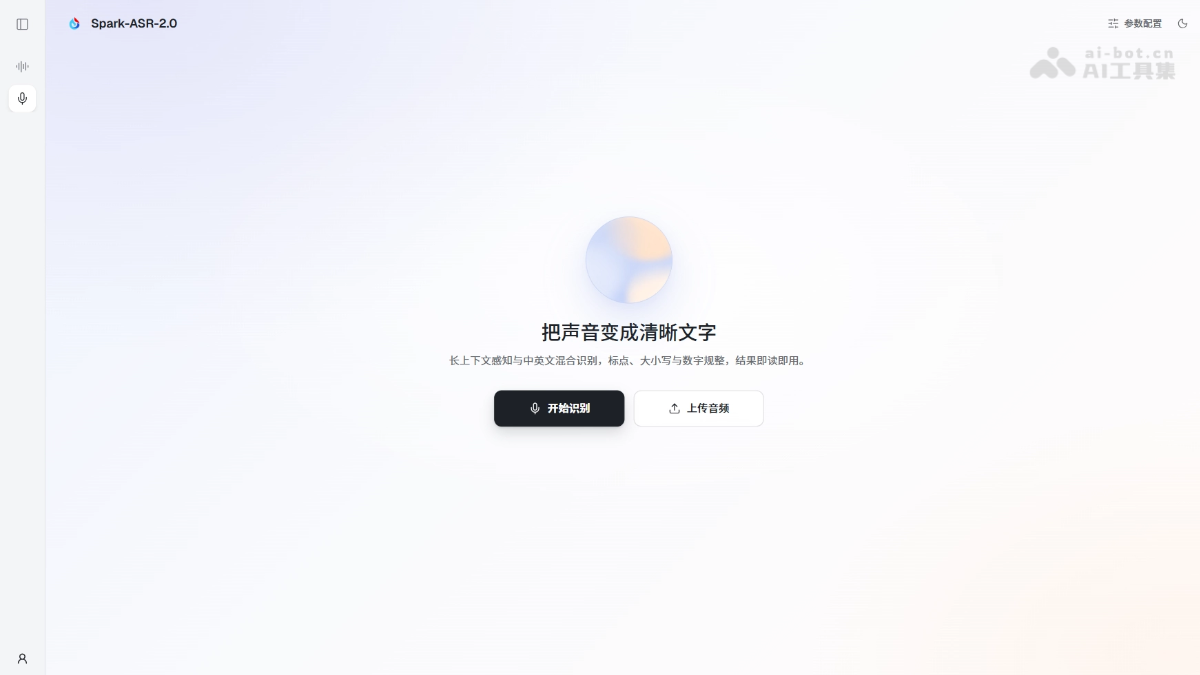
Main features of Spark-ASR-2.0
-
Chinese-English mixed recognition: Accurate recognition in complex mixed-speech scenarios without switching.
-
Dialect recognition without switching: Supports dialects from 202 cities nationwide, accurately transcribing speech as spoken.
-
Professional terminology recognition: Significantly improved recognition of tongue-twisting terminology in medicine, chemistry, science and technology, etc.
-
Recognition in complex acoustic scenarios: Outstanding performance in scenarios such as high noise, low volume, fast speech, and children's speech, surpassing the industry's best level.
-
Context recognition: Integrates recognition history, modification records, and hot words to disambiguate homophones and semantic ambiguities.
-
Fluent text normalization: Automatically streamlines redundancy, removes filler words, completes punctuation, and standardizes numbers, symbols, and units, achieving "speaking like writing."
Technical principles of Spark-ASR-2.0
- Non-autoregressive and LLM-enhanced autoregressive collaborative architecture: Continues the non-autoregressive paradigm of Spark-ASR-1.0, outputting the entire text sequence in parallel at once to ensure inference efficiency; at the same time, introduces LLM-enhanced autoregressive recognition, and the two collaborate to improve overall accuracy and language understanding capability.
- Joint enhancement of Chinese-English mixed text and acoustics: Models and enhances the text level and acoustic level separately, then performs joint optimization, greatly improving the model's performance in general recognition scenarios such as Chinese-English mixed speech, dialects, and professional terminology.
- Dynamic context injection: During recognition, fuses the user's historical recognition content, modification records, and personalized hot word information in real time, and combines the context of preceding and following sentences for understanding and judgment, effectively eliminating recognition bias caused by easily confused pronunciations and similar nouns.
- Continuation of speech foundation large model capabilities: Built overall on the Spark-Audio-1.0-Preview speech foundation, inheriting its recognition advantages in complex acoustic scenarios, and on this basis making specialized optimizations for accuracy and text normalization.
How to use Spark-ASR-2.0
Method 1: Online experience
- Open the experience page: Visit https://iflytekresearch.iflytek.com/experience/spark-asr
- Input or record speech: Speak directly on the page or upload audio to view recognition results in real time.
Method 2: iFlytek Input Method
- Download the iFlytek Input Method: Scan the QR code or install the latest version of the iFlytek Input Method from the app store.
- Switch to voice input: In the input interface, tap the microphone icon and press and hold to speak to use Spark-ASR-2.0 recognition.
Method 3: API integration (developers)
- Visit the open platform: Log in to the iFlytek Open Platform https://www.xfyun.cn/services/spark_asr_zh_en_v2.0
- Create an application and obtain the key: After registering the application, obtain authentication information such as AppID and APIKey.
- Call API Service: Pass in the audio stream according to the API documentation to integrate recognition capabilities into your own application.
Core Advantages of Spark-ASR-2.0
-
Industry-leading recognition performance: Outperforms the current industry best level in scenarios such as dialects, high noise, and low volume, with significantly reduced WER.
-
Extremely low inference cost: While performance is greatly improved, inference cost increases by only 10% compared with 1.0.
-
Efficient non-autoregressive architecture: Outputs text sequences in parallel in one pass, balancing high accuracy and inference efficiency.
-
Full coverage of complex scenarios: Accurately recognizes Chinese-English code-switching, switch-free dialects across 202 cities, professional terminology, fast speech, and children's speech.
-
Strong contextual understanding: Integrates recognition history and hotword dynamic disambiguation to accurately handle homophones and similar terms.
-
Fluent formal text output: Automatically removes filler words, adds punctuation, and standardizes numerals and symbols, directly outputting polished and coherent formal text.
Comparison of Spark-ASR-2.0 with Similar Competing Products
| Comparison Dimension | iFLYTEK Spark-ASR-2.0 | SenseTime AudioClaw |
|---|---|---|
| Product Positioning | Dedicated speech recognition large model (ASR foundation capability) | AI-native intelligent input method / voice agent application |
| Large Model Foundation | Spark Speech Foundation Large Model Spark-Audio-1.0-Preview | SenseTime SenseNova multimodal large model + OpenClaw ecosystem |
| Technical Architecture | Non-autoregressive + LLM-enhanced autoregressive collaborative architecture | Self-developed ASR + multimodal large model semantic optimization |
| Dialect Support | Switch-free recognition of dialects in 202 cities nationwide | Supports translation between some dialects and multiple languages |
| Contextual Capabilities | Dynamic context injection, integrating history, modification records, and hotword disambiguation | Automatically accumulates a dedicated knowledge base, enabling cross-meeting Q&A retrieval |
| Featured Functions | "Fluent formal text": removes filler words, adds punctuation, standardizes numerals, symbols, and units | Spoken language purification, correction recognition, meeting summarization, voice command rewriting and translation |
| Recognition Performance | Outperforms the industry best level in dialects, high noise, and low volume, with inference cost increased by only 10% | Millisecond-level response, accurate recognition in noisy environments and professional terminology scenarios |
| Deployment Channels | iFLYTEK Input Method, Open Platform API, AI glasses, office notebooks, iFLYTEK Hearing | Client-ready upon installation, seamlessly integrates with WeChat and other applications |
Application Scenarios of Spark-ASR-2.0
-
Mobile Input: Voice typing in iFLYTEK Input Method, freely mixing Chinese and English or speaking dialects, automatically "speaking in finished prose" that can be sent directly.
-
Meeting Notes: Office notebooks/iFLYTEK Hearing transcribe meeting content in real time, accurately recognizing and standardizing drafts even in noisy meeting rooms.
-
Professional Domain Records: Voice records of discussions and lectures in the medical, chemical, and technological fields, accurately transcribing complex terminology.
-
Intelligent Hardware Interaction: Voice command and dialogue recognition in devices such as iFLYTEK AI glasses and translators, working stably in low-volume environments.
-
Developer Business Integration: Through open platform APIs, it provides a highly accurate, low-cost recognition foundation for enterprise applications such as customer service, subtitle generation, and voice input.