
What is SkillSpector
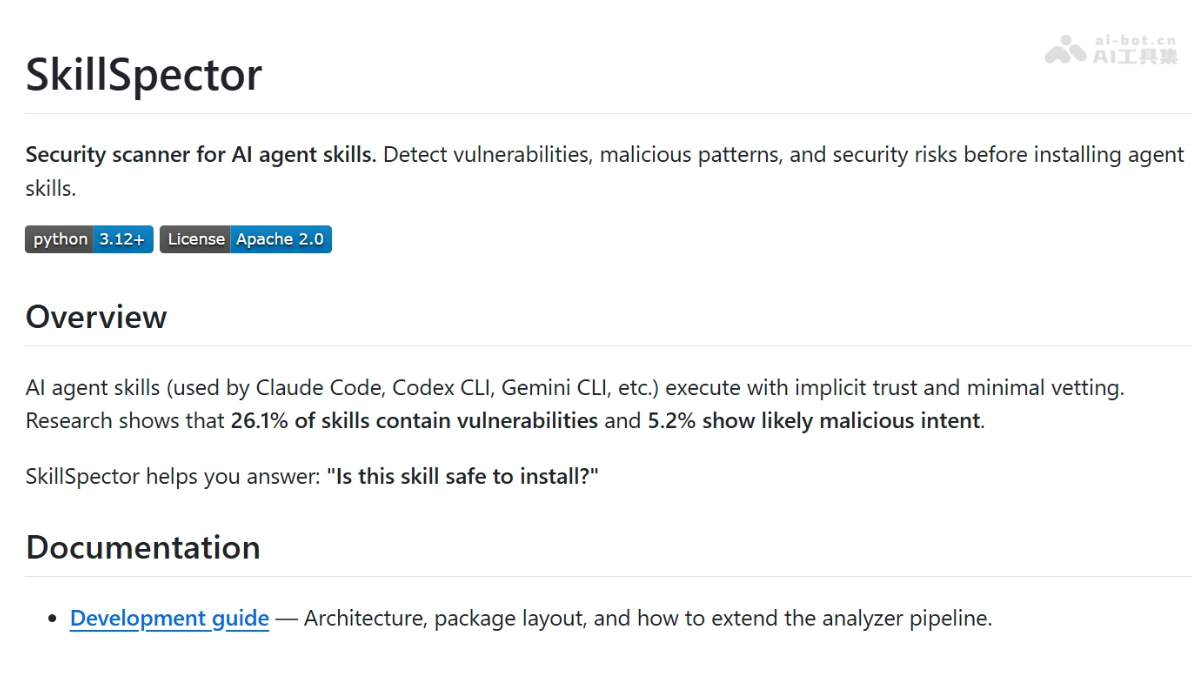
SkillSpector is NVIDIA's open-source AI Agent skill security scanning tool that can automatically detect vulnerabilities, malicious patterns, and security risks before installing skills on platforms such as Claude Code、Codex CLI、Gemini CLI . The tool supports multiple input formats including Git repositories, URLs, archives, directories, and single files, comes with 64 vulnerability patterns spanning 16 security categories, provides a two-stage analysis pipeline consisting of fast static scanning and optional LLM semantic evaluation, outputs reports in formats such as terminal, JSON, Markdown, and SARIF, and includes a 0-100 risk score with remediation recommendations.
SkillSpector's Main Features
- Multi-format input scanning: Supports Git repositories, URLs, archives, directories, and single files.
- 64 vulnerability patterns covering 16 security categories: Includes prompt injection, data exfiltration, privilege escalation, supply chain, excessive agency, output handling, system prompt leakage, memory poisoning, tool misuse, rogue agents, trigger abuse, dangerous code AST, taint tracking, YARA signatures, MCP least privilege, and MCP tool poisoning.
- Two-stage analysis pipeline: The first stage is fast static scanning, and the second stage is optional LLM semantic evaluation.
- Real-time vulnerability lookup: Queries known CVEs through the OSV.dev API, with automatic offline fallback support.
- Multi-format output: Supports terminal, JSON, Markdown, and SARIF report formats.
- Risk scoring system: 0-100 scoring, with severity level labels and clear remediation recommendations.
SkillSpector's Technical Principles
- First-stage static analysis: Performs fast pattern matching based on regular expressions and AST, detects dangerous code calls such as exec, eval, subprocess, etc., queries dependency vulnerabilities in real time through the OSV.dev API, scans all files, and has high recall and moderate precision.
- Second-stage LLM semantic analysis (optional): Evaluates context and intent through compatible endpoints such as OpenAI, Anthropic, or NVIDIA, filters false positives, provides human-readable explanations, raises precision to about 87%, and the LLM prompt includes anti-jailbreak protection mechanisms to prevent malicious skills from manipulating analysis results.
- Risk score calculation: CRITICAL issues +50 points, HIGH +25 points, MEDIUM +10 points, LOW +5 points, executable scripts impose an additional 1.3x multiplier, and the final grading is 0-20 (LOW/SAFE), 21-50 (MEDIUM/CAUTION), 51-80 (HIGH/DO NOT INSTALL), 81-100 (CRITICAL/DO NOT INSTALL).
How to Use SkillSpector
- Environment preparation: Clone the GitHub repository and create and activate a Python virtual environment, supporting uv or pip.
- Installation and deployment: Run the
make installcommand to install production dependencies, ormake install-devto install development dependencies. - Run a scan: Use the
skillspector scancommand followed by the target path. - Configure LLM (optional): Set the
SKILLSPECTOR_PROVIDERenvironment variable to select the OpenAI, Anthropic, or NVIDIA provider, and configure the corresponding API key to enable semantic analysis. - View reports: Use the
--formatparameter to specify the terminal, JSON, Markdown, or SARIF output format, and--outputto specify the report save path.

Follow WeChat and reply “Open Source” to joinAI Open Source Project Exchange Group
SkillSpector's Core Advantages
- Agent Scenario Specialization: Focused on AI Agent skill security scanning, with detection rules deeply optimized for platforms such as Claude Code, Codex CLI, Gemini CLI, and more.
- Two-Stage Precision Balance: Static scanning enables rapid response, while LLM semantic analysis raises precision to about 87%, balancing efficiency and accuracy.
- Full-Chain Risk Coverage: Built-in 64 vulnerability patterns spanning 16 security categories, enabling end-to-end detection from prompt injection to supply chain poisoning.
- Real-Time Vulnerability Lookup: Connects to the OSV.dev database for real-time queries of known CVEs, requires no API key, and automatically falls back offline to ensure availability in isolated environments.
- Native CI/CD Integration: Supports SARIF standard format output and can be directly integrated into GitHub Code Scanning and enterprise continuous integration pipelines.
- Multi-Format Input Compatibility: Supports scanning skill packages in any form, including Git repositories, URLs, compressed packages, directories, and single files, lowering the barrier to use.
SkillSpector's Project Address
- GitHub Repository:https://github.com/NVIDIA/skillspector
SkillSpector's Comparison with Similar Competitors
| Comparison Dimension | SkillSpector | Cisco Skill Scanner |
|---|---|---|
| Developer | NVIDIA | Cisco |
| Open Source License | Apache 2.0 (fully open source) | Not open source (commercial product) |
| Detection Engine | Two-stage pipeline: fast static analysis + optional LLM semantic evaluation | Four-engine layering: static analysis + behavioral data flow analysis + LLM semantic analysis + cloud threat scanning |
| Covered Platforms | Claude Code、Codex CLI、Gemini CLI | OpenAI Codex、Cursor |
| Vulnerability Patterns | 64 vulnerability patterns spanning 16 security categories | Specific number not disclosed; emphasizes multi-engine layered coverage |
| Risk Scoring | 0-100 quantitative score, four severity levels (LOW/MEDIUM/HIGH/CRITICAL) | Severity level labels, combined with cloud threat intelligence context |
| Real-Time Vulnerability Database | Connects to OSV.dev for real-time queries of known CVEs, requires no API key, and supports automatic offline fallback | Integrates Cisco cloud threat intelligence, relies on cloud queries |
| Output Format | Terminal、JSON、Markdown、SARIF | SARIF、JSON |
| CI/CD Integration | Native SARIF support, can integrate with GitHub Code Scanning and general-purpose pipelines | Officially provides GitHub Actions integration, deeply adapted to DevSecOps workflows |
| Analysis Depth | Static AST analysis + LLM semantic explanation (precision about 87%) | Behavioral data flow tracing + execution path simulation + cloud correlation analysis |
| Deployment Method | Local CLI tool, supports offline static scanning | Cloud hybrid architecture, some capabilities rely on the cloud scanning engine |
SkillSpector's Application Scenarios
- Developer Pre-Installation Review: Perform a quick scan before locally installing third-party AI skills, and decide whether to install or reject based on the risk score.
- Enterprise CI/CD Security Gate: Integrate scanning into the continuous integration pipeline to automatically block high-risk skill submissions and achieve shift-left security control.
- Skill marketplace platform review: AI skill stores or MCP marketplaces perform automated security reviews before skills are listed and show trust scores to users.
- Independent developer self-audit: Skill authors proactively scan their own projects before release to identify and fix potential vulnerabilities and improve the credibility of their work.
- Batch analysis for security research: Researchers perform batch scans on large-scale skill datasets to analyze vulnerability distribution, malicious pattern trends, and the ecosystem security baseline.