
What is CodeWave SDD
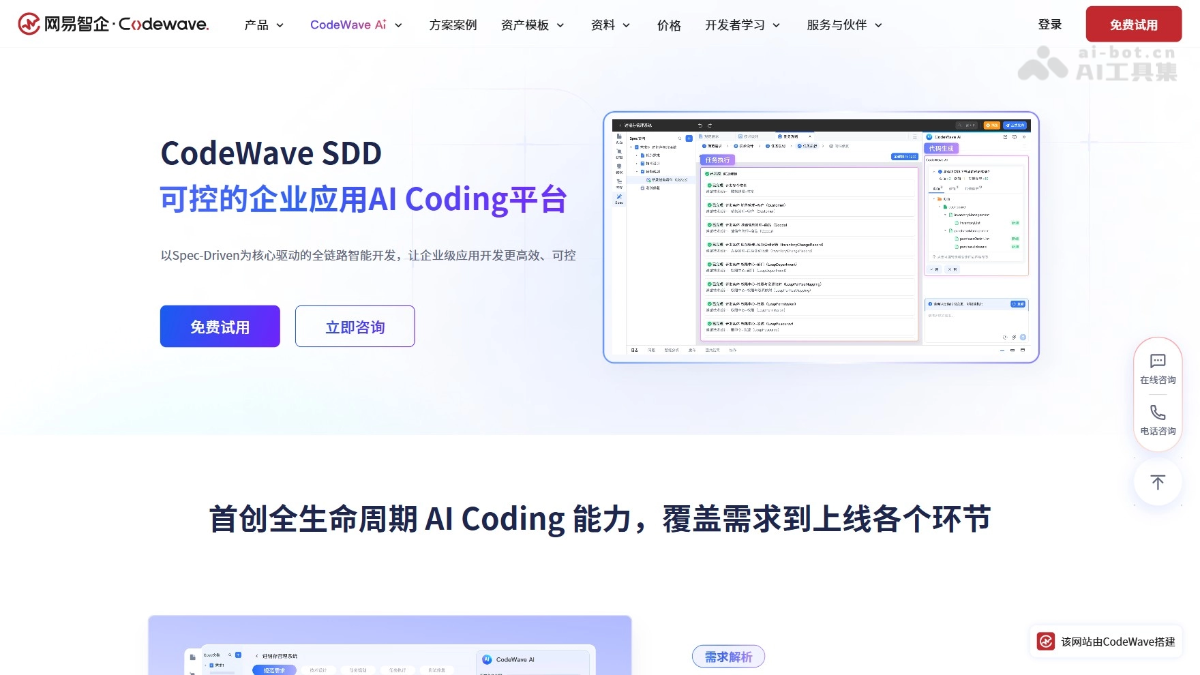
CodeWave SDD is a controllable enterprise-grade AI Coding platformunder NetEase Zhiqu. Based on the self-developed NASL domain language and Spec-driven development, it replaces Prompt mysticism and enables the entire Prompt→Requirements→Design→Tasks→Code process to be controllable, auditable, and rollback-capable. CodeWave SDD unifies the technology stack, accumulates reusable enterprise assets such as components and services, and can export standard Vue/React/Spring source code without vendor lock-in. CodeWave SDD has served leading enterprises such as China Railway, BOE, and Industrial and Commercial Bank of China, helping enterprises deliver digitalization efficiently.
Main features of CodeWave SDD
- NASL domain-specific language: A Web application description language self-developed by NetEase. Through a strong type system and static checks, AI-generated code is made visible and controllable, eliminating architectural chaos and security vulnerabilities at the source.
- Visual programming: Drag-and-drop page/logic/data/process designers allow non-technical members to participate in development and validation, greatly reducing maintenance barriers and communication costs.
- Dynamic recall and intelligent generation: Intelligent matching based on NASL constraints and enterprise assets allows AI to recommend best practices under enterprise standards, saying goodbye to "black-box guessing."
- Spec-driven development: Standardized Spec documents replace Prompt mysticism, implementing a standardized process of Prompt → Requirements → Design → Tasks → Code, with generation results that are traceable.
- Enterprise asset center: Centrally manages IT assets such as components, services, and connectors, supports intelligent generation and reuse, and breaks the dilemma of "starting from scratch every time."
- Historical source code reuse: Connects to existing enterprise code repositories and identifies common code, improves the usage scenarios of legacy code, and accelerates the accumulation of IT assets.
- Source code export: Supports exporting Vue/React/Spring project templates and generating standard JS/Java source code without vendor lock-in, meeting enterprises' needs for autonomous control.
How to use CodeWave SDD
- Visit the official website: Visit the CodeWave SDD official website https://codewave.163.com/ to complete account login and registration.
- Clarify requirements: Describe business requirements in natural language, and the platform helps transform vague ideas into structured requirement documents.
- Write Spec: Standardize requirements into Spec documents (replacing traditional Prompts) as the sole basis for subsequent AI generation.
- Design confirmation: Use the visual designers to build pages, logic, data, and processes, so the technical solution can be reviewed and adjusted.
- Task breakdown: The platform automatically breaks down Specs into a Design → Tasks development task list, confirmed collaboratively by multiple roles.
- AI code generation: AI intelligently generates code based on NASL constraints and the enterprise asset library, with a traceable generation process and rollback-capable results.
- AI automatic testing: AI tests and verifies the code it generates and automatically fixes and iterates when problems are found.
- Preview and delivery: Preview the interactive prototype online, and once confirmed, publish it online or export standard Vue/React/Spring source code for independent deployment.
Core advantages of CodeWave SDD
-
Controllable generation: Based on NASL's strong typing constraints and static checks, AI-generated results are reviewable, rollback-capable, and correctable, saying goodbye to "black-box guessing."
-
Process Standardization: Replacing Prompt mysticism with Spec-driven development, standardizing the entire process from requirements to code, with everything documented and traceable.
-
Unified Technology Stack: Eliminates architectural chaos at the source and avoids the accumulation of technical debt caused by AI improvising freely.
-
Asset Accumulation and Reuse: The enterprise asset center uniformly manages components, services, and connectors. Historical source code can be identified and reused, making development faster the more it is used.
-
Low-Barrier Collaboration: Visual drag-and-drop design allows non-technical personnel to participate in development and validation, reducing communication and maintenance costs.
-
Dual-Modal Editing: Supports free switching between visual and code modes, balancing efficiency and flexibility.
-
Autonomous and Controllable: Can export standard Vue/React/Spring source code, with no vendor lock-in, meeting enterprise compliance and privatization needs.
-
Proven: Serves leading enterprises such as China Railway, BOE, and Industrial and Commercial Bank of China, and has been proven to achieve doubled workforce efficiency or nearly 2x profit improvement.
Application Scenarios of CodeWave SDD
-
Rapid Delivery of Enterprise Internal Management Systems: For middle and back-office applications such as OA, CRM, and ERP peripheral systems, Spec-driven + AI generation greatly shortens the cycle from requirements to launch.
-
High-Compliance Scenarios in Finance/Government and Enterprises: For industries such as banking, tobacco, and state-owned enterprises that have high requirements for code security and autonomous controllability, NASL's static checks and source code export capabilities enable controllable delivery and private deployment.
-
Legacy System Transformation and Asset Revitalization: Connects to enterprises' existing code repositories, identifies and reuses historical common code, and gradually modernizes and migrates old systems to a unified technology stack.
-
Agile Development with Business Personnel Participation: With visual drag-and-drop design, non-technical personnel such as product managers and business operations can participate in prototype building and validation, reducing losses in requirements communication.
-
University Teaching and Software Talent Cultivation: Cooperates with more than a hundred universities as a low-barrier AI development teaching platform, helping students quickly build complete applications and understand engineering-oriented development processes.

