
What is MoMA
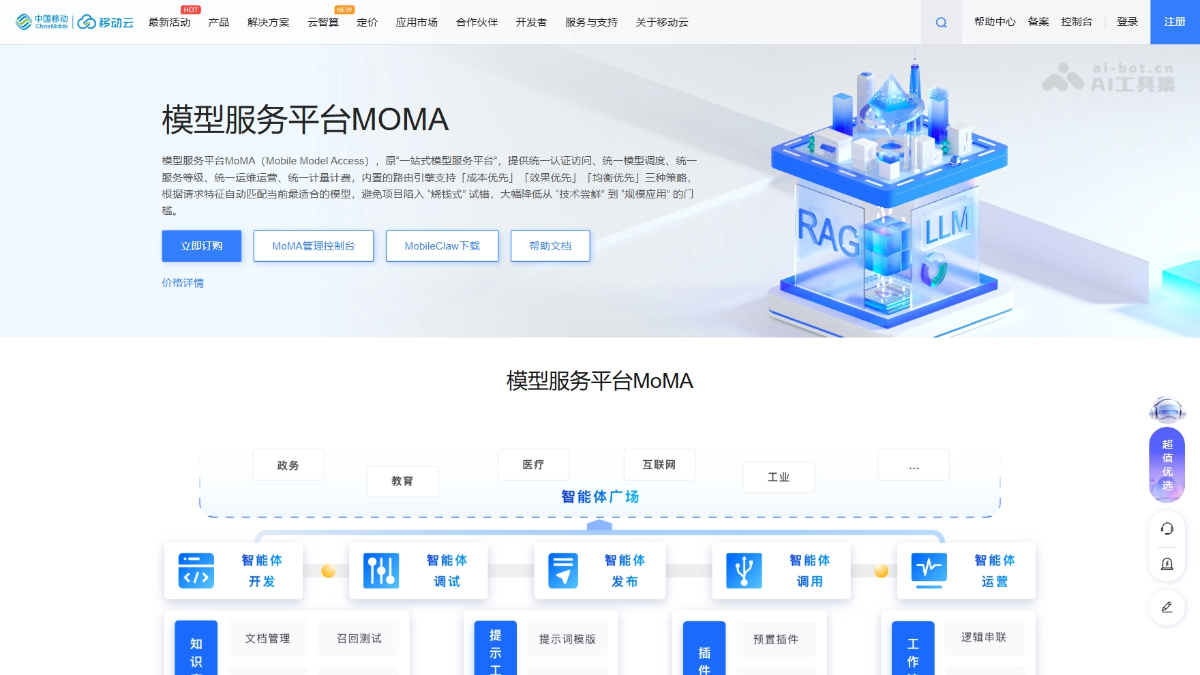
MoMA is China Mobile's first open and inclusivelarge model aggregation platform, bringing together over 300 mainstream large models (open-source, closed-source, and self-developed Jiutian), providing a unified API gateway and intelligent routing capabilities. Users do not need to register accounts one by one; through a single platform, they can experience models, call APIs, deploy with one click, and fine-tune, with support for pay-as-you-go/one-time billing, and a free quota of 25 million Tokens, greatly lowering the threshold from "technical trial" to "scale application".
MoMA's main features
-
Model Marketplace: Brings together 300+ AI models, covering text, vision, speech, vector, multimodal and other categories, supporting online experience, API calls, one-click deployment, and fine-tuning.
-
Unified API Gateway: Provides standardized interfaces; once integrated, all models can be called without adapting to different vendors' protocols.
-
Intelligent Routing (Jiutian inside): Automatically analyzes user needs, dynamically matches the best model, supports three strategies—cost priority, effect priority, and balanced priority—and enables second-level disaster recovery switching during failures.
-
RAG Retrieval-Augmented Generation: Provides multi-source knowledge base construction capabilities, supports hybrid retrieval and multi-path recall, effectively integrates massive fragmented knowledge resources inside and outside the enterprise, and improves the accuracy of generated content.
-
Agent Development: An agent orchestration approach based on LLM autonomous planning and workflows, meeting no-code/low-code agent development needs and quickly building AI Agents.
-
Agent Store: Brings together ready-made agents from multiple domains that can be experienced directly; it also supports publishing self-developed agents to the store to expand application channels.
-
Visual Workflow Orchestration: Combines and orchestrates plugins, models, code, knowledge bases, and other functions through drag-and-drop, enabling complex and stable business process automation.
-
Token Metering and Transparent Billing: Provides detailed Token consumption per transaction, latency, and throughput performance monitoring, and supports pay-as-you-go and one-time billing.
How to use MoMA
- Enter the Console: Visit the MoMA official website https://ecloud.10086.cn/portal/product/MaaS , complete account login and registration to enter the console.
- Browse the Model Marketplace: Open the Model Marketplace to view 300+ models, filter by category, function, or series, or directly search for the target model.
- Experience or call models: Select a single model and click "Online Experience" to test it instantly, or click API Call to obtain the interface address and key.
- Configure intelligent routing: Enter the intelligent routing module, select a strategy, check the model set, and create automatic scheduling rules.
- Build a RAG knowledge base: Enter the RAG module, upload enterprise documents to build a multi-source knowledge base, and configure a hybrid retrieval strategy to enhance generation results.
- Develop agents: Enter the agent development module, based on LLM autonomous planning capabilities, orchestrate workflows through no-code/low-code methods, and build exclusive agents.
- Publish to the Agent Store: Publish the developed agent to the store for direct experience and use by internal teams or external users.
MoMA's core advantages
-
Most comprehensive model coverage: China's largest model service platform, with 300+ models covering open-source, closed-source, self-developed Jiutian, and confidential models.
-
Intelligent cost reduction: Intelligent routing automatically selects the most cost-effective model, reducing unit Token cost by about 30% and resource usage by more than 50%.
-
Full-stack AI capabilities: Provides model invocation and integrates RAG knowledge enhancement, agent development, and workflow orchestration, covering the entire chain from underlying models to upper-layer applications.
-
Low-code agent development: No deep programming background is required; agents can be built and published through visual orchestration, lowering the barrier to AI application development.
-
High availability assurance: Second-level automatic disaster recovery mechanism; a single point of failure does not affect business, making it suitable for production environments.
-
Transparent billing: Pay based on actual Token consumption, with detailed-level monitoring, saying goodbye to the muddled accounts of "billing by package".
-
Free trial: Provides 25 million Token free quota, supporting try first and pay later.
Comparison of MoMA's similar competitors
| Comparison dimension | MoMA (China Mobile) | Alibaba Cloud Bailian | Baidu AI Cloud Qianfan |
|---|---|---|---|
| Platform positioning | Open and inclusive model aggregation platform | Large model application development platform | Enterprise-level one-stop large model platform |
| Number of models | 300+ (open-source + closed-source + self-developed) | 100+ | 100+ |
| Access method | Unified API, one-time access for global invocation | Standard API + SDK | Standard API + SDK |
| Intelligent routing | Original dual-mode SLA tiered routing | Automatic model routing | Model fine-tuning and routing |
| Cost optimization | Token intensification, about 30% cost reduction | On-demand billing + resource packages | On-demand billing + resource packages |
| Agent capabilities | Dual modes of autonomous planning + workflow orchestration | Application center + Agent framework | AppBuilder + workflow |
| Infrastructure | Mobile Cloud computing network + 1500+ edge intelligent computing centers | Alibaba Cloud Feitian architecture | Baidu AI Cloud + Kunlun Chip |
| Security and compliance | Carrier-grade network + content security protection | Alibaba Cloud security system | Baidu security system |
| Distinctive advantages | Computing-network integration, low latency, high security | Strong Alibaba ecosystem integration capability | Deep Wenxin large model ecosystem |
MoMA's application scenarios
-
Enterprise AI middle platform: As a unified model entry point, it supports the intelligent needs of multiple internal business lines and avoids repeated integration.
-
Knowledge Q&A and customer service: Builds an enterprise knowledge base based on RAG capabilities to achieve accurate Q&A and reduce large model hallucinations.
-
Agent application development: Use low-code intelligent agents to develop and orchestrate workflows, rapidly building vertical applications such as approval assistants and data analysis Agents.
-
AIGC Content Production: Call text, image, and video generation models, combined with workflows to achieve batch content creation and publishing.
-
Industry Solutions: Fine-tune foundation models based on industry data, and combine RAG and intelligent agents to create dedicated solutions for finance, healthcare, government, and other sectors.

