

What is DMXAPI
DMXAPI (Large Model API) is an intelligent API aggregation service platform launched by LangChain Chinese Network, helping developers easily access a variety of large models and quickly enter the field of AI application development. It supports RMB pricing and directly connects to more than 300 multimodal large models at home and abroad, covering multiple modalities such as text-to-text, text-to-image, text-to-video, and text-to-audio, so all models can be used with one Key. DMXAPI provides unlimited RPM/TPM, and enterprise customers are supported with unlimited concurrency. By cooperating with the original large model manufacturers and centrally procuring resources, DMXAPI provides highly competitive prices, with overseas models as low as 30% off. It adopts an advanced architecture design, supports high concurrency, guarantees data security, and does not store any customer data. DMXAPI provides one-on-one considerate customer service, 24/7 online support, and strictly follows business processes to ensure transactions are legal and compliant.
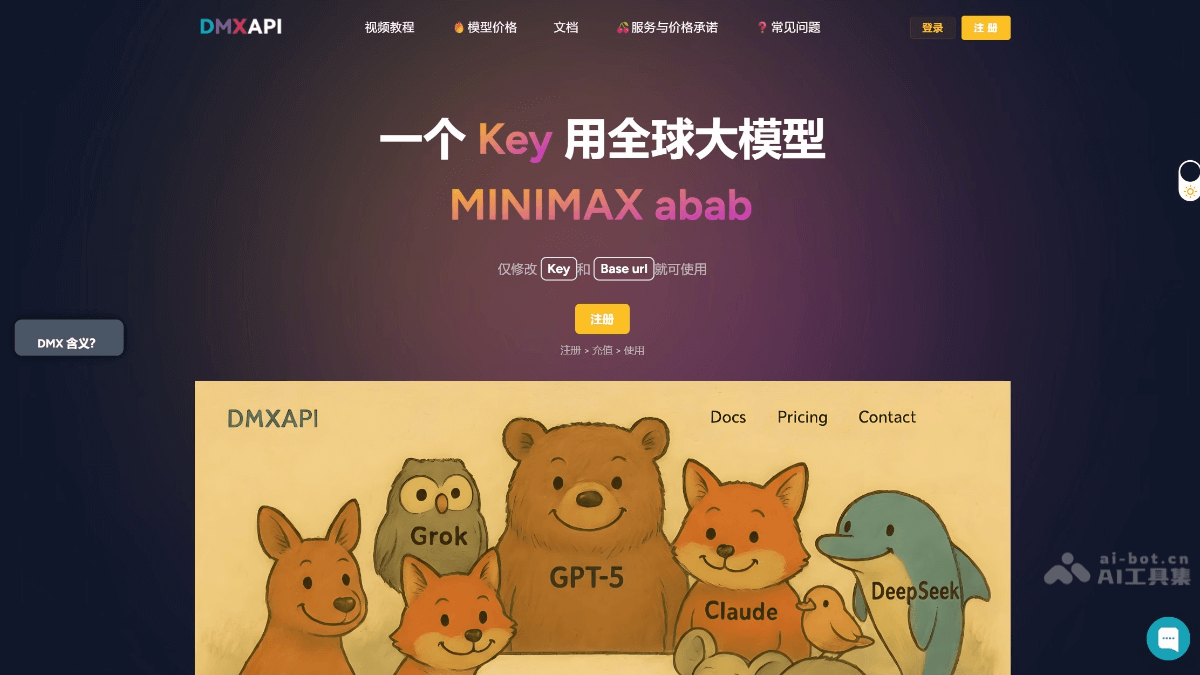
Main features of DMXAPI
-
Multimodal large model aggregation: Integrates more than 300 large models worldwide, covering multiple modalities such as text-to-text, text-to-image, text-to-video, and text-to-audio, meeting diverse AI application needs.
-
RMB pricing and global direct connection: Provides global large model API services priced in RMB, directly connects to leading large models at home and abroad, and simplifies cross-border usage processes.
-
Unlimited RPM/TPM: Enjoy unlimited requests per minute (RPM) and tokens per minute (TPM) upon registration, and enterprise customers are supported with unlimited concurrency, suitable for high-traffic scenarios.
-
High performance and data security: Adopts an advanced architecture design and supports high concurrency to ensure efficient performance; does not store customer data, safeguarding information security and privacy.
-
Dedicated customer service and standardized service: Provides one-on-one considerate customer service and 24/7 online support; strictly follows business processes, supports corporate-to-corporate payments, and issues compliant invoices.
-
Compatibility and integration: Fully compatible with the OpenAI interface protocol, supports seamless connection with various OpenAI interface applications, and simplifies the integration process.
-
Cost optimization: Through centralized resource procurement, provides highly competitive prices, with overseas models as low as 30% off, helping enterprises reduce costs.
How to use DMXAPI
-
Register an account: Visit the DMXAPI official website https://dmxapi.cn/ , complete account registration, and obtain the API Key.
-
Select a model: Choose a suitable multimodal large model according to your needs, such as text-to-text, text-to-image, text-to-video, etc.
-
Configure parameters: Configure request parameters according to the API documentation, such as model name, input text, generation length, etc.
-
Send request: Use the API Key and configured parameters to call the DMXAPI interface via HTTP request.
-
Receive response: Receive the result returned by the API and process and display it according to business needs.
-
Optimization and debugging: Optimize request parameters based on the returned results and debug to achieve the best effect.
-
Integrate application: Integrate the API into your own application or service to achieve automation and batch processing.
-
Monitoring and management: Use the monitoring tools provided by DMXAPI to manage API calls and ensure stable service operation.
- Other tools
- Interface testing tool:https://test.DMXAPI.cn
- AI error analysis: https://err.DMXAPI.cn
Application Scenarios of DMXAPI
-
Content Creation: Use text generation capabilities to quickly generate articles, stories, scripts, and other content, improving creative efficiency.
-
Image Generation: Generate images based on text descriptions through text-to-image capabilities, applied in fields such as design and advertising.
-
Video Production: Convert text into video content with text-to-video capabilities, used for short video creation, film and television production, and more.
-
Audio Synthesis: Generate speech content using text-to-audio capabilities, suitable for audiobooks, voice assistants, and more.
-
Intelligent Customer Service: Integrate large models to implement intelligent customer service systems that automatically answer user questions and improve service efficiency.
-
Educational Assistance: Generate teaching materials, answer questions, and provide learning suggestions to assist educational work.

