

Zidong Taichu is an omni-modal large model jointly launched by the Institute of Automation of the Chinese Academy of Sciences and the Wuhan Institute of Artificial Intelligence. It is a 2.0 version upgraded from the trillion-parameter multimodal large model "Zidong Taichu 1.0". The Zidong Taichu large model supports comprehensive Q&A tasks such as multi-turn question answering, text creation, image generation, 3D understanding, and signal analysis. It has powerful cognition, understanding, and creation capabilities and can bring a brand-new interactive experience.
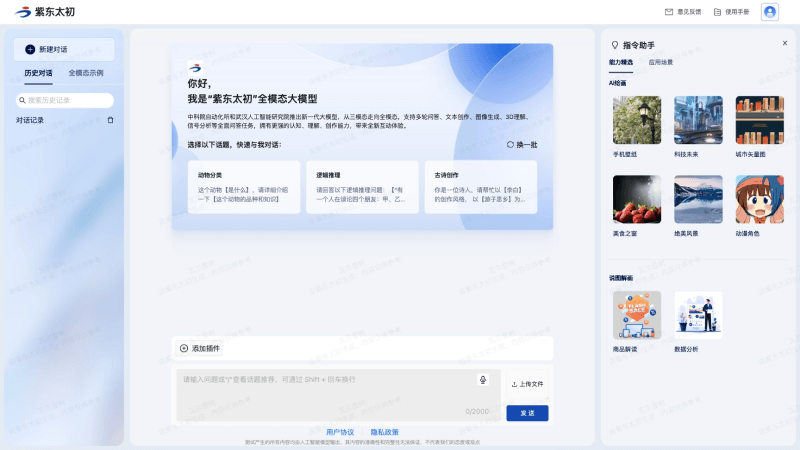
Main functions of Zidong Taichu
1. Image capabilities
- Image description: Based on image materials uploaded by users, accurately understand and answer image recognition questions
- Object detection: Supports object detection tasks across a rich range of categories, and can determine the target type, quantity, and corresponding location information
- Image retrieval: Based on a massive library of high-quality image materials, it can search for highly relevant and refined image materials for users
- Image generation: Generates corresponding refined images according to user instructions and demands, and can modify descriptions to fine-tune image content
- Text recognition: Based on image content, supports multi-scenario, multilingual, high-precision text detection and recognition services
2. Language capabilities
- Chinese Q&A: Accurately understands the context of questions input by users and can provide accurate knowledge-based Q&A
- Text continuation: Automatically continues writing rich story content based on the story prompt input by users
- Text creation: Accurately understands the intent of user input and generates text content with coherent semantics and smooth logic
- Title generation: Based on understanding of an article or long text, quickly aggregates and generates concise and summarizing title copy
- Grammar analysis: Accurately understands and analyzes the grammar of Chinese and English sentences, reminds users of grammatical errors and makes corrections, etc.
- Machine translation: Helps users translate various types of text materials, including Chinese-English mutual translation, and mutual translation between classical Chinese and vernacular Chinese, etc.
- Ancient poetry creation: Improvises poems, quatrains, etc. based on the theme or guiding content provided by users
- Code understanding: Understands most programming languages such as C, Python, and JAVA, as well as algorithms and data structures, and quickly provides the required answers
- Code writing: Can help users quickly write simple code snippets, such as functions, classes, or loops, etc.
- Mathematical calculation: Can handle both conventional mathematical calculation problems and mathematical application problems such as the chicken-and-rabbit problem recorded in The Mathematical Classic of Sun Zi, etc.
- Logical reasoning: Supports handling complex logical reasoning problems, including scientific reasoning, commonsense reasoning, spatiotemporal reasoning, etc.
3. Video capabilities
- Video description: Based on video materials uploaded by users, accurately understand and answer video recognition and video description questions
- Video retrieval: Based on a massive library of high-quality video materials, it can search for highly relevant and refined video materials for users
- Video Q&A: Based on video materials uploaded by users, accurately understand and answer video-related questions, while supporting contextual information understanding and multi-turn Q&A
4. Music capabilities
- Music generation: Controllably generates high-fidelity music through given text prompts, and supports impromptu creation of music in multiple styles and with multiple instruments
- Music multimodal Q&A: Based on understanding of music materials uploaded by users, can complete related multimodal Q&A tasks
5. Audio capabilities
- Audio authenticity detection: Zidong Taichu can determine whether the current audio is a real person speaking or machine-synthesized
- Audio event classification: It can detect the types of sound events contained in the current audio, and currently supports 11 types of single sound events and mixed sound events.
- Speech recognition: It can quickly and accurately recognize speech as text, supporting multiple scenarios such as mobile application voice interaction and voice content analysis.
- Speech synthesis: It provides highly human-like, fluent, and natural speech synthesis services to meet the needs of various scenarios such as text reading and voice announcements.
VI. 3D Capabilities
- 3D scene description: Zidong Taichu 2.0 has 3D scene understanding and object perception capabilities based on point cloud data.
VII. Signal-related Capabilities
- Signal recognition: It supports radar signal identification and knowledge interaction, and can use the model to quickly grasp the basic sources and parameters of signals, etc.
How to use Zidong Taichu
- Visit the official website of Zidong Taichu (taichu-web.ia.ac.cn) and click Dialogue Experience.
- Log in/register your account and apply for use. After successful login, you will be automatically redirected to the dialogue interface.
- Enter your question or type a slash to select a recommended prompt instruction (you can also choose a built-in example to view), and then click Send.
- Zidong Taichu will then intelligently answer your question.
Frequently Asked Questions
How do I apply for a trial of Zidong Taichu?
Visit the official website of Zidong Taichu, click Register on the login page, enter information such as "username," "nickname," "password," and "mobile phone number" to submit an account registration application, and after passing the backend review, you can use it for free.
Does Zidong Taichu support uploading files?
Zidong Taichu supports users in uploading image, video, point cloud, audio, music, and signal files, and can conduct targeted dialogue question answering.
Has Zidong Taichu passed the generative AI filing?
The Zidong Taichu large model passed the filing under the Interim Measures for the Administration of Generative Artificial Intelligence Services in the first batch in August 2023, and can officially launch and provide services to the public.

