

What is PubMedQA
PubMedQA is a dataset specifically used for answering biomedical research questions. PubMedQA answers research questions in the form of "yes/no/maybe" through literature abstracts, for example, "whether a certain drug is effective." The dataset contains 1,000 expert-annotated question-answer instances, 61,200 unlabeled instances, and 211,300 human-generated question-answer pairs. PubMedQA provides researchers with a standardized testing platform for developing and evaluating biomedical natural language processing models, helping to improve models' understanding of biomedical literature and their question answering capabilities.
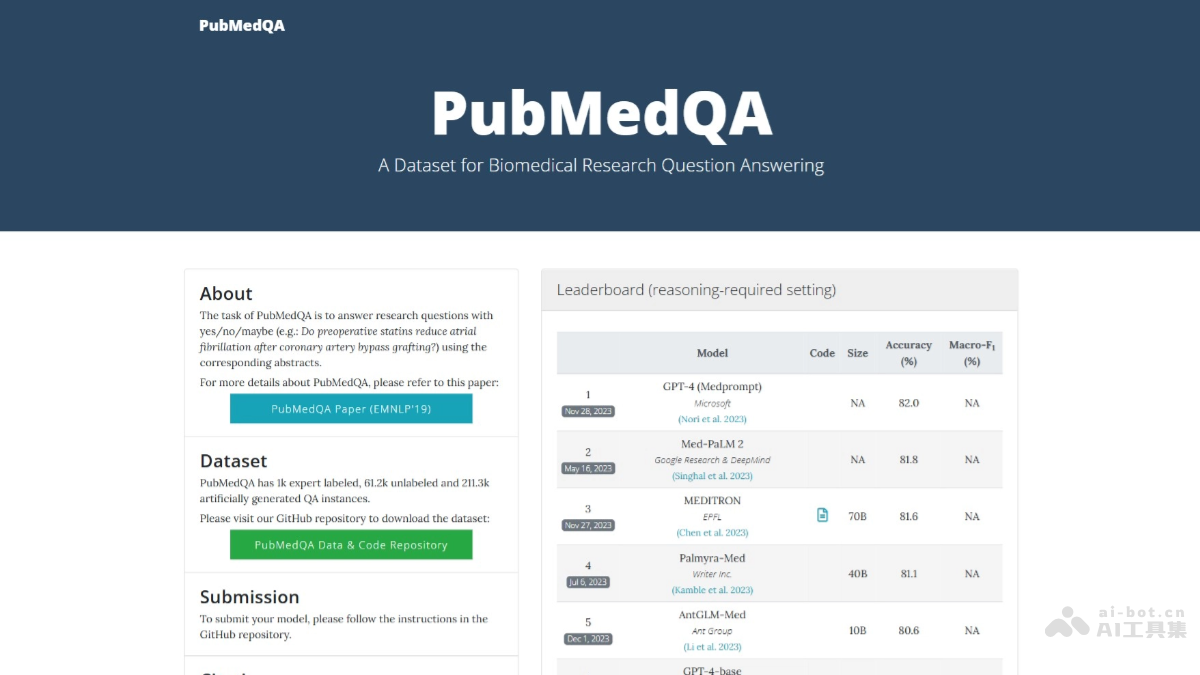
Main Features of PubMedQA
- Provides high-quality biomedical question answering datasets: PubMedQA contains 1,000 expert-annotated question-answer pairs, 61,200 unlabeled question-answer pairs, and 211,300 human-generated question-answer pairs, providing abundant data resources for biomedical natural language processing research.
- Serves as a benchmark platform for model evaluation: PubMedQA provides a standardized testing benchmark for biomedical question answering models. By publishing the performance metrics of different models, it helps researchers compare and improve models.
- Supports efficient information extraction for biomedical research: The dataset assists biomedical natural language processing research, promotes the rapid extraction of key information from massive literature, and improves research efficiency.
- Promotes the development of biomedical natural language processing technology: PubMedQA provides high-quality data, promotes advances in technologies such as biomedical question answering systems and text understanding, and lays the foundation for developing more intelligent artificial intelligence models.
How to use PubMedQA
- Download the PubMedQA dataset: Visit the PubMedQA GitHub repository:https://github.com/pubmedqa/pubmedqa,克隆仓库并下载数据集文件。
- Understand the dataset structure: Load the dataset files, inspect the structure, and understand the information contained in each instance, such as the question, answer, and related literature abstract.
- Preprocess the data: Preprocess the data, for example, use a tokenizer to convert questions and abstracts into a format acceptable to the model, and extract labels, etc.
- Train the model: Choose an appropriate model architecture (such as BERT, PubMedBERT, etc.), train the model with the preprocessed data, and optimize model parameters to improve performance.
- Evaluate the model: Evaluate model performance on the test set, calculate metrics such as accuracy and F1 score, and verify the effectiveness of the model.
- Submit to the leaderboard: Follow the "Submission" guide in the GitHub repository to submit the model's prediction results and performance metrics to the PubMedQA leaderboard and wait for review.
- Refer to the leaderboard to optimize the model: Review the performance and methods of high-scoring models on the leaderboard, compare them with your own model, and further optimize the model.
Application scenarios of PubMedQA
- Clinical decision support: Help doctors quickly obtain the latest research results and assist in diagnosis and treatment decisions.
- Medical research: Provide literature information for researchers and accelerate the research process.
- Medical education: As a learning tool, help medical students quickly acquire biomedical knowledge.
- Drug development: Support pharmaceutical companies and researchers in quickly understanding drug effects and clinical trial results.
- Intelligent medical systems: Integrate into intelligent medical platforms to provide users with personalized medical advice based on the latest research.

