

What is OpenCompass
OpenCompass is a large model open evaluation system officially launched by Shanghai Artificial Intelligence Laboratory (Shanghai AI Laboratory) in August 2023. Through a fully open-source and reproducible evaluation framework, it supports one-stop evaluation for various models such as large language models and multimodal models, and regularly publishes evaluation result leaderboards. OpenCompass includes three core parts: CompassKit (evaluation toolkit), CompassHub (benchmark community), and CompassRank (evaluation leaderboard). OpenCompass supports multiple models (such as Hugging Face models, API models, etc.), covers eight major capability dimensions including language, knowledge, and reasoning, and provides multiple evaluation methods such as zero-shot and few-shot. OpenCompass features distributed efficient evaluation and flexible extensibility, has attracted cooperation from many well-known enterprises and universities, and is committed to promoting the standardization and normalization of large model evaluation.
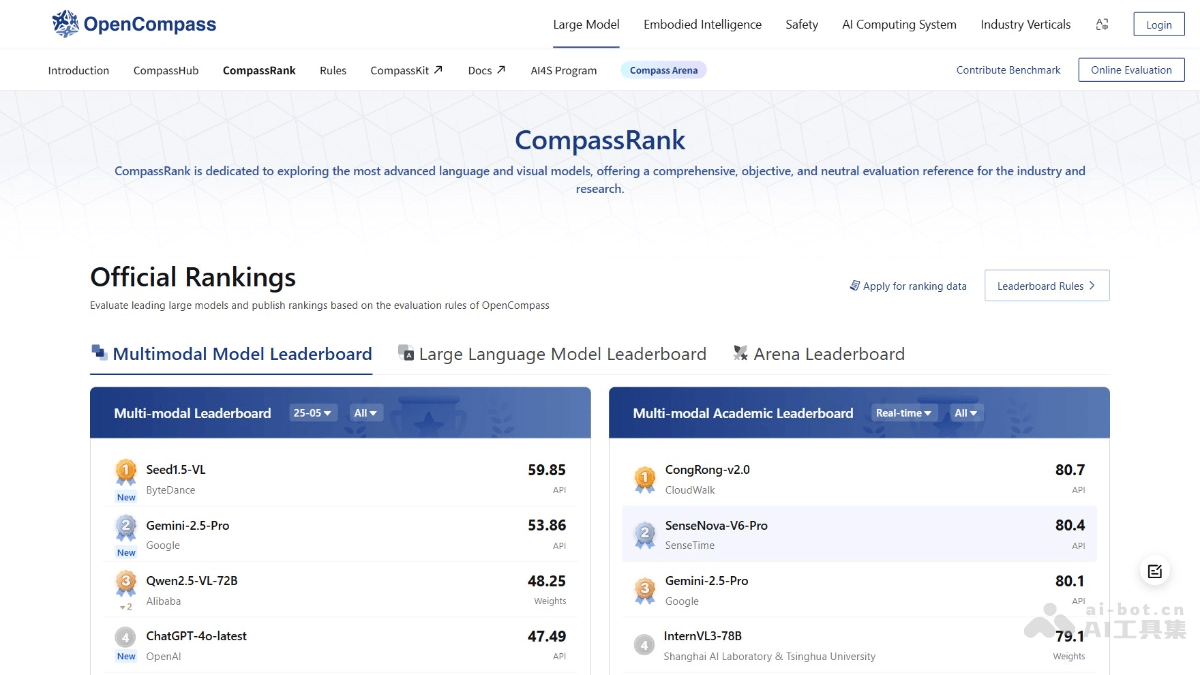
Main features of OpenCompass
- Model evaluation tool(CompassKit): Provides a rich set of evaluation benchmarks and model templates, supports multiple evaluation methods such as zero-shot and few-shot, and makes it convenient for users to flexibly extend according to their needs.
- Benchmark community(CompassHub): Supports users in publishing and sharing evaluation benchmarks. Leaderboards can be displayed within the community, and high-quality benchmarks can be included in the official leaderboard.
- Evaluation leaderboard(CompassRank): Provides comprehensive and objective scoring and ranking, covers eight major capability dimensions, supports evaluation of language models and multimodal models, and has already had many models participate.
- Efficient evaluation system: Supports distributed evaluation, quickly processes large-scale models, and is equipped with experiment management and reporting tools for convenient real-time viewing of results.
How to use OpenCompass
- Visit the official website: Visit the OpenCompass official website to learn about platform features and resources.
- Choose a functional module: Choose CompassKit (evaluation tool), CompassHub (benchmark community), or CompassRank (leaderboard) according to your needs.
- Submit a model or benchmark: Submit the model's API or repository address on CompassRank, or publish an evaluation benchmark on CompassHub.
- Installation and configuration: If using CompassKit, clone the code from GitHub, install dependencies, and configure the environment.
- Run evaluation: Use CompassKit for local evaluation, or wait for official evaluation results to be updated to CompassRank.
- View results: View model rankings on CompassRank, or use CompassKit to view local evaluation reports.
Application scenarios of OpenCompass
- Model performance evaluation and optimization: Enterprises and research institutions conduct multidimensional evaluations of language models or multimodal models, precisely identify model strengths and weaknesses, and then optimize model performance.
- Academic research: Researchers use its rich benchmarks to conduct comparative model research and promote academic development.
- Enterprise-level application development: When developing applications such as intelligent customer service and intelligent writing, enterprises evaluate the performance of different models on specific tasks and choose or customize the most suitable model.
- Education and training: Educational institutions use OpenCompass as a teaching tool to help students learn evaluation methods and optimization techniques for large models, and improve their understanding and application ability of artificial intelligence technology.
- Community co-building and sharing: Developers and researchers contribute models or benchmarks to the OpenCompass community, share resources with other users, and jointly advance the development of large model evaluation technology.

