

What is ModelArk
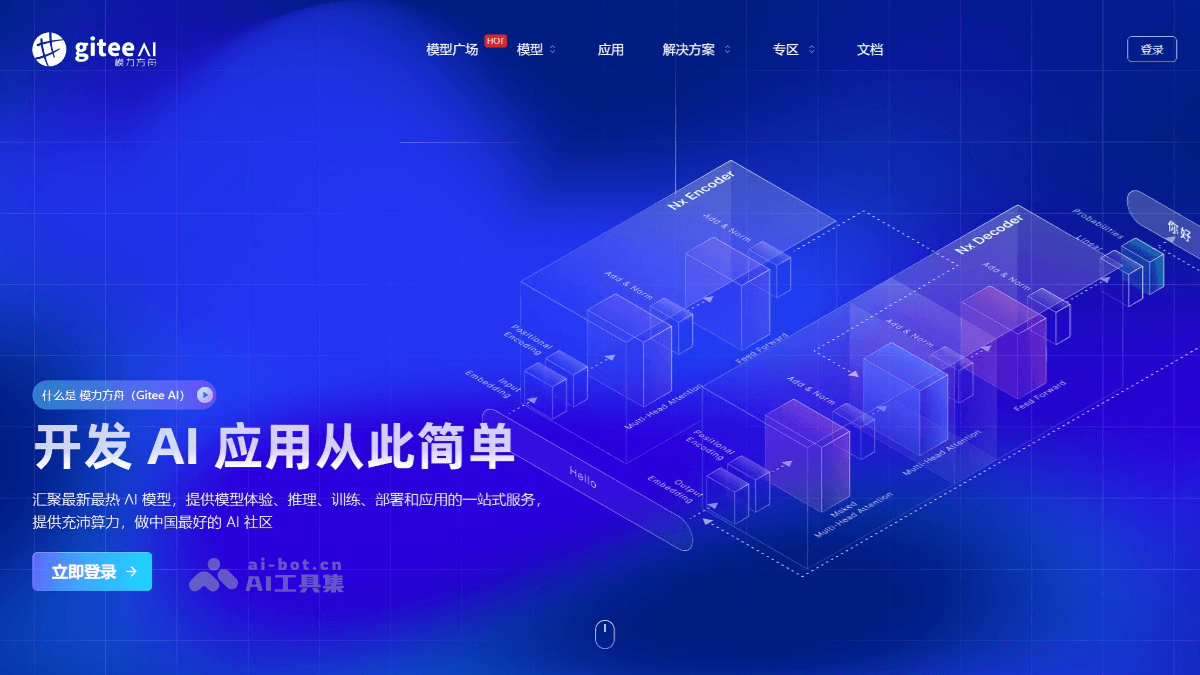
ModelArk (Gitee AI) is an AI application co-creation platformfor developers, end users, and industry scenarios. Leveraging the DevOps capabilities of Gitee, the world's second-largest developer platform, and its open-source developer service ecosystem, it provides highly available model service capabilities, Serverless application building capabilities, and API composition capabilities. The platform brings together over 70 mainstream large models, covering a variety of task types and industry scenarios, and supports Serverless deployment and private delivery. The AI Model Plaza features minimalist integration, high-performance inference, and flexible scaling, helping developers quickly build AI applications. The platform offers AI developer education, AI application co-creation, model customization, and other services. It is a co-creation platform connecting creators with users and AI capabilities with real-world scenarios, driving the development of the AI application ecosystem.
Main features of ModelArk
- AI Model Plaza: Provides standardized model interfaces and supports private deployment and Serverless invocation.
- Visual application building: Graphical configuration interface, zero-code application generation and launch.
- Broad computing power compatibility: Compatible with mainstream domestic AI chips such as Ascend, Iluvatar CoreX, and MetaX, while also supporting international mainstream hardware environments such as NVIDIA.
- Significantly reduced inference costs: The Serverless architecture significantly reduces development and deployment burdens, with inference costs reduced by up to 90%.
- AI application co-creation: Provides full-process services covering AI applications from "development → listing → display → monetization", helping developers efficiently achieve a complete closed loop from idea to product and from product to users. Co-create the AI application ecosystem, linking creativity, users, and the computing power value chain.
- Model customization: Provides model customization services including fine-tuning, reinforcement learning, and parameter plug-ins, helping enterprise customers quickly build exclusive AI capabilities, adapt to business scenarios, and efficiently implement applications.
- AI developer education: Through a series of AI technical activities, including frontier technology sharing and scenario-based practical training camps, it creates a space for learning and exchange for developers. At the same time, it provides enterprises with a cooperation window to showcase technical capabilities and product solutions, jointly building an open and co-created AI ecosystem.
- Stable and highly available service channel: API tokens are independently bound and support high-concurrency calls.
- Intelligent inference caching mechanism: Built-in multi-level caching and model reuse mechanisms improve response efficiency.
- Support for multiple model types: Compatible with mainstream models such as Diffusion, multilingual, multimodal, and RAG.
- LoRA dynamic loading: Supports hot-plugging lightweight model parameters at runtime, quickly achieving personalized fine-tuning.
- Capability composition and multi-model chains: Supports multi-API orchestration and workflow-style invocation to build personalized AI applications.
- Private deployment: Private deployment capabilities cover inference services, the Serverless platform, and a complete MaaS model management platform, supporting implementation in enterprise-level scenarios in the form of integrated software-hardware appliances, improving security and deployment efficiency.
How to use ModelArk
- Visit the official website: Visit theofficial website。
- Register an account: Register an account using your email or mobile phone number, or log in directly with a Gitee account.
- Complete Information: Complete your personal or enterprise information as prompted to use the platform's various services.
- Browse Models: In the AI Model Square, view more than 70 mainstream large models provided by the platform, covering task types such as text generation, image generation, semantic understanding, and multimodality.
- Select a Model: Choose an appropriate model for application development based on your needs. For example, if you need to develop a text generation application, you can choose a model that excels at text generation.
- Use API Services
- Obtain an API Key: Create an application on the platform and obtain an API Key, which is the necessary credential for calling model interfaces.
- Read the Documentation: View the API documentation of the selected model to learn detailed information such as interface parameters and return values.
- Call the API: Use the API Key to call the model interface via an HTTP request, send your input data to the model, and obtain the model's output results.
- Visual Application Building
- Enter the Application Building Interface: Find the visual application building tool on the platform.
- Configure the Application: Configure the application through a graphical interface without writing code. You can set basic information such as the application's name, description, input, and output.
- Connect the Model: Connect the selected AI model to the application and configure the model's calling parameters.
- Generate the Application: After completing the configuration, click the Generate Application button, and the platform will automatically generate and launch the application.
Application Scenarios of ModelArk
- Intelligent Customer Service and Assistants: Train enterprise-customized private models based on existing data such as enterprise knowledge bases, product documentation, and user manuals, and connect them to speech models.
- Government Services: Provide comprehensive solutions suitable for government work, such as intelligent business handling solutions and cloud courtroom solutions.
- E-commerce Livestreaming Industry: Provide intelligent content generation, identify user interests and emotions, and deliver targeted marketing content.
- Content Creation: Generate high-quality content such as text, images, and videos for industries such as advertising, media, and creative industries.
- Data Analysis: Provide intelligent decision support for enterprises through natural language processing and data analysis technologies.
- Intelligent Office: Automate office processes such as document generation, meeting minutes organization, and task management to improve work efficiency.

