
What is Elements of AI
Elements of AI is a free online introductory AI general education course for non-specialists, jointly launched by the University of Helsinki in Finland and the company Reaktor. The course popularizes AI knowledge and helps people understand the basic concepts and principles of AI and its applications in daily life. Elements of AI is suitable for anyone to learn, with no need for a complex mathematics or programming background. The course content includes the history of AI, the fundamentals of machine learning, neural networks, and more, and explores the impact of AI on society. In an easy-to-understand way, the course enables learners to grasp the core ideas of AI and improve their awareness and application ability regarding cutting-edge technology.
Main features of Elements of AI
- Popularization of basic knowledge: The course covers the history, definitions, main technologies (such as machine learning and neural networks), and practical applications of artificial intelligence, helping learners build a comprehensive understanding of AI.
- Interactive learning experience: Through the format of an online course, combined with videos, reading materials, quizzes, and practical exercises, learners deepen their understanding through interaction.
- Multilingual support: The course provides versions in multiple languages, making it convenient for people in different countries and regions to learn and promoting the popularization of AI knowledge worldwide.
- Exploration of social impact: It explains the technical aspects and explores the impact of artificial intelligence on society, the economy, and ethics, helping learners comprehensively think about the applications and challenges of AI.
- Free and open: The course is completely free and requires no background knowledge, lowering the learning threshold and allowing more people to access and learn about artificial intelligence.
Course structure of Elements of AI
- Introduction to AI:
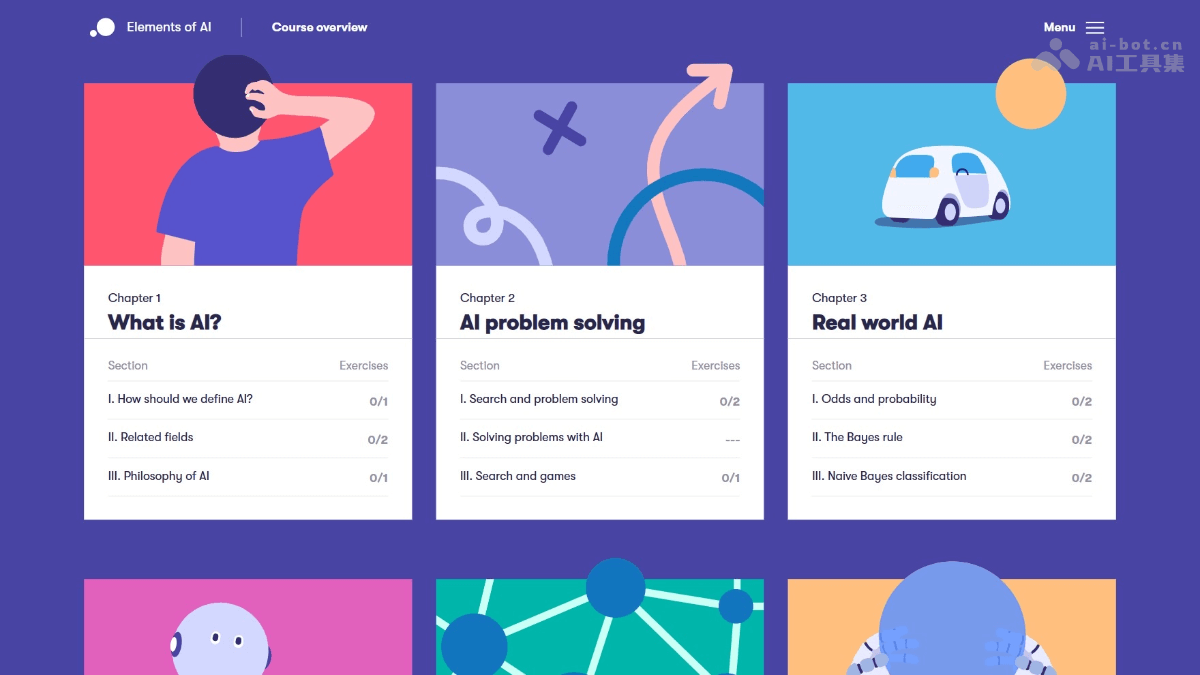
- What is AI?: Explores the definition and history of artificial intelligence, its relationship with other disciplines, and philosophical issues.
- AI problem solving: Introduces search algorithms, problem-solving methods, and their applications in games.
- Real world AI: Discusses the application of probability, Bayes' rule, and naive Bayes classifiers in practical problems.
- Machine learning: Introduces the types of machine learning (supervised learning, unsupervised learning, reinforcement learning) and their applications.
- Neural networks: Introduces the basics of neural networks, construction methods, and deep learning techniques.
- Implications: Explores the impact of artificial intelligence on society, the economy, and ethics, as well as its future trends.
- Building AI:
- Getting started with AI: Introduces the importance of artificial intelligence, optimization problems, and the hill-climbing algorithm.
- Dealing with uncertainty: Introduces the fundamentals of probability, Bayes' rule, and naive Bayes classifiers.
- Machine learning: Introduces linear regression, nearest neighbor methods, text processing, and the overfitting problem.
- Neural networks: Introduces logistic regression, the extension from logistic regression to neural networks, and deep learning.
- Conclusion: Summarize the course content, showcase students' artificial intelligence ideas, and provide a community exchange platform.
Application scenarios of Elements of AI
- Education sector: Provide foundational artificial intelligence knowledge for university students, working professionals, and online learners, helping with personal skill improvement and career development.
- Corporate training: Integrate into corporate LMS to help employees master artificial intelligence technology and promote enterprise digital transformation and cross-department collaboration.
- Government and public sector: Help policymakers and civil servants understand artificial intelligence, optimize public services, and increase public acceptance of artificial intelligence.
- People with non-technical backgrounds: Provide introductory knowledge for individuals without a technical background, supporting personal interest learning and career transition.
- Social and ethical discussion: Promote public discussion of artificial intelligence ethics, privacy, and social impact, and provide a research foundation for ethicists and legal experts.