
What is NLTK
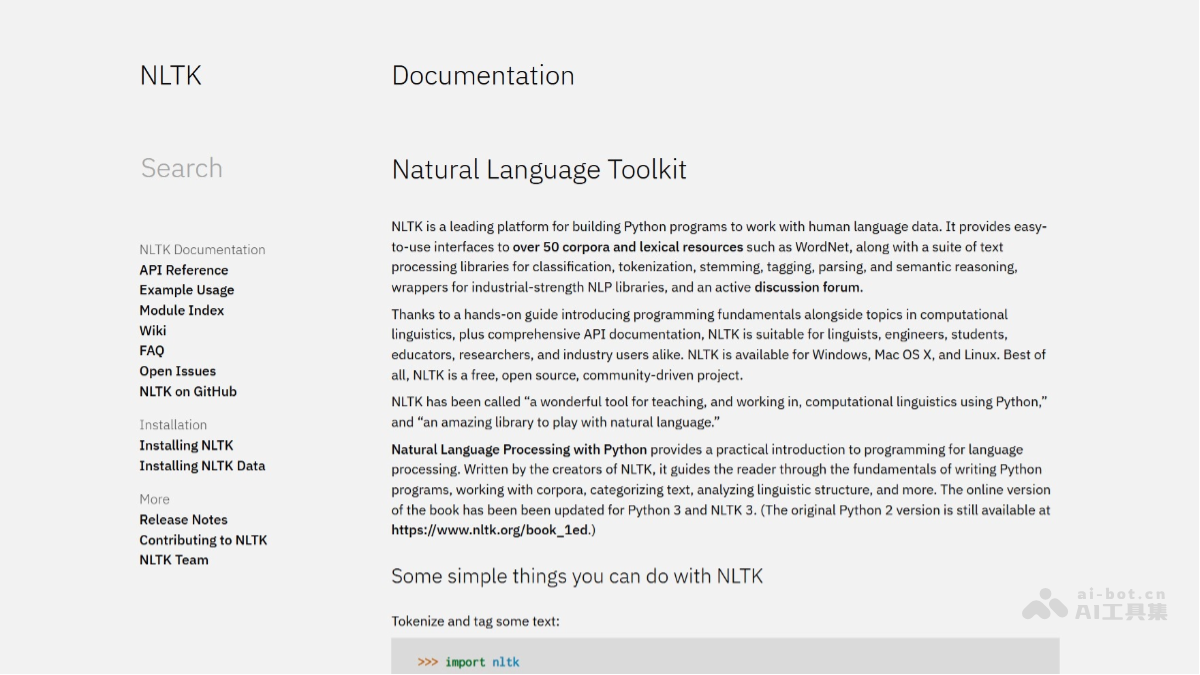
NLTK (Natural Language Toolkit) is an open-source set of Python modules, datasets, and tutorials specifically used for natural language processing (NLP). NLTK provides a rich set of tools and resources, including text tokenization, part-of-speech tagging, syntactic parsing, named entity recognition, and more. NLTK includes a large number of corpora and lexical resources, such as WordNet, making it convenient for users to conduct linguistic research and development. NLTK supports Python versions 3.7, 3.8, 3.9, 3.10, or 3.11, and is suitable for a variety of users from beginners to professionals, and is widely used in academic research, commercial applications, and education. NLTK has complete documentation and an active community, making it an excellent tool for learning and practicing natural language processing.
Main features of NLTK
-
Tokenization: Split text into words or sentences for subsequent processing.
-
Part-of-Speech Tagging: Tag words in text with their parts of speech, such as nouns, verbs, adjectives, etc.
-
Named Entity Recognition, NER: Identify named entities in text such as person names, place names, organization names, etc.
-
Stemming: Reduce words to their base form (stem) for unified processing.
-
Lemmatization: Reduce words to their dictionary form (lemma) for more accurate vocabulary processing.
-
Parsing: Generate syntax trees and analyze the grammatical structure of sentences.
-
Corpus access: Provide various corpora, such as the Brown Corpus, PENN Treebank, etc., for research and development.
-
Classifiers: Provide various classifiers, such as Naive Bayes classifiers, decision tree classifiers, etc., for text classification tasks.
-
Feature Extraction: Extract features from text for training machine learning models.
How to use NLTK
- Install NLTK: Run the following command in a terminal or command line:
pip install nltk- Verify installation: Run the following code in a Python environment:
import nltk
print(nltk.__version__)- Download the necessary data packages: Run the following code to download the basic data packages:
import nltk
nltk.download('punkt')  # 分词器
nltk.download('averaged_perceptron_tagger') # 词性标注器- Basic usage:
- Tokenization:
from nltk.tokenize import word_tokenize

text = "NLTK is a powerful library for natural language processing."
words = word_tokenize(text)
print("分词结果:", words)-
- Part-of-Speech Tagging:
from nltk import pos_tag

tagged_words = pos_tag(words)
print("词性标注结果:", tagged_words)
Application scenarios of NLTK
-
Text classification: Use NLTK classifiers to classify text, such as spam detection or document classification.
-
Sentiment analysis: Analyze the sentiment tendency in text to determine whether the text is positive, negative, or neutral, commonly used in social media monitoring and market research.
-
Machine translation: Assist in translating text between different languages through language models and syntactic parsing.
-
Question answering systems: Use NLTK's natural language processing capabilities to build systems that can understand and answer questions.
-
Text summarization: Extract key information from text and generate concise summaries to help quickly understand the text content.

