
What is SenseNova U1
SenseNova U1 is a natively unified multimodal model launched by SenseTime SenseNova based on the NEO-Unify architecture, achieving understanding, reasoning, and generation within a single architecture. The model abandons traditional visual encoders and VAEs and builds a unified representation space. The open-source Lite version includes an 8B-MoT dense model and an A3B-MoE model. It reaches open-source SOTA of the same scale on benchmarks such as image understanding, generation, editing, and visual reasoning. The 8B version is comparable to some commercial closed-source models, and its inference latency is significantly lower than similar competitors.
SenseNova U1 Infographic Enhanced Version V2 (SenseNova-U1-8B-MoT-Infographic-V2), based on the 8B-MoT architecture, achieves leapfrog breakthroughs on the basis of V1's accurate text, reliable charts, and stable backgrounds. Small text clarity is greatly improved, complex layouts are well-balanced in density, and the overall visual quality is on par with professional designers.
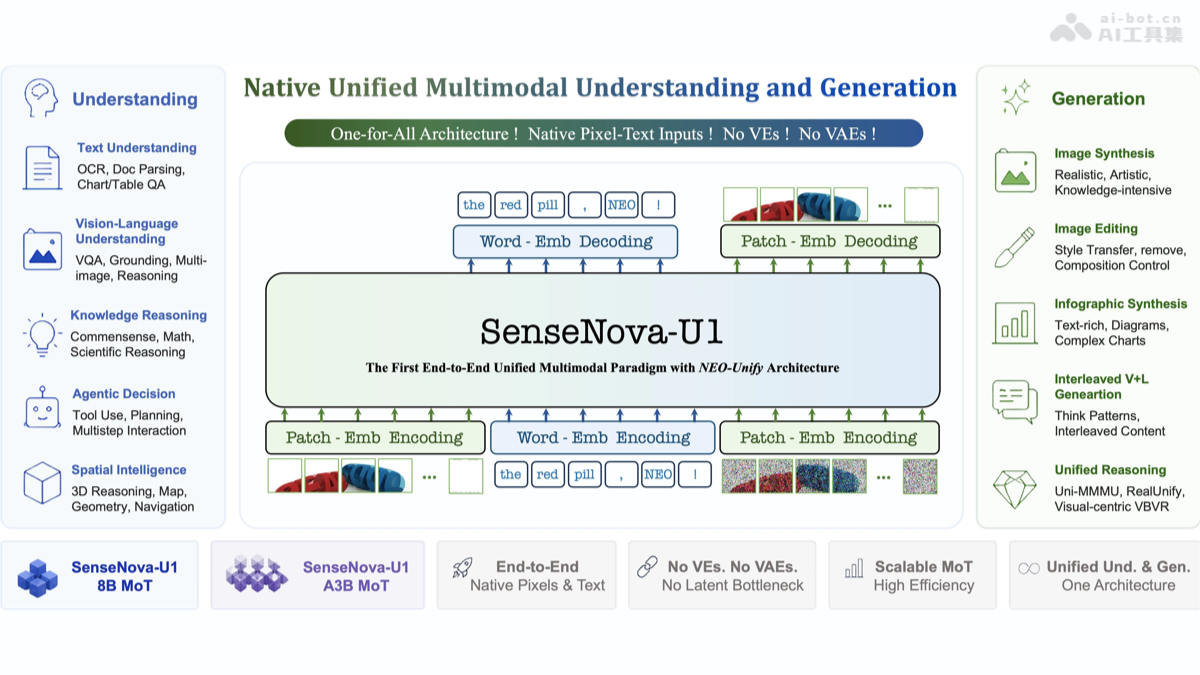
Main features of SenseNova U1
-
Multimodal understanding: Supports OCR, document parsing, chart question answering, visual question answering, and multi-image reasoning.
-
Image generation: Can generate realistic, artistic, and knowledge-intensive images, and supports complex infographic synthesis.
-
Image editing: Enables precise editing operations such as style transfer, object removal, and composition control.
-
Interleaved generation: Supports interleaved output of visual and language content, enabling mixed text-image creation.
-
Unified reasoning: Possesses cross-modal mathematical, commonsense, and scientific reasoning capabilities.
- V2 version:
- Small text clarity upgrade: Greatly improves the readability of tiny text in dense infographics, keeping small font sizes clear and sharp.
- Complex layout handling: Supports richer multi-column layouts, mixed text-image arrangements, and hierarchical structures, easily handling high-information-density layouts.
- Professional visual quality: The overall layout is well-balanced in density, and the color coordination and visual hierarchy are on par with professional designer standards.
- Stable rendering of long text: When processing longer text content, the correspondence between text and images is more stable, avoiding mismatches or omissions.
Technical principles of SenseNova U1
-
NEO-Unify native architecture: Starting from first principles, it completely removes the visual encoder and VAE, eliminating the latent space bottleneck.
-
Unified representation space: Pixel and text information are modeled end-to-end in the same space, avoiding inter-modal translation loss.
-
Native MoT mechanism: Adopts the Mixture of Tokens extended architecture to achieve efficient cross-modal computation and parameter utilization.
-
End-to-end training: Images and language are directly input as a unified composite, completing understanding and generation in the same computational process.
How to use SenseNova U1
-
Visit the repository: Visit the GitHub repository https://github.com/OpenSenseNova/SenseNova-U1 to browse the project documentation.
-
Download weights: Visit the HuggingFace model page https://huggingface.co/collections/sensenova/sensenova-u1 to download the corresponding model.
-
Configure the environment: Install dependencies according to the README and prepare a GPU inference environment.
-
Load the model: Load the SenseNova-U1-8B-MoT or A3B-MoT model locally.
-
Execute tasks: Input text or image prompts to run multimodal understanding, generation, or editing tasks.
Key information and usage requirements for SenseNova U1
-
Development team: SenseTime
-
Open-source license: Open source (available on GitHub / HuggingFace)
-
Model specifications: SenseNova-U1-8B-MoT (dense), SenseNova-U1-A3B-MoT (MoE)
-
Hardware requirements: GPU support required; refer to the official documentation for specific VRAM requirements
-
Usage threshold: Requires basic model deployment and inference environment configuration skills
Core advantages of SenseNova U1
-
Unified architecture: A single model covers both understanding and generation, with no need for multi-module assembly or adapter translation.
-
Outstanding efficiency: After removing VE/VAE, information flow is more direct, and inference latency is significantly lower than comparable open-source and commercial models.
-
Leading performance: The lightweight 8B version already reaches open-source SOTA at the same scale, rivaling some large commercial closed-source models.
-
Spatial intelligence: Excellent performance on complex spatial tasks such as 3D reasoning, geometric understanding, and navigation.
-
Infographic generation: The model has commercial-grade control and generation quality for complex layout and text rendering.
Project addresses for SenseNova U1
- GitHub repository:https://github.com/OpenSenseNova/SenseNova-U1
- HuggingFace model library:
- https://huggingface.co/collections/sensenova/sensenova-u1
- https://huggingface.co/sensenova/SenseNova-U1-8B-MoT-Infographic-V2
Comparison of SenseNova U1 with similar competitors
| Comparison dimension | SenseNova U1 | Qwen3VL | Janus |
|---|---|---|---|
| Development team | SenseTime | Alibaba Cloud | DeepSeek |
| Architecture features | NEO-Unify native unification, no VE/VAE | Vision encoder + LLM assembly | Decoupled visual encoding unified architecture |
| Model scale | 8B / A3B MoE | 8B / 30B-A3B MoE, etc. | 1.3B / 7B |
| Understanding capability | OCR/VQA/spatial reasoning/document parsing | Strong visual understanding, leading in OCR/VQA | Multimodal understanding and reasoning |
| Generation capability | Image generation + editing + infographics + interleaved generation | Mainly focused on understanding; generation requires a separate model | Image generation and editing |
| Open-source status | Open source (Lite version) | Open source | Open source |
Application scenarios of SenseNova U1
-
Intelligent document parsing: Automatically recognize and understand text, tables, and charts in scanned documents and PDFs to enable structured information extraction and question answering.
-
Marketing poster generation: Automatically generate high-quality e-commerce posters and infographics based on text descriptions, with precise control over layout and text rendering.
-
Precise image editing: Supports operations such as style transfer, object removal, and composition adjustment, enabling "what you think is what you get" image modification.
-
Multimodal content creation: Supports interleaved text-image generation, automatically producing long-form articles, tutorials, and social media content with mixed text and images.
-
Robotic embodied intelligence: As a robot's "brain", it completes environment perception, logical reasoning, and task execution within a single-model closed loop.