
What is Janus
Janus is an autoregressive framework introduced by DeepSeek AI, designed to unify multimodal understanding and generation tasks. It separates visual encoding into distinct pathways to address the limitations of previous methods and processes them with a single transformer architecture. It alleviates the role conflict of visual encoders in understanding and generation tasks, improving the framework's flexibility. Janus surpasses previous unified models in performance, and in some cases exceeds the performance of task-specific models. Janus's design supports the easy integration of more types of input modalities in the future, such as point clouds, EEG signals, or audio data, making Janus a strong candidate for the next generation of unified multimodal models.
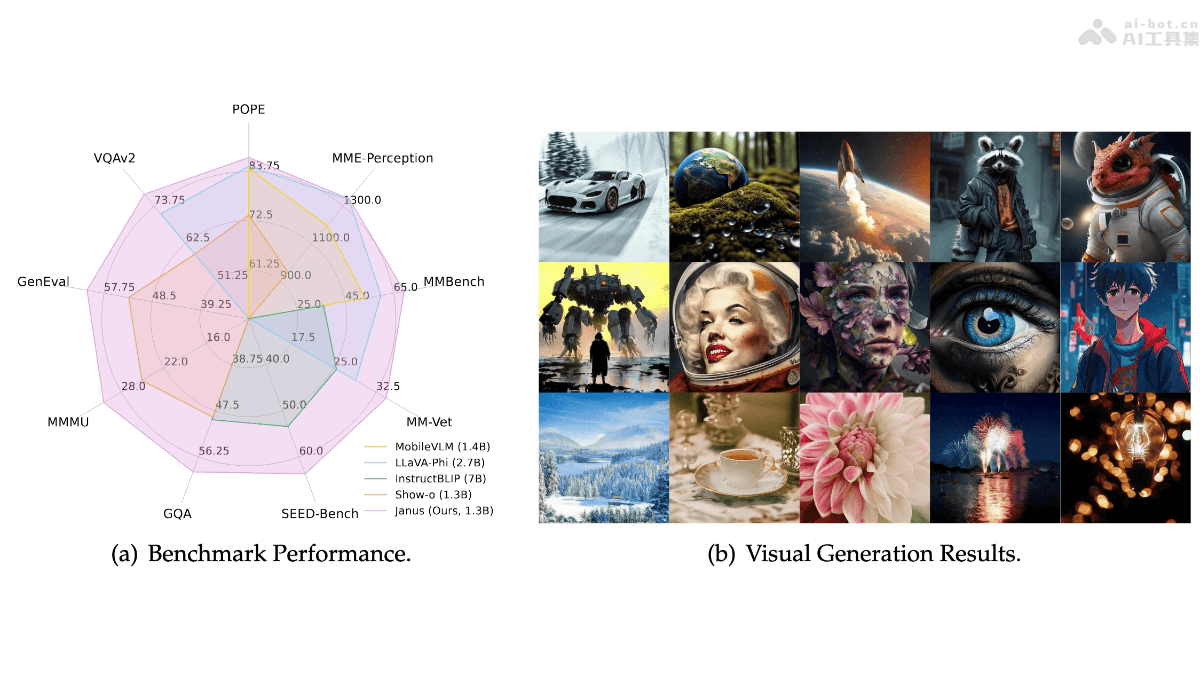
Janus's main features
- Multimodal understanding: Janus can process and understand information containing images and text, enabling large language models to understand image content.
- Image generation: Based on text descriptions, Janus can generate corresponding images, demonstrating creativity from text to image.
- Flexibility and extensibility: Janus's design supports independently selecting the most suitable encoding method for multimodal understanding and generation, and is easy to extend and integrate new input types, such as point clouds, EEG signals, or audio data.
Janus's technical principles
- Decoupling of visual encoding: Janus is based on setting up independent encoding pathways for multimodal understanding and generation tasks, resolving the conflict between the two tasks' different needs for visual information granularity.
- Unified Transformer architecture: Janus uses a single Transformer architecture to handle different encoding pathways, maintaining the model's unity and efficiency.
- Autoregressive framework: Janus is based on an autoregressive approach, gradually generating text or image data, offering flexibility and control in generation tasks.
- Multi-stage training: Janus's training is divided into multiple stages, including training of adapters and image heads, unified pretraining, and supervised fine-tuning, ensuring the model's performance on multimodal tasks.
- Cross-modal interaction: Janus can handle interactions between different modalities, such as converting text to images or extracting information from images to answer questions, achieving seamless conversion and understanding between different modalities.
Janus's project addresses
- GitHub repository:https://github.com/deepseek-ai/Janus
- HuggingFace model library:https://hf-mirror.com/deepseek-ai/Janus-1.3B
- arXiv technical paper:https://arxiv.org/pdf/2410.13848
Janus's application scenarios
- Image and video content creation: Janus generates images or videos based on text descriptions, which is very useful for fields such as digital art creation, game design, and film production.
- Automatic image annotation and organization: Janus can understand image content and generate descriptive tags, helping with image database management, search engine optimization, and content recommendation systems.
- Visual question answering (VQA): In fields such as education, e-commerce, or customer support, Janus answers image-related questions based on understanding image content.
- Assisted design and architectural planning: Janus can help designers generate visual prototypes of design concepts through text descriptions, accelerating the creative process.
- Augmented reality (AR) and virtual reality (VR): In AR/VR applications, Janus can generate or enhance visual effects in virtual environments.