
What is SeFi-Image
SeFi-Image is a text-to-image model based on semantics-first diffusion, available in three specifications: 1B, 2B, and 5B. The model separates high-level semantic structure from texture details, allowing the semantic stream to denoise ahead of time and provide clear structural anchors for texture generation. The 5B model was trained with 125K A800 GPU hours and performs strongly on benchmarks such as GenEval, LongTextBench, CVTG-2K, and OneIG, supporting scene synthesis, rich text layout, anime characters, style diversity, and portrait generation.
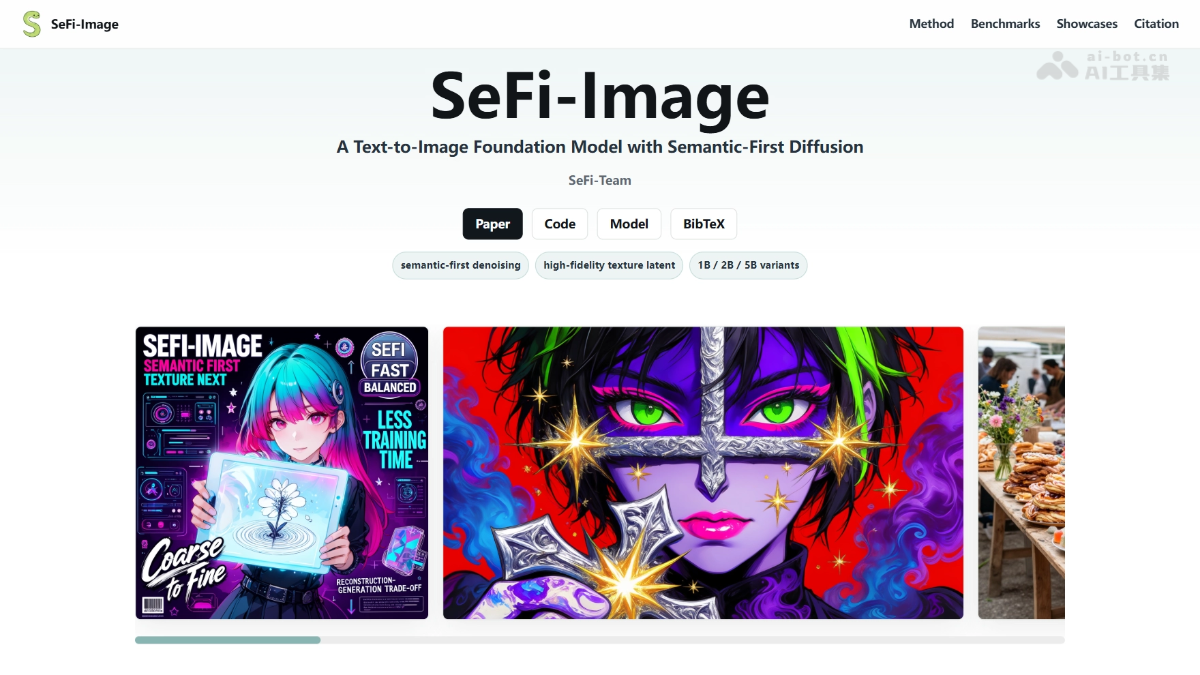
Main Features of SeFi-Image
-
Text-to-Image Generation: Generates high-quality images based on text prompts, supporting natural language descriptions.
-
Multi-Specification Models: Offers three parameter scales—1B, 2B, and 5B—to accommodate different computing power requirements.
-
Semantics-First Diffusion: Separates semantic structure from texture details to achieve clearer geometry and composition control.
-
Multi-Domain Support: Covers scene synthesis, rich text layout, anime characters, stylized art, and portrait generation.
-
Long Text Rendering: Supports long Chinese and English text prompts and leads on LongTextBench.
Technical Principles of SeFi-Image
-
Semantic-Texture Decoupled Architecture: SeFi-Image adopts a semantics-first diffusion architecture, splitting the image generation process into two independent denoising trajectories: the semantic stream and the texture stream.
-
Temporal Offset Mechanism: The model introduces a temporal offset mechanism that allows the semantic stream to begin denoising one time step earlier, providing clear structural anchors for texture generation.
-
Three-Stage Generation Process: The entire generation process is divided into three stages: the first stage performs semantic initialization, the second stage achieves asynchronous joint denoising of semantics and texture, and the third stage completes fine refinement and completion of the texture.
-
Reconstruction-Generation Balance: The architecture improves texture reconstruction fidelity while increasing the training difficulty of the diffusion model, achieving an effective balance between reconstruction and generation.

Follow on WeChat and reply with “Open Source” to join theAI Open Source Project Communication Group
How to Use SeFi-Image
-
Obtain Resources: Visit the SeFi-Image official website or arXiv page to download the paper, open-source code, and model weight files for the corresponding specification.
-
Configure the Environment: Install deep learning dependencies such as PyTorch on a local server or workstation, and prepare GPU memory resources matching the model scale.
-
Load the Model: Load the downloaded 1B, 2B, or 5B model checkpoint into the inference framework, completing weight initialization and parameter settings.
-
Input Prompts: Write Chinese or English text prompts containing scene descriptions, style requirements, or text content, supporting long text and complex compositional descriptions.
-
Execute Generation: Run the semantics-first diffusion sampling process. The model will first complete semantic structure denoising, then generate texture details based on the semantic anchors.
-
Output Images: Convert the final denoised latent variables into pixel images through the decoder, and save them as output files in the required resolution and format.
Core Advantages of SeFi-Image
-
Precise Structural Control: The semantics-first mechanism enables the model to achieve more precise structural control over complex spatial compositions and text layouts.
-
Low training cost: The 5B parameter model is trained using only 125K A800 GPU hours, achieving first-tier generation performance at a lower compute cost.
-
Leading in long text: In long-text rendering evaluations, SeFi-Image scores 0.978 on LongTextBench, significantly ahead of comparable competitors.
-
Accurate visual text: The model achieves 0.895 accuracy in the CVTG-2K character-level visual text generation test, and the generated posters and labels are highly readable.
-
First across multiple benchmarks: SeFi-Image ranks first on multiple authoritative benchmarks such as GenEval and OneIG-EN, demonstrating comprehensive generation capabilities.
SeFi-Image project address
- Project website:https://jmliu206.github.io/sefi-web/
- GitHub repository:https://github.com/jmliu206/SeFi-Image
- HuggingFace model library:https://huggingface.co/SeFi-Image
- arXiv technical paper:https://arxiv.org/pdf/2606.22568
Comparison of SeFi-Image with comparable competitors
| Comparison dimension | SeFi-Image-5B | Qwen-Image |
|---|---|---|
| Architecture features | Semantics-first diffusion, decoupling the semantic stream and texture stream, introducing a temporal offset mechanism | Conventional diffusion or autoregressive architecture, with no explicit adoption of a semantic-texture separation mechanism |
| GenEval | 0.88(First) | 0.87 |
| LongTextBench | 0.978(First) | 0.945 |
| CVTG-2K | 0.895(First) | 0.829 |
| DPG-Bench | 87.27 | 88.32(First) |
| OneIG-EN | 0.5606(First) | 0.5390 |
| OneIG-ZH | 0.5379 | 0.5480(First) |
SeFi-Image application scenarios
-
Advertising poster design: In the field of advertising and poster design, SeFi-Image can generate brand posters, product menus, and product labels containing clear and readable text.
-
Anime character creation: For anime and character creation, the model supports generating anime characters, fantasy scenes, and various composition forms such as full-body or close-up.
-
Natural scene generation: In natural scene and landscape generation, SeFi-Image can create images of weather, cities, animals, and landscapes with free aspect ratios.
-
Artistic style creation: The model supports various artistic styles such as illustration, ink painting, plush toys, stickers, and sketches, making it suitable for stylized visual content creation.
-
Portrait photography assistance: In portrait and photography assistance scenarios, SeFi-Image can generate portraits and environmental portraits with diverse lighting, poses, and materials.