
What is Seed3D 2.0
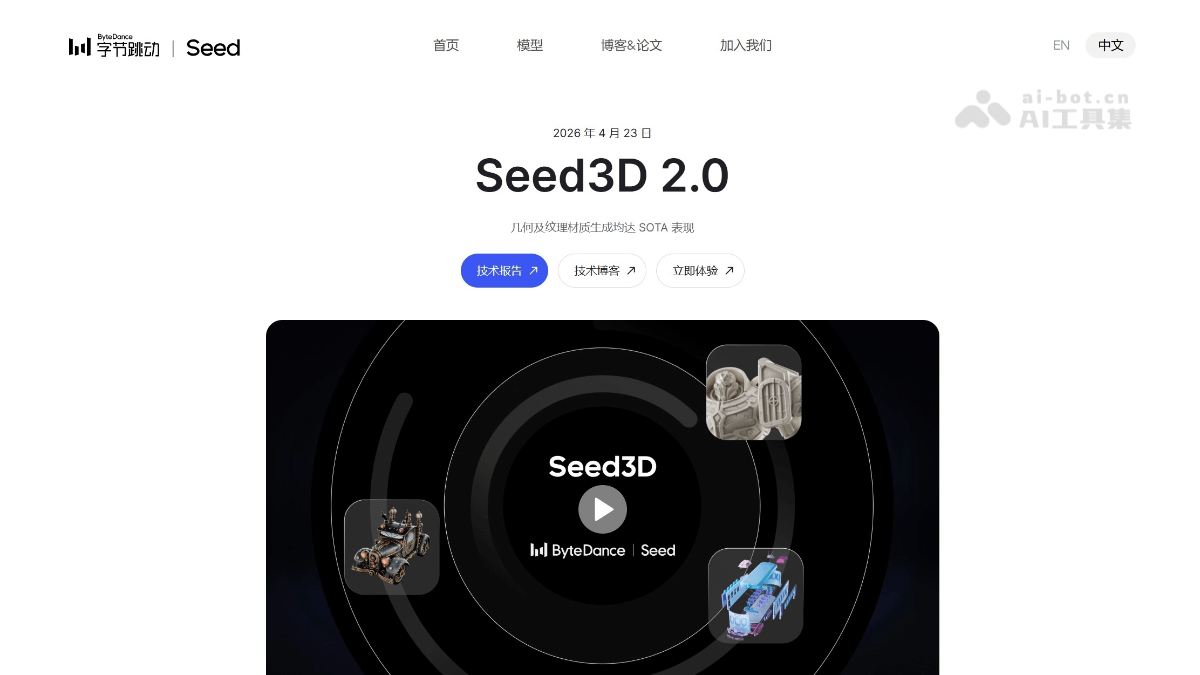
Seed3D 2.0 is a new generation 3D generation large model launched by ByteDance. It has undergone systematic architectural upgrades around geometric precision and texture material quality, driving 3D generation from "usable" to "production-ready." The model adopts a MoE architecture and a Coarse-to-Fine two-stage generation strategy, achieving industry-leading SOTA levels on both core metrics: geometry generation and PBR texture material generation. Users only need to input a single image to generate 3D assets with precise structure and realistic materials. It supports part-level segmentation, articulated asset generation, and multimodal scene composition. The output results can seamlessly connect with mainstream physics simulation engines such as Isaac Sim, and are widely used in fields such as gaming, embodied intelligence, industrial simulation, and digital content production.
Main Features of Seed3D 2.0
-
High-Precision Geometry Generation: Adopts a Coarse-to-Fine two-stage generation strategy, decoupling and optimizing the overall structure and local details, accurately reproducing sharp edges, thin-wall structures, complex topology, and hollowed-out details, effectively avoiding noise, broken faces, and blurred chamfers common in traditional 3D generation.
-
Realistic PBR Material Generation: A unified PBR generation model jointly models complete PBR maps (including parameters such as metallicness and roughness), supports multi-level, multi-type complex material combinations such as metal, plastic, ceramic, and fabric, and maintains physically consistent visual performance under different lighting conditions.
-
High-Definition Restoration of Text and Symbols: Significantly improves text clarity in scenarios such as product nameplates, packaging, logos, and labels, reducing blurriness, distortion, and garbled characters to meet commercial-grade display requirements.
-
Part-Level Segmentation and Articulated Asset Generation: Supports splitting complete 3D assets into independent parts by function and automatically adding joint information, adapting to multi-degree-of-freedom physical movements such as hinge rotation, drawer pushing and pulling, and robot joints.
-
Multimodal Scene Composition Generation: Supports 3D scene composition generation based on a single image, video sequence, or text description, flexibly expanding the ways of creative input.
-
Physics Simulation Engine Compatibility: The generated 3D assets, after processing, can be directly compatible with mainstream physics simulation engines such as Isaac Sim, and used for simulation training tasks such as robotic grasping and dynamic interaction.
-
MoE Architecture for Efficient Inference: Based on a sparse expert routing (Mixture of Experts) architecture, it controls inference computation while expanding model parameter count and resolution, achieving a balance between high-resolution material details and precise boundaries.
-
VLM Prior-Enhanced Material Decomposition: Introduces visual language model (VLM) prior knowledge to enhance the stability and accuracy of material decomposition under unknown lighting conditions, improving material restoration quality in complex scenes.
How to Use Seed3D 2.0
-
Visit the Volcano Engine Platform: Go to the Volcano Engine official website (Volcano Ark), and register or log in to a personal/enterprise account.
-
Locate the Model Entry: In the console, select "Vision Models" → "3D Generation" → "Doubao" → "Seed3D 2.0" to enter the model experience page.
-
Select Input Modality: Choose the input method according to creative needs. It supports a single image, video sequence, or text description as generation conditions.
-
Upload Material or Enter Description: Upload a reference image/video, or enter a detailed text prompt describing the geometric structure and material characteristics of the target 3D asset.
-
Configure generation parameters(optional): Adjust generation settings as needed, such as part-level segmentation, articulated joint definition, material complexity, and other advanced options.
-
Initiate the generation task: After submission, wait for the model to complete the two-stage Coarse-to-Fine generation and obtain a 3D geometric model with complete PBR textures.
-
Preview and download assets: Preview the generated 3D model online, and after confirming the geometric precision and material appearance, download the 3D file in standard format and the texture resources.
-
Integrate into the production pipeline: Import the exported 3D assets into DCC tools such as Blender and Maya, or directly connect them to physics simulation engines such as Isaac Sim for subsequent editing and dynamic interaction training.
Seed3D 2.0the official website address
- Project official website:https://seed.bytedance.com/zh/seed3d_2_0
Technical Principles of Seed3D 2.0
-
MoE sparse expert routing architecture: It adopts a Mixture of Experts architecture. Through a sparse activation mechanism, it effectively controls the computational overhead in the inference stage while expanding the model parameter count and generation resolution, achieving a balance between high-resolution material details and precise geometric boundaries.
-
Coarse-to-Fine two-stage generation strategy: It decouples overall structure modeling from local geometric detail optimization, first performing coarse-grained overall structure generation and then fine-grained geometric detail optimization, accurately restoring sharp edges, thin-walled structures, and complex topologies, and avoiding noise and bad faces.
-
Unified PBR material joint modeling: It builds an end-to-end PBR generation model that jointly models complete physically based rendering textures (including parameters such as metalness, roughness, and normals), supports multi-level and multi-type complex material combinations, and ensures physical consistency under different lighting conditions.
-
VLM prior-enhanced material decomposition: It introduces prior knowledge from a Visual Language Model to enhance the stability and accuracy of material decomposition under unknown lighting and complex environmental conditions, improving the ability to distinguish physical properties such as metal, plastic, ceramic, and fabric.
-
Part-level semantic segmentation and joint binding: Based on functional semantics, it automatically splits a complete 3D asset into independent parts and automatically infers and adds joint information, supporting multi-degree-of-freedom physical motion definitions such as hinge rotation, drawer push-pull, and robot joints.
Key information and usage requirements for Seed3D 2.0
-
Product name:Seed3D 2.0。
-
Developer: ByteDance Seed team.
-
Release date: April 23, 2026.
-
Technical report: Already publicly available.
-
API service: Already launched on Volcano Engine (Volcano Ark) — after logging in, select "Visual Models → 3D Generation → Doubao → Seed3D 2.0" to try it.
-
Input method: Supports multimodal inputs such as images, videos, and text.
-
Output format: Complete 3D geometric model + PBR material textures, supporting part segmentation and joint binding.
-
Applicable scenarios: Game asset production, embodied intelligence training, simulation environment construction, industrial digital twins, e-commerce 3D displays, etc.
Core advantages of Seed3D 2.0
-
Dual SOTA evaluation results: Achieves industry-leading SOTA (state-of-the-art) results on both core tasks: geometry generation and end-to-end asset generation with materials.
-
Leading in professional blind evaluation: 60 human raters with 3D modeling experience participated in a Pairwise Comparison blind test. The geometry generation preference rate is significantly better than all comparison models; the preference rate for textured 3D content generation reaches over 69%.
-
Efficient inference with MoE architecture: Through sparse expert routing, it controls inference computation while expanding model parameters and resolution, achieving a balance between high-resolution material details and precise boundaries.
-
VLM prior-enhanced material decomposition: Introduces vision-language model (VLM) priors to enhance the stability and accuracy of material decomposition under unknown lighting conditions.
-
Production-grade usability: Outputs complete PBR textures; assets maintain physically consistent visual performance under different lighting conditions and can be directly integrated into standard rendering pipelines and production workflows.
Seed3D 2.0comparison with similar competing products
| Comparison dimension | Seed3D 2.0 | Tripo 3D | Hunyuan 3D |
|---|---|---|---|
| Core positioning | High-precision 3D asset generation, excellent in both geometry and materials | 3D asset generation, excellent geometry generation performance | 3D asset generation, excellent texture generation performance |
| Geometry generation | Coarse-to-Fine two-stage strategy, SOTA level, accurately reproduces sharp edges, thin-wall structures, and complex topology | Excellent geometry generation performance, good overall structure reproduction | Average geometry generation capability, relatively weak reproduction of complex topology and thin-wall structures |
| PBR material generation | Unified PBR joint modeling, supports multi-level complex material combinations such as metal, plastic, ceramic, and fabric | Average material generation capability, moderate physical consistency | Excellent texture generation performance, strong visual realism |
| Text/symbol reproduction | Significantly improves the clarity of product nameplates, logos, and labels, commercially usable | No explicit support for high-precision text reproduction | No explicit support for high-precision text reproduction |
| Part-level segmentation | Supports automatic splitting into independent parts by functional semantics and automatically adds joint information | No explicit support for part-level segmentation and joint binding | No explicit support for part-level segmentation and joint binding |
| Multimodal input | Supports three modal inputs: image, video, and text | Mainly image input | Mainly image input |
| Physics simulation compatibility | Generated assets can seamlessly connect to mainstream physics simulation engines such as Isaac Sim | No explicit mention of native compatibility with physics simulation engines | No explicit mention of native compatibility with physics simulation engines |
| Blind test preference rate | Dual SOTA in geometry and asset generation with materials; preference rate for textured 3D content over 69% | Excellent performance in geometry generation alone; overall preference rate lower than Seed3D 2.0 | Excellent performance in texture generation alone; overall preference rate lower than Seed3D 2.0 |
| API service status | Now available on Volcano Engine (Volcano Ark), can be called directly | Commercially available, providing API services | Commercially available, providing API services |
Application scenarios of Seed3D 2.0
-
Game and film production: Quickly generate high-precision character, prop, and scene assets, shortening the 3D modeling cycle.
-
Embodied intelligence and robot training: Generate articulated assets with physical properties for robot grasping and interaction training in simulation environments such as Isaac Sim.
-
Industrial design and digital twins: Infer complete 3D structures from schematics, reconstructing complex mechanical structures such as industrial equipment and conveyor belts.
-
E-commerce and marketing: Generate product 3D models with high-definition text and logos, supporting realistic display with multiple materials.
-
Virtual reality and the metaverse: Build physically consistent, interactive 3D scenes and assets.