
What is Sage
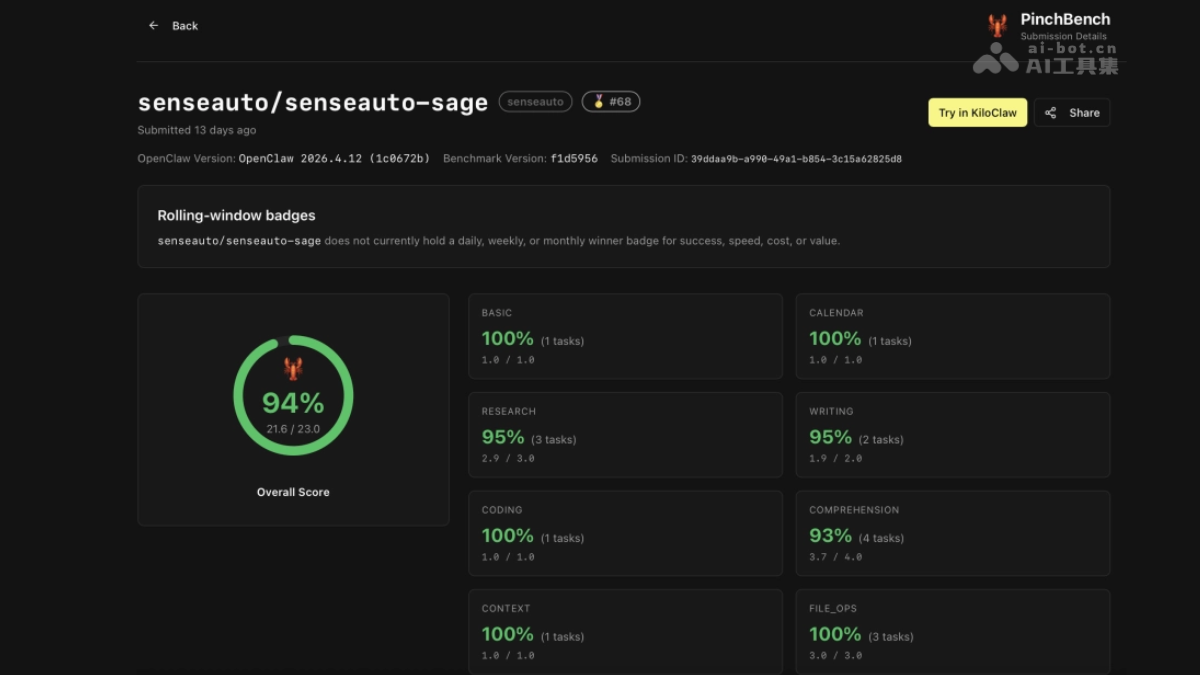
Sage is an on-device multimodal agent foundation large model launched by SenseAuto, adopting a MoE architecture with 32B total parameters and only 3B activated parameters. The model has been deployed on the NVIDIA Orin X platform. On the PinchBench evaluation, it achieves a 94% task completion rate, surpassingClaude-Opus-4.6、GPT-5.4and other cloud-based flagships. Sage incorporates two post-training technologies, SCOUT and ERL, supporting composite instruction parsing, multi-system linkage, and proactive perception, providing cloud-level Agent capabilities for intelligent cockpits.
Sage's main features
- Composite instruction parsing: Supports one-time parsing of users' multi-intent composite instructions, automatically linking in-vehicle systems such as air conditioning, navigation, and audio-visual to complete the task loop.
- Proactive perception services: Combines sensors to perceive occupant status and road conditions in real time, proactively triggering scenario-based services such as child mode and route adjustment.
- Multimodal cockpit understanding: Leveraging native in-vehicle data, it achieves cockpit semantic and visual understanding, accurately identifying the in-cabin environment and user needs.
- Tool calling and task loop closure: Supports long-chain tool calling and multi-step reasoning, achieving 80 points on the τ2-bench benchmark, with genuine agent execution capabilities.
- On-device real-time response: On the Orin X platform, first-token response is about 0.5 seconds, single-token latency is 0.03 seconds, and generation throughput is 80 tk/s, without relying on the cloud.
Sage's technical principles
- MoE sparse activation architecture: 32B total parameters with only 3B activated parameters, achieving efficient inference under limited on-device compute through a sparse activation mechanism.
- SCOUT hierarchical collaborative learning: Adopts a hierarchical collaboration mechanism of "small model scouts ahead, large model absorbs," saving about 60% of GPU hours in complex task training.
- ERL erasable reinforcement learning: The model automatically identifies erroneous steps in the reasoning chain and erases and regenerates them, blocking the spread of bias and increasing the completion rate of complex tasks by 20%.
- Integrated multimodal architecture: An native training system that integrates visual, language, and sensor data, building differentiated understanding capabilities for in-vehicle scenarios.
How to use Sage
The model has now been deployed on the NVIDIA Orin X on-device platform.
Sage's key information and usage requirements
- Model architecture: MoE architecture, 32B total parameters, 3B activated parameters.
- Deployment platform: Already deployed on the NVIDIA Orin X on-device platform.
- Evaluation results: PinchBench best task completion rate 94%, surpassing mainstream models such as Claude-Opus-4.6 and GPT-5.4.
- Hardware product: SageBox, equipped with Sage, was launched during the Beijing Auto Show.
- Target users: Mainly aimed at automakers, Tier 1 suppliers, and on-device agent developers.
- Network requirements: On-device deployment, able to run without relying on a cloud network connection.
- Framework compatibility: Supports integration with mainstream Agent frameworks such as OpenClaw and Hermes.
Sage's core advantages
- Leading on-device performance: With 3B activated parameters, it achieves a 94% task completion rate on PinchBench, surpassing many large-parameter cloud flagship models.
- Ultimate efficiency ratio: Compared with MiMo-v2-Pro (42B activated), Sage's activated compute is only 1/14 of it, memory usage is about 1/31, and performance is 6.6 percentage points higher.
- Training cost optimization: SCOUT technology saves about 60% of GPU hours for complex task training, reducing model post-training costs.
- Inference error correction capability: ERL technology enables automatic identification and erasure of erroneous steps during inference, blocking task failure at the source.
- Native in-vehicle data advantage: Scored 91.5 on the Human Semantic Understanding test, leading peer on-device models by 32%, with deep understanding of cabin scenarios.
- Mass production feasibility: Verified and deployed on the Orin X platform, meeting automotive-grade mass production conditions.
Comparison of Sage with similar competitors
| Comparison dimension | Sage | Google Gemma 4 | MiMo-v2-Pro |
|---|---|---|---|
| Publisher | SenseAuto | Xiaomi | |
| Total parameter count | 32B | Same-tier on-device | Over 1T |
| Activated parameter count | 3B | Not disclosed | 42B |
| PinchBench completion rate | 94% | 83.9% | 87.4% |
| MMLU Pro | 75.8 | 69.2 | – |
| GPQA Diamond | 77.3 | 58.5 | – |
| τ2-bench | 80.7 | 42.1 | – |
| Human Semantic Understanding | 91.5 | 69.5 | – |
| Deployment platform | NVIDIA Orin X | On-device | On-device |
| Core positioning | On-device agent foundation | On-device general model | On-device reasoning model |
Sage's application scenarios
- Smart cockpit interaction: Users issue compound commands in natural language, and Sage parses them in one pass and coordinates multiple in-vehicle systems such as air conditioning, navigation, and music to complete the service loop.
- Child safety protection: When rear-seat sensors detect a child riding, Sage proactively triggers child mode, automatically locks the windows, switches to age-appropriate content, and limits the volume.
- Smart travel planning: Combining real-time traffic conditions with user needs, Sage proactively recommends the optimal route and provides alternatives during congestion, realizing the shift from passive response to proactive service.
- Cockpit-driving integrated service: As the core AI support for the cockpit-driving fusion solution, Sage connects cockpit interaction and driving perception, providing full-scenario agent services.