
What is S2V-01
S2V-01 is MiniMax's latest self-developed video model and an important innovative achievement in multimodal generation technology. Through a single-image subject reference architecture, the model requires only one image input from the user and can achieve precise restoration of visual details at extremely low input and computational cost, while also offering high degrees of freedom and composability. User waiting time is greatly reduced, achieving a highly usable effect. The S2V-01 model can accurately recognize different facial features in photos such as gender, age, skin tone, and facial structure. The generated character is stable and coherent, and character consistency can be maintained in every frame. Users canHailuo AISelect the "Subject Reference" feature to experience it.
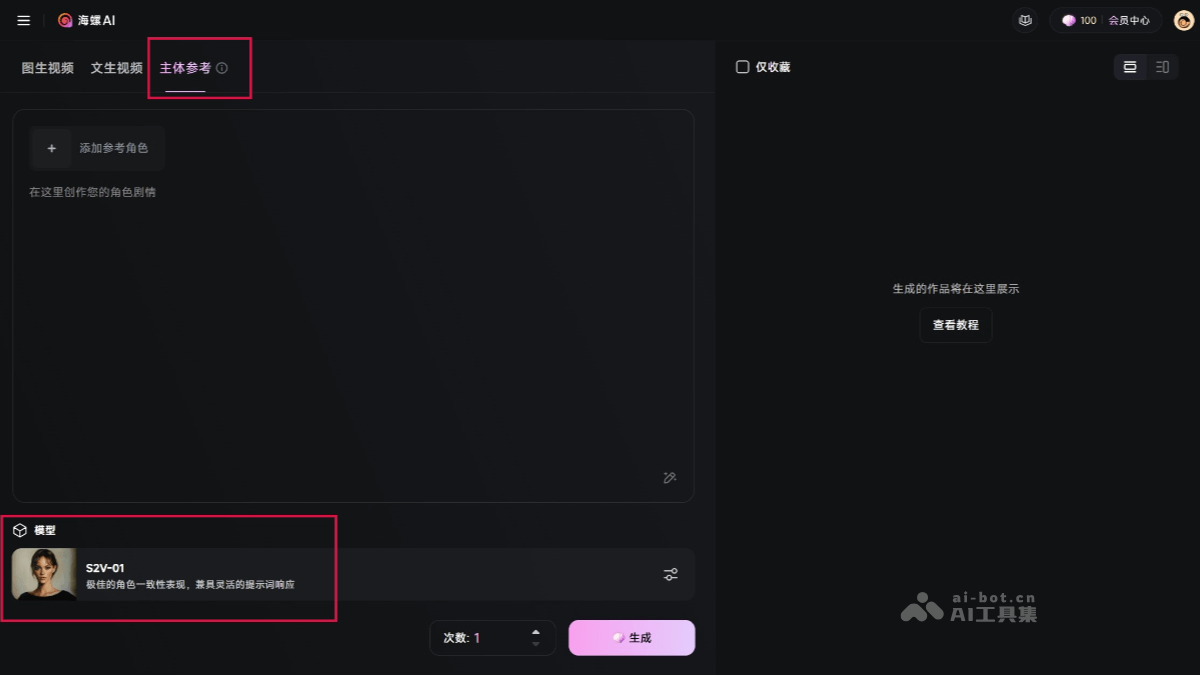
Main features of S2V-01
- Single-image subject reference: Users only need to upload one image, and the model can accurately identify and lock onto the subject character in the image, using it as the core character for video generation.
- Precise restoration of visual details: The model can highly restore the visual details of the subject in the reference image, including facial features such as gender, age, skin tone, and facial structure, ensuring that the character in the generated video is highly similar in appearance to the original image.
- High degrees of freedom and composability: In addition to the subject's facial features, other dimensions such as pose, expression, environment, and action have a very high degree of freedom and can be flexibly controlled and combined through text prompts.
- Fast generation and efficient experience: Compared with traditional solutions, the S2V-01 model greatly reduces input and computational costs. Users do not need to wait for a long time and can quickly generate high-quality video content.
- Feature expansion: Currently supports reference to a single person. In the future, it will expand to richer reference capabilities such as multiple people, objects, and scenes, further unleashing creativity.
- Generation results: Supports generating 720p resolution, 25fps high-definition video, with a cinematic camera movement effect, and can quickly create visually impactful content based on text descriptions.
Technical principles of S2V-01
- Single-image subject reference architecture
- Simplified input: The S2V-01 model adopts a single-image subject reference architecture and only requires the user to input one image as a reference. This simplifies the user's input cost and avoids complex multi-image input or additional training steps.
- Feature extraction: Through advanced image processing technology, the model extracts detailed features of the subject from the input single image, including facial features, body structure, and so on. These features are encoded into a format that the model can understand and process, providing the foundation for subsequent video generation.
- Mixture-of-Experts (MoE) architecture
- Division of labor among experts: The S2V-01 model may adopt a Mixture-of-Experts (MoE) architecture. In this architecture, multiple expert networks handle different tasks separately, such as subject feature recognition, background generation, and action prediction. Each expert network focuses on a specific subtask, improving the overall efficiency and accuracy of the model.
- Gating mechanism: Through the gating mechanism, the expert network most suitable for processing the current input is dynamically selected. Computing resources can be flexibly allocated according to the characteristics of the input image and text prompt, ensuring that each part can be processed optimally.
- Linear attention mechanism
- Efficient computation: The model adopts a linear attention mechanism. Compared with the traditional self-attention mechanism, linear attention is more efficient when processing long sequence data. This enables the model to quickly process each frame in the video while maintaining consistency and coherence of the subject's features.
- Reduced complexity: The linear attention mechanism reduces the complexity of video generation by decreasing computational load and memory requirements. This not only speeds up generation but also improves the model's scalability, enabling it to handle videos with higher resolution and higher frame rates.
- Accurate restoration of visual details
- Feature matching: Through complex feature matching algorithms, the model ensures that the subject in the generated video is highly consistent with the input image in visual details. This includes the accurate restoration of details such as facial features, skin tone, and facial structure.
- Style transfer: While preserving the subject's features, the model can also perform style transfer based on text prompts, placing the subject in different scenes and environments while maintaining natural and harmonious lighting and background effects.
- High flexibility and composability
- Text control: Users can flexibly control various elements in the generated video through text prompts, such as the subject's pose, expression, actions, scene, etc. The model generates the corresponding video content based on the text prompts, enabling highly flexible creation.
- Compositional generation: The model supports the compositional generation of multiple elements, allowing free combination of different subjects, scenes, actions, etc., to create rich and diverse video content. This composability provides creators with great creative space and can meet various complex creative needs.
- Optimized data construction and training strategies
- Data augmentation: During training, the model adopts various data augmentation techniques, such as random cropping, rotation, color adjustment, etc., to increase the diversity and robustness of the training data.
- Regularization techniques: Through regularization techniques such as weight decay and dropout, the model is prevented from overfitting and its generalization ability is improved.
- Multi-task learning: The model may adopt a multi-task learning strategy, simultaneously optimizing multiple tasks such as subject recognition, background generation, and action prediction, making the model's performance in all aspects more balanced and excellent.
How to use S2V-01
- Visit the creation platform:Hailuo AI Video Creation Platform
- Select the "Subject Reference" feature: Click the "Subject Reference" button.
- Upload a reference image: Choose an image containing the subject you want to generate a video for. This image can be a person, an animal, or any other object you want to use as the video subject. Make sure the subject in the image is clearly visible and the facial features are distinct, so that the model can accurately recognize and extract features.
- Enter a Prompt: Enter a detailed Prompt in the text box to describe the video content you want to generate. The Prompt can include the scene, actions, expressions, other details, etc.
- Generate the video: Click the generate button and wait for the video to be generated.
- View and download the video: After the video is generated, view the result and download the video.
Application scenarios of S2V-01
- Short video creation: Creators can quickly generate high-quality short video content for social media platforms such as Douyin, Kuaishou, Bilibili, etc. For example, turning a static photo into a dynamic short video to increase the appeal of the content.
- Advertising Production: Advertising agencies can use the S2V-01 model to generate personalized advertising videos, quickly generating a variety of creative videos based on different products and target audiences, improving the appeal and传播 effect of advertisements.
- Game Development: Game developers can use the S2V-01 model to generate character animations in games. By uploading character design drawings, they can generate dynamic animation clips, enriching the visual effects of the game.
- Online Courses: Educational institutions can use the S2V-01 model to generate teaching videos, turning static teaching images into dynamic video content, improving students' learning interest and participation.
- Animation Production: Animation designers can use the S2V-01 model to generate animation clips. By uploading character design drawings and scene descriptions, they can generate high-quality animation content, improving creative efficiency.
- Digital Art: Artists can use this model to generate digital art works. By uploading photos of art works and creative descriptions, they can generate dynamic digital art videos, showcasing the dynamic effects of the art works.