
What is Rome
Rome is an open-source Agentic OS. The tool lets AI develop apps for users: describe your needs in natural language, and the Agent automatically generates an App with an interface, data, and backend logic that can run long-term after installation. Apps recursively evolve based on usage feedback, getting smoother the more you use them. Rome is compatible with mainstream models such as Claude and Codex, supports local Docker deployment and cloud use, and can connect to platforms such as WeChat, Feishu, and Discord.
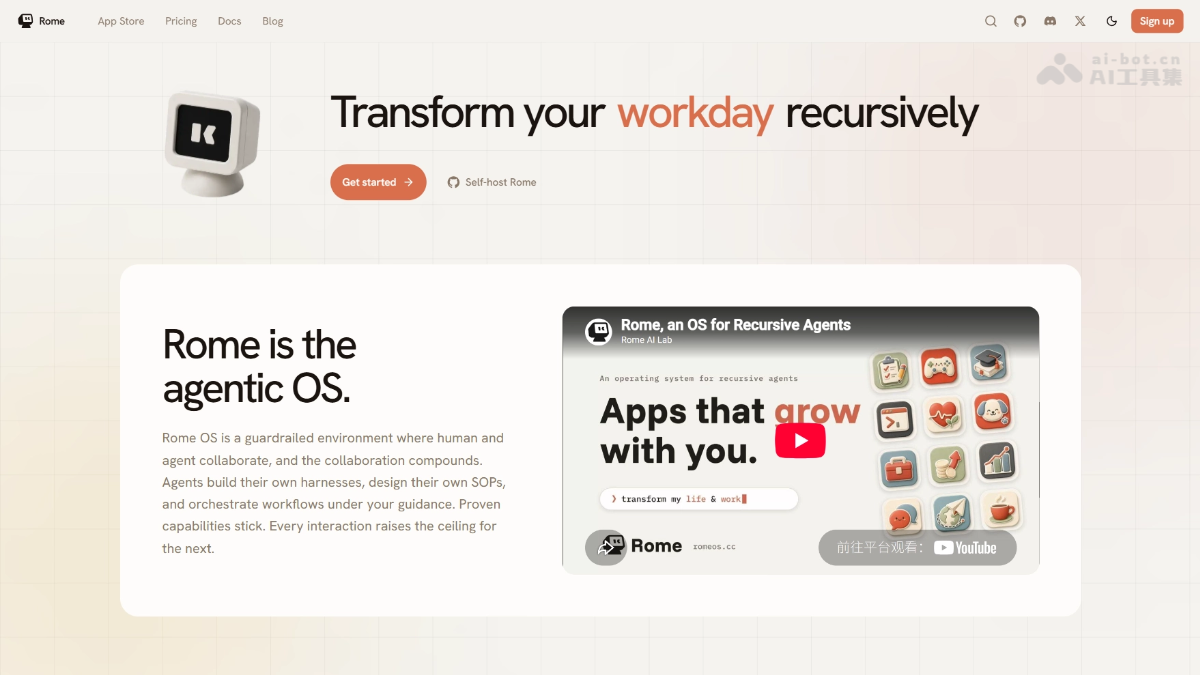
Rome's main features
-
AI autonomous app development: Describe your needs in natural language, and the Agent automatically generates a complete App with an interface, data structures, and backend logic.
-
Recursive app evolution: After an app runs, it continuously modifies itself based on feedback, making your personal environment smoother the more you use it.
-
App Store: Includes 80+ community apps, and supports installing, sharing, and publishing apps you create yourself.
-
Multi-platform message integration: Connect WeChat, Feishu, Telegram, Discord, email, and more, turning messages directly into task entry points.
-
Model-agnostic compatibility: Not tied to a single model; can connect to AI subscriptions users already have, such as Claude and Codex.
-
Persistent data management: Apps come with structured data storage, so data remains even after closing the page or conversation.
-
Flexible deployment options: Supports local Docker self-hosting, or you can use an official Rome Cloud dedicated cloud instance.
-
Skill and App collaboration: Skills record how to do things, Apps carry long-term data, and the two work together to complete complex tasks.
-
Scheduled task automation: Supports continuous operation on a schedule, such as daily briefings, price monitoring, email organization, and other automated workflows.

Follow on WeChat and reply "open source" to join theAI Open Source Project Community Group
How to use Rome
-
Choose a deployment method: Visit the Rome official website https://romeos.cc/注册 for a Rome Cloud preview, or deploy locally with one click using Docker (
curlscript). -
Complete initial setup: After local deployment, open
http://localhost:7663, and follow the guidance to complete first-time setup and account creation. -
Connect an AI model: Configure the model subscription you already have (such as Claude, Codex, etc.); Rome handles calling the Harness layer.
-
Connect commonly used platforms: In settings, bind WeChat, Feishu, Telegram, Discord, or email, so messages become task entry points.
-
Install or create an app: Install an existing app from the App Store, or describe your needs in natural language and let the Agent automatically generate a dedicated App.
-
Configure app parameters: Set data fields, scheduling rules, push channels, and more to define how the app runs and stores information.
-
Daily interactive use: Give the Agent instructions through the chat interface; before executing sensitive operations, the system will ask you to confirm manually.
-
Continuous iterative optimization: Based on usage feedback, let AI modify app rules, interfaces, or logic to achieve recursive evolution.
Rome's Core Advantages
-
AI self-developed applications: Agents can automatically turn methods for completing tasks into standalone apps with interfaces, data, and logic.
-
Recursive self-evolution: Applications continuously modify rules and interfaces based on usage feedback, making the personal environment smoother and more intuitive the more it is used.
-
No model lock-in: Compatible with users' existing AI subscriptions such as Claude and Codex, without bundling a single model service.
-
Persistent data retention: Applications come with structured data storage, so information remains after the conversation is closed and does not rely on the model's temporary memory.
-
Open source and self-hostable: Open source under the MIT license, supports local Docker deployment, with code and data fully controlled by the user.
-
Tailored for individuals: Breaks the limitations of traditional software serving the masses, allowing everyone's niche needs to have a dedicated application.
-
Seamless multi-platform access: Connects to commonly used platforms such as WeChat, Feishu, and Discord, turning everyday messages directly into automated task entry points.
Rome's Project Address
- Project Website:https://romeos.cc/
- GitHub Repository:https://github.com/rome-os/rome
Comparison of Rome with Similar Competitors
| Comparison Dimension | Rome | OpenClaw |
|---|---|---|
| Core Form | Agentic OS (Agent Operating System), where AI develops long-running applications for itself | Personal AI Agent, residing on a computer/server to execute background tasks |
| Output | Standalone apps with interfaces, data structures, and backend logic (installable, shareable) | Skill / operation instructions (textual work manuals) |
| Data Persistence | Applications come with structured data storage, so information remains after the conversation is closed | Mainly relies on model context or external files, with no native persistent application layer |
| Evolution Method | Recursive evolution: applications automatically modify interfaces, rules, and data structures based on feedback | Generates or modifies Skills through self-summarization, but has no standalone application form |
| Interaction Interface | Dedicated app interface + dual chat entry points, supporting scheduled tasks and event triggers | Chat conversation as the primary interaction interface |
| Deployment Method | Open source (MIT) + cloud Rome Cloud, supporting local Docker self-hosting | Open source, mainly local deployment or self-hosting |
| Model Compatibility | Model-agnostic, compatible with users' existing subscriptions such as Claude and Codex | Usually requires configuring the model API yourself |
| Application Ecosystem | Built-in App Store (80+ applications), supporting community sharing and publishing | Mainly community Skill sharing, with no unified app store |
Rome's Application Scenarios
- Smart Price Monitoring: Create a game/product tracking app that automatically monitors e-commerce platform prices, sends notifications via WeChat or email when the target price is reached, and retains historical price data for the long term.
- Personal Fitness Coach: Build an adaptive fitness app that records equipment settings, workout history, and body feedback; the Agent dynamically adjusts the daily training plan accordingly and presents movement guidance and completion progress in a visual interface.
- Automated code review: Install the Code Review App; the Agent continuously monitors GitHub PRs, automatically checks code, summarizes risks, and tracks fix progress until there are no blocking items.
- Daily information briefing: Build a Morning Brief App that periodically fetches emails, RSS, and specified data sources, automatically generates summaries, and pushes them to Feishu or Discord every morning.
- Customer interviews and organization: Create a research app; the Agent automatically converses with customers according to a preset questionnaire, asks follow-up questions for details, structures and archives the interview results, and ultimately outputs an actionable improvement recommendations report.