
What is Qwen3-TTS-Flash
Qwen3-TTS-Flash is a flagship model launched by Alibaba Tongyi that supports multiple timbres, multiple languages, and multiple dialects forspeech synthesis. The model has excellent Chinese-English speech stability, outstanding multilingual performance, and highly expressive anthropomorphic timbres. The model provides 49 high-fidelity timbres with distinct personality traits (from lively and playful to calm and wise), and further supports 10 mainstream languages and 9 Chinese dialects (including authentic Tianjin dialect, Sichuan dialect, etc.), truly realizing the personalized need for "a thousand voices for a thousand people." Compared with previous-generation products, Qwen3-TTS has achieved a significant breakthrough in speech naturalness, and can intelligently adjust speech rate and prosody, making synthesized speech full of "human feel"—whether emotional fluctuations or speech rhythm are closer to real human expression. As another major work in the open-source world, it is especially suitable for scenarios such as virtual characters, content creation, and AI assistants. Users can quickly integrate it through the Alibaba Cloud Model Studio platform API, or experience its excellent speech synthesis effects online in communities such as Hugging Face.
The newly upgraded Qwen3-TTS launches two models, the voice design model Qwen3-TTS-VD-Flash (VoiceDesign) and the voice cloning model Qwen3-TTS-VC-Flash (VoiceClone). VoiceDesign supports generating customized timbres through natural language descriptions, allowing users to freely define features such as timbre, emotion, and rhythm to achieve highly personalized speech synthesis. VoiceClone can complete voice cloning with only 3 seconds of audio, supports multilingual generation, has an error rate lower than mainstream competitors, and features innovative cross-species voice cloning, greatly expanding the application boundaries of speech synthesis.
Main Features of Qwen3-TTS-Flash
- Highly anthropomorphic: Focuses on naturalness, multiple timbres, and multilingual/dialect support, with speech closer to real humans in speech rate, prosody, and emotion.
- Rich timbre library: Provides 49 high-fidelity timbres, covering multiple styles (such as lively, tsundere, steady, anime, etc.), suitable for different scenarios (such as short videos, virtual characters, and knowledge explanations).
- Broad language support: Covers 10 languages(Chinese, English, German, French, Spanish, Italian, Portuguese, Japanese, Korean, Russian) and 9 Chinese dialects(such as Cantonese, Sichuan dialect, Tianjin dialect, etc.), with authentic and natural dialect reproduction.
-
High expressiveness: The generated speech is natural and expressive, and can automatically adjust tone according to the input text, making the speech more vivid.
-
High robustness: Supports automatic processing of complex text, extracts key information, and has strong adaptability to complex and diverse text formats.
-
Fast generation: Has extremely low first-packet latency (as low as 97ms), can quickly generate speech, and improves user experience.
-
High timbre similarity: Performs excellently in multilingual speech stability and timbre similarity, surpassing other similar models.
-
Voice Design (VoiceDesign): Through natural language descriptions, users can freely define timbre, emotion, rhythm, and character features to achieve highly personalized speech generation, breaking through the limitations of traditional preset timbres.
-
Voice Clone (VoiceClone): Only 3 seconds of audio is needed to clone a voice, with support for multilingual synthesis, low error rates, and cross-species voice cloning capabilities, suitable for a variety of complex scenarios.
Technical Principles of Qwen3-TTS-Flash
- Deep Learning Models:
- Text Encoder: Converts the input text into semantic representations, extracting the key information and semantic features of the text.
- Speech Decoder: Generates speech waveforms based on the output of the text encoder, ensuring the naturalness and expressiveness of the speech.
- Attention Mechanism: Through the attention mechanism, the model can better align text and speech, improving the accuracy and fluency of the generated speech.
- Multilingual and Multidialect Support: The model is trained on data in multiple languages and dialects, learning the pronunciation characteristics and intonation patterns of different languages and dialects. Through voice embedding technology, the model can generate speech with different timbres, meeting diverse user needs.
- High Robustness: Preprocesses the input text, including word segmentation, part-of-speech tagging, semantic parsing, etc., ensuring that the model can correctly understand the text content. The model has the ability to automatically handle complex text and erroneous text, extracting key information and generating accurate speech.
- Technical Improvements: Significantly optimized in prosody control, able to automatically adjust speech rate and intonation based on text content, with multilingual test performance (WER metric) outperforming some mainstream competitors (such as MiniMax, ElevenLabs, GPT-4o Audio Preview).
Performance of Qwen3-TTS-Flash
-
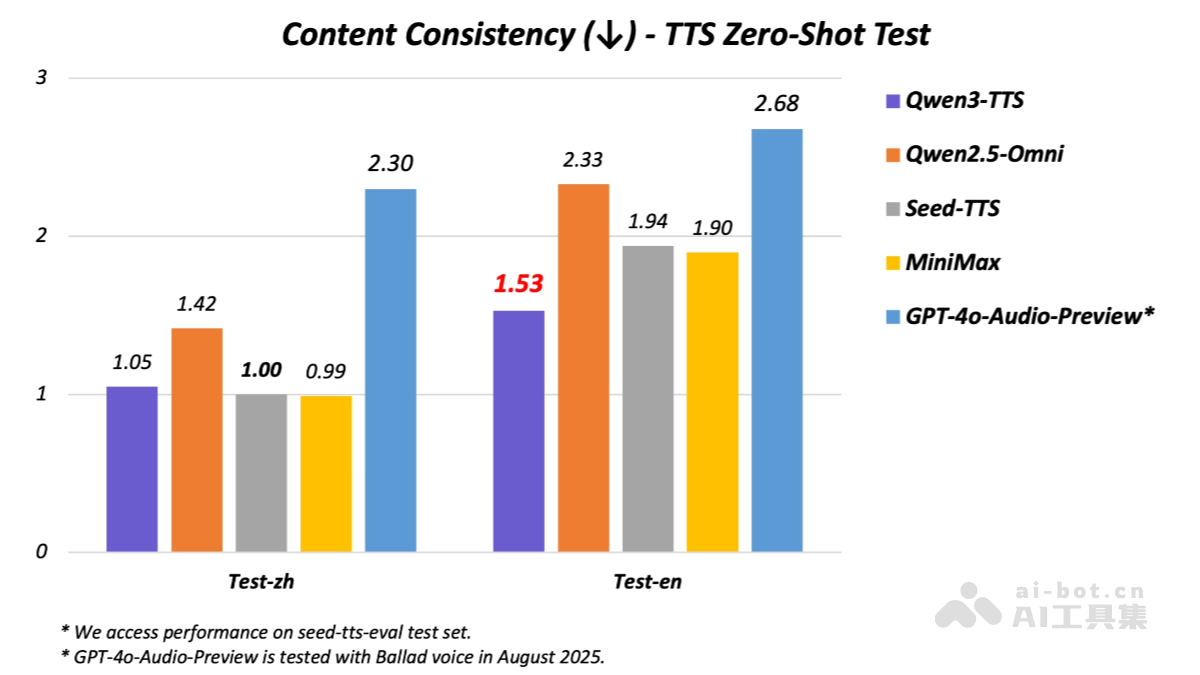
Chinese and English Speech Stability: On the seed-tts-eval test set, Qwen3-TTS-Flash achieves SOTA in Chinese and English speech stability, surpassing SeedTTS, MiniMax, and GPT-4o-Audio-Preview.
- Multilingual Speech Stability: On the MiniMax TTS multilingual test set, Qwen3-TTS-Flash achieves SOTA in WER for Chinese, English, Italian, and French, significantly lower than MiniMax, ElevenLabs, and GPT-4o-Audio-Preview.
-
Voice Similarity: In terms of speaker similarity for English, Italian, and French, Qwen3-TTS-Flash surpasses MiniMax, ElevenLabs, and GPT-4o-Audio-Preview, demonstrating excellent voice expressiveness.
Project Address of Qwen3-TTS-Flash
- Project Official Website:https://qwen.ai/blog?id=qwen3-tts-1128
- Online Experience Demo:https://huggingface.co/spaces/Qwen/Qwen3-TTS-Demo
Application Scenarios of Qwen3-TTS-Flash
-
Intelligent Customer Service: Provides users with natural and fluent voice interaction, improving the service experience, such as automatically answering common questions and guiding users through operations.
-
Audiobooks: Converts text content into vivid speech, allowing listeners to enjoy the pleasure of listening to books, suitable for novels, news, textbooks, and other content.
-
Voice Assistant: In smart home, smart wearable, and other devices, provides voice interaction functions, making it convenient for users to control devices and obtain information.
-
Education: Assists teaching, providing students with multilingual and multi-timbre voice explanations, helping users better learn languages and knowledge.
-
Entertainment Industry: Used in the production of animation, games, film and television, etc., dubbing for characters and creating more evocative sound effects.