
What is Seed-TTS
Seed-TTS is an advanced text-to-speech developed by ByteDanceText to Speech(Text to Speech, TTS) model, capable of generating high-quality speech that is extremely similar to human speech, with excellent in-context learning capability and naturalness. Seed-TTS supports fine-grained control over speech attributes such as emotion, intonation, and speaking style, and is suitable for various scenarios such as audiobooks and video dubbing. In addition, the model also has zero-shot learning capability, and can generate high-quality speech even without training data, and supports content editing and multilingual translation functions.
Main features of Seed-TTS
- High-quality speech generation: Seed-TTS adopts advanced autoregressive models and acoustic vocoder technology, and can generate high-quality speech close to natural human speech. The model is trained on large amounts of data, learning rich speech features and language patterns, thereby being able to synthesize clear, fluent, and natural speech output.
- In-context learning: The model has excellent in-context learning capability, and can generate speech that matches the style and semantics of the context based on understanding the context of the given text. Whether it is a continuous dialogue or a single sentence, Seed-TTS can maintain the coherence and consistency of speech.
- Emotion control: Seed-TTS can control the emotional tone of the generated speech according to the text content or additional emotion labels. Users can specify the emotion that should be expressed in the speech, such as anger, happiness, sadness, or surprise, and the model will adjust the pitch, intensity, and rhythm of the speech accordingly to match the selected emotion.
- Controllable speech attributes: In addition to emotion, Seed-TTS also allows users to control other speech attributes, including intonation, rhythm, and speaking style. Users can adjust the speech according to the needs of the application scenario to make it more formal or informal, or more dramatic.
- Zero-shot Learning capability (Zero-shot Learning): Even without training data for a specific speaker, Seed-TTS can use the generalization ability obtained from training on large amounts of data to generate high-quality speech. This capability enables Seed-TTS to quickly adapt to new speakers or languages without the need for an additional training process.
- Speech editing: Seed-TTS supports editing of generated speech, including content editing and speaking speed editing. Users can modify specific parts of the speech as needed, or adjust the speaking rate to suit different listeners or application scenarios.
- Multilingual support: The model design supports text input in multiple languages and can generate speech in the corresponding language, enabling Seed-TTS to serve globalized applications and meet the needs of users in different languages.
- Speech decomposition: Seed-TTS achieves attribute decomposition of speech through a self-distillation method. For example, it can separate the timbre of speech from other attributes such as content and emotion, providing higher flexibility and control for speech synthesis and allowing users to independently modify and reorganize different components of speech.
Seed-TTS official website entry
- Official project entry:https://bytedancespeech.github.io/seedtts_tech_report/
- arXiv technical paper:https://arxiv.org/pdf/2406.02430
How Seed-TTS works
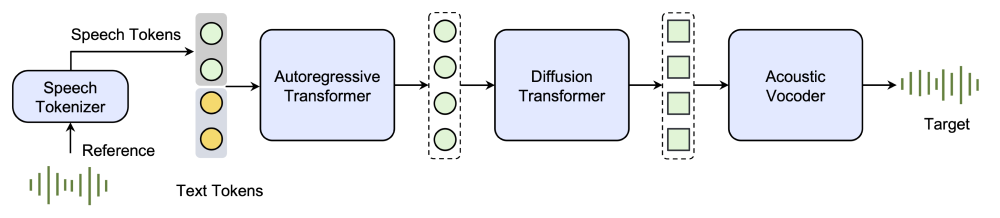
- Speech Tokenization: First, Seed-TTS uses a speech tokenizer to convert the input speech signal into a series of discrete speech tokens. These tokens are the foundation of speech synthesis, similar to characters or words in text.
- Conditional Text and Speech Processing: Next, Seed-TTS's autoregressive language model generates a token sequence for the target speech based on the input text and speech tokens. This process relies on the model's understanding of language structure and speech characteristics, ensuring that the generated speech token sequence matches the input text semantically and syntactically.
- Speech Representation Generation: The generated speech token sequence is then fed into a diffusion transformer model. This model is responsible for converting the discrete speech tokens into continuous speech representations. This process is progressively refined, from coarse to fine, to generate smooth and natural speech waveforms.
- Acoustic Vocoder: Finally, the continuous speech representations are fed into an acoustic vocoder, a component responsible for converting these representations into audible, high-quality speech. Vocoders typically use deep learning techniques to simulate the process by which the human vocal tract produces speech.
- Training and Fine-Tuning: The Seed-TTS model is pretrained on large amounts of data to learn the basic patterns of language and speech. Afterward, it can be fine-tuned to adapt to a specific speaker or speech style, further improving the naturalness and expressiveness of the speech.
- Self-Distillation and Reinforcement Learning: Seed-TTS also employs self-distillation methods to achieve the decomposition of speech attributes, such as timbre separation, as well as reinforcement learning techniques to enhance the model's robustness, speaker similarity, and controllability.
- End-to-End Processing: For the non-autoregressive variant Seed-TTSDiT, it adopts a fully diffusion-based architecture, performing end-to-end processing directly from text to speech without relying on pre-estimated phoneme durations.
How to Use Seed-TTS
Seed-TTS currently only provides a technical paper and an official demo; no usage address has been opened yet. Interested users can visit the official website to view the official demonstration.
Application Scenarios of Seed-TTS
- Virtual Assistants: Seed-TTS can provide virtual assistants with natural and fluent voice interaction capabilities, improving the user experience.
- Audiobooks and Audio Books: By using Seed-TTS to generate high-quality speech, e-books can be converted into audiobooks for users to listen to.
- Video Dubbing: Seed-TTS can be used for dubbing video content, especially in scenarios that require specific emotional expression or intonation.
- Customer Service Automation: In the customer service field, Seed-TTS can provide automated voice reply functionality to handle routine inquiries and information requests.
- Film and Game Voice Acting: In film production and video game development, Seed-TTS can be used for character voice acting, providing a diverse range of voice options.
- News and Podcast Production: Seed-TTS can automatically convert text news or podcast scripts into speech, quickly producing audio content.
- Assisting People with Disabilities: Seed-TTS can provide speech synthesis services for people with speech impairments, helping them communicate better.