
What is Qwen3-Coder-Flash
Qwen3-Coder-Flash is a high-performance programming model launched by the Alibaba Tongyi Qianwen team, with the full name Qwen3-Coder-30B-A3B-Instruct. The model possesses excellent Agentic capabilities and excels at tasks such as agentic programming and tool calling, approaching the top-tier version Qwen3-Coder-480B-A35B-Instruct as well as leading closed-source models such as Claude Sonnet-4 and GPT4.1. The model supports long-context understanding of 256K tokens and can be extended to 1M tokens, making it suitable for repository-level code understanding and avoiding context fragmentation. The model optimizes the function calling format and supports platforms such as Qwen Code and CLINE. Currently, the model can be accessed throughQwen Chatplatform and has been open-sourced, allowing developers to deploy it on local hardware and build dedicated code assistants.
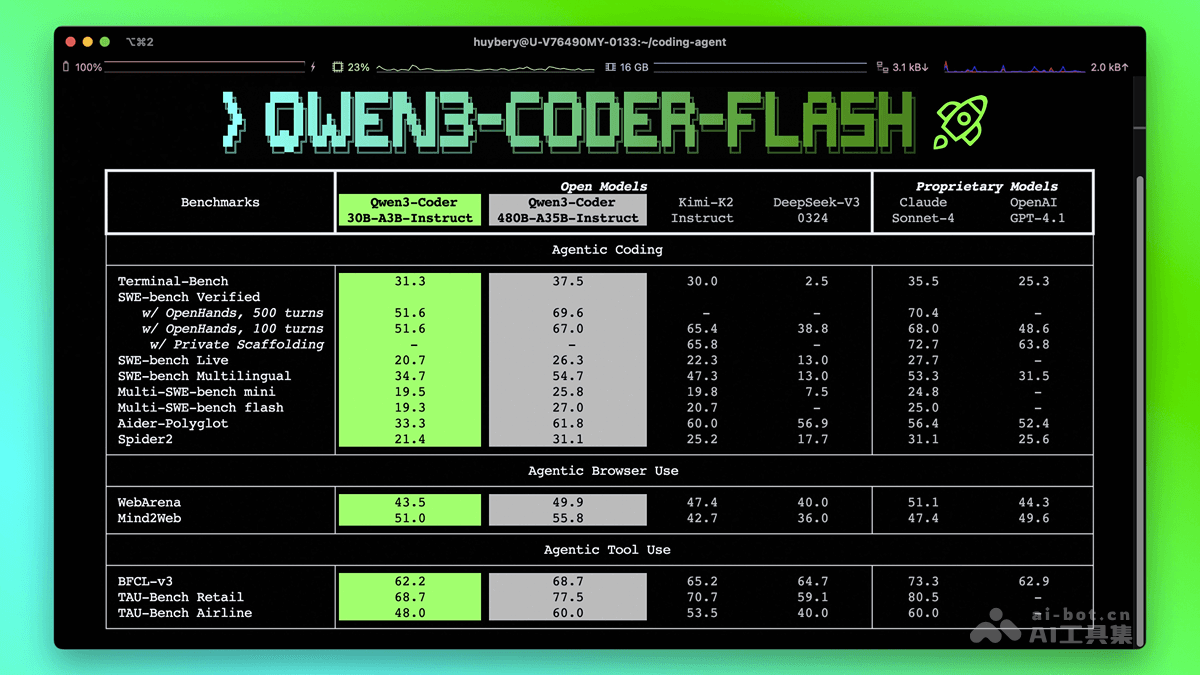
Main Features of Qwen3-Coder-Flash
- Excellent Agentic Capabilities: Qwen3-Coder-Flash performs excellently in tasks such as agentic programming, tool calling, and browser use, and can efficiently complete complex programming tasks.
- Long-Context Understanding: Natively supports 256K tokens and can be extended to 1M tokens, making it suitable for handling large codebases and avoiding context fragmentation.
- Multi-Platform Support: Optimizes the function calling format and supports platforms such as Qwen Code and CLINE, making it convenient for developers to use in different environments.
- Efficient Code Generation: Provides high-quality code generation capabilities and supports multiple programming languages, helping developers quickly implement features.
- Local Deployment: An open-source model that supports deployment on local hardware, enabling developers to build dedicated code assistants.
Technical Principles of Qwen3-Coder-Flash
- Model Architecture: Based on the Causal Language Models architecture, it has 30.5 billion parameters, of which 3.3 billion parameters are activated. The model has a total of 48 layers and uses the Grouped Query Attention (GQA) mechanism, in which the number of query heads (Q) is 32 and the number of key-value heads (KV) is 4. The model is equipped with 128 experts, and 8 experts are activated each time. This allows the model to efficiently allocate computational resources when handling complex programming tasks while maintaining strong language generation capabilities.
- Training Stages: In the pretraining stage, the model performs unsupervised learning on large-scale code data, and based on learning the syntax and semantic structure of code, masters the general rules of programming languages. In the post-training stage, it is fine-tuned for specific programming tasks to further improve the model's performance in practical application scenarios. The staged training approach enables the model to balance generality and specialization and adapt to diverse programming needs.
- Long-Context Processing: The model natively supports a context length of 256K tokens and extends it to 1M tokens based on YaRN technology. This enables the model to understand and process large codebases and avoid code generation errors caused by context fragmentation. Long-context support is especially important for repository-level code understanding and complex project development, and can significantly improve programming efficiency and code quality.
- Agentic Capabilities: The model has strong Agentic capabilities and supports tasks such as agentic programming, tool calling, and browser use. The model automatically calls external tools (such as APIs, databases, etc.) according to user instructions and obtains real-time information through the browser, enhancing programming capabilities. This allows the model to generate code and also interact with external systems to complete more complex programming tasks.
Project Address of Qwen3-Coder-Flash
- HuggingFace Model Repository:https://huggingface.co/Qwen/Qwen3-Coder-30B-A3B-Instruct
Application Scenarios of Qwen3-Coder-Flash
- Code Generation and Assisted Programming: Quickly generate code snippets and optimization suggestions for developers, reduce repetitive work, and improve programming efficiency.
- Automated programming tasks: Automatically generate test code and scripts, implement automated operations, and improve development and testing efficiency.
- Project development and maintenance: With long-context understanding capabilities, quickly locate issues and provide refactoring suggestions to improve project maintenance efficiency.
- Education and training: Generate code and provide explanations in real time in programming teaching, helping students quickly understand programming concepts.
- Enterprise-level applications: Assist with code review and generate automated test scripts, helping enterprises improve code quality and development efficiency.