
What is Qwen3.7-Plus
Qwen3.7-Plus is a new-generation multimodal large model launched by Tongyi Qianwen, unifying vision and language into an integrated agentic foundation. The model can perceive real-world scenes, read screens and operate GUIs, generate code based on visual references, support end-to-end navigation of mobile applications, answer visual questions by combining web knowledge, and seamlessly integrate GUI and CLI interactions within a single agent loop. As an all-around coding agent and productivity assistant, the model uses omni-modal input to handle tasks ranging from front-end prototypes to complex software engineering and multi-step workflow automation, with cross-framework generalization capabilities.
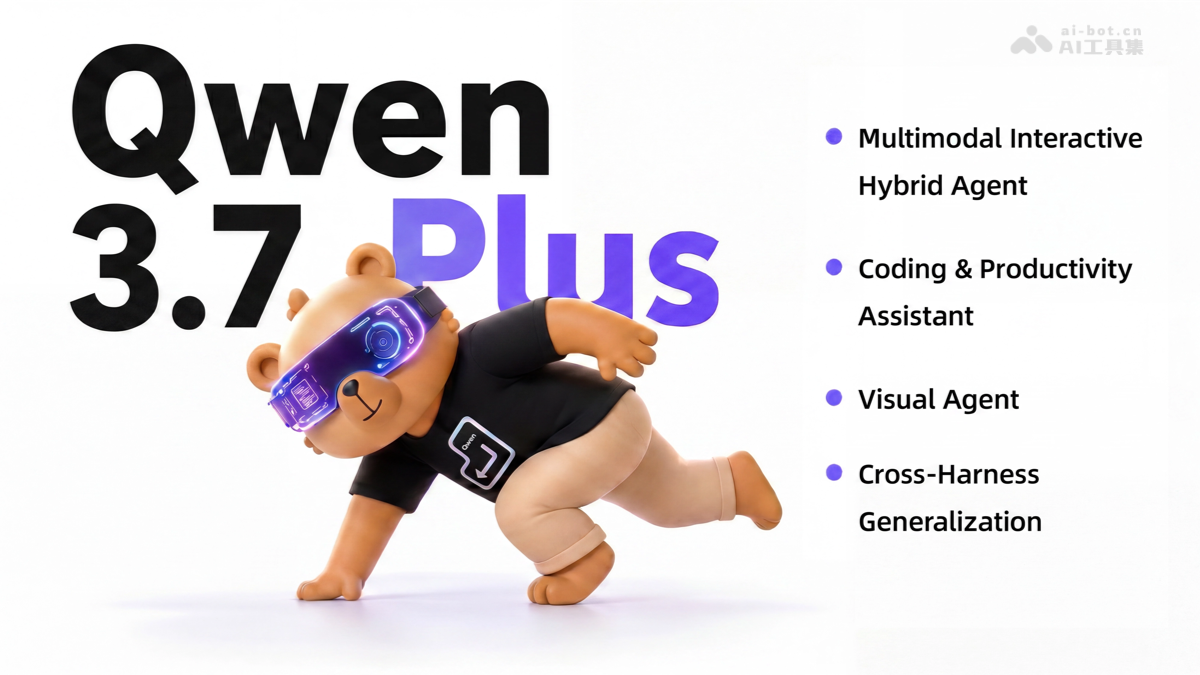
Qwen3.7-Plus's Main Features
-
Multimodal Interaction Hybrid Agent: uniformly processes image, video, screen, web, and text inputs, completing complex task loops in GUI/CLI/tool environments.
-
Visual Agent: combines visual understanding, code interpreter, and search enhancement to solve visual puzzles, real-world question answering, and complex reasoning tasks.
-
Visual Programming: generates SVG, web pages, and interactive front-ends from images or videos, enabling end-to-end transformation from visual references to code.
-
GUI Agent: understands mobile and desktop interfaces, performing control localization, task planning, and multi-step operations.
-
Real-World Perception and Reasoning: covers real-world scenes, document charts, OCR, video, and driving scene understanding.
Qwen3.7-Plus's Technical Principles
- Integration of Visual Perception and Reasoning: The model performs strongly on high-difficulty visual reasoning benchmarks such as BabyVision, MathVision, and HiPhO, demonstrating comprehensive understanding of image details, spatial relationships, physical common sense, and multi-step logic. In particular, it shows significant improvement over the previous generation on BabyVision, indicating stronger generalization capability on tasks closer to early human visual cognition and spatial reasoning.
- End-to-End Transformation from Vision to Code: Through code interpreter integration, the model can transform visual problems into computable problem representations, autonomously writing and executing code for solving, searching, or verification. In tasks such as spot-the-difference, image block completion, Klotski, mazes, and jigsaw puzzles, the model can recognize image content and perform spatial modeling, path searching, state deduction, and result verification.
- GUI Automation and Multi-Step Interaction: The model can recognize screen content, locate key UI elements, understand task intent, and complete multi-step interaction operations. It shows significant improvements on ScreenSpot Pro, OSWorld-Verified, and AndroidWorld, supporting the progression from "understanding interfaces" to "operating interfaces" and "building interfaces."
- Search-Enhanced Multimodal Knowledge Question Answering: The model combines visual input with external knowledge retrieval, first extracting key entities, scenes, text, and contextual clues from visual input, obtaining external knowledge through search, and giving answers by integrating visual evidence and retrieval results.
- Video Understanding and Driving Scene Perception: Enhances the processing of events, actions, temporal sequences, and semantic relationships in short and long videos, while demonstrating strong understanding of dynamic scenes, traffic participants, and spatial relationships in driving-related evaluations such as LingoQA, SURDS, and VLADBench.
How to Use Qwen3.7-Plus
- Visit the Official Platform: Access the model service throughAlibaba Cloud Model Studioor the Qwen Studioofficial website.
- Select a model version: Choose Qwen3.7-Plus in the model marketplace and configure the invocation parameters according to your needs.
- Input multimodal content: Supports uploading images, videos, screenshots, or web links, and interacting in combination with text instructions.
- Execute tasks: Select the corresponding capability mode according to the scenario (Visual Agent, GUI Agent, Visual Coding, etc.), and the model will automatically complete the closed loop of perception, reasoning, and execution.
Core advantages of Qwen3.7-Plus
-
Multimodal Agent closed-loop capability: Integrates seeing, thinking, writing, doing, and verifying into a unified agent workflow, supporting end-to-end automatic completion of complex software tasks from understanding to delivery.
-
Cross-framework generalization: Whether deployed through Claude Code, OpenClaw, Qwen Code, or other frameworks, it maintains stable performance.
-
Leading in visual programming: Scores 1772.0 on QwenVision2Code, close to GPT-5.4's 1884.0, and significantly ahead of Claude-Opus-4.6 (1518.0) and Gemini-3.1 Pro (1632.0).
-
Strong GUI operation capability: ScreenSpot Pro 79.0, AndroidWorld 81.0, placing it in the top tier for interface understanding and operation tasks.
-
Long-duration autonomous operation: Cases show that the Agent can run continuously and stably for 11+ hours, cumulatively generate over 10,000+ lines of code, and trigger over 1,000+ invocations.
Project address of Qwen3.7-Plus
- Project official website:https://qwen.ai/blog?id=qwen3.7-plus
Comparison of Qwen3.7-Plus with similar competing products
| Comparison dimension | Qwen3.7-Plus | GPT-5.4 |
|---|---|---|
| Positioning | Multimodal interactive hybrid agent foundation model | General multimodal large model |
| Vision Arena ranking | 5th globally / 1st in China | Did not enter the top 7 |
| ScreenSpot Pro (GUI positioning) | 79.0 | 67.4 |
| AndroidWorld (mobile operation) | 81.0 | Not tested |
| QwenVision2Code (visual programming) | 1772.0 | 1884.0 |
| BabyVision (visual reasoning) | 70.4/64.7 | 53.1 |
| RealWorldQA (real-world question answering) | 86.9 | 83.8 |
| Terminal Bench 2.0 (terminal coding) | 70.3 | Not tested |
| SWE-bench multilingual | 75.8 | 77.5 |
| Video understanding VideoMMMU | 88.0 | 89.5 |
| Multimodal search MMSearchPlus | 41.4 | 19.7 |
| Core advantages | GUI operation, visual reasoning, long-duration Agent closed loop, cross-framework generalization | Visual programming, video understanding, general language tasks |
| Applicable scenarios | Complex software engineering automation, desktop/mobile GUI operation, multimodal Agent workflows | General content generation, visual reference to code, multilingual translation |
Application scenarios of Qwen3.7-Plus
-
Intelligent software development: Full-chain APP development from requirements document generation to code writing, test case creation, GUI automated testing, and version iteration evolution.
-
Desktop application replication: Autonomously understands the UI layout and functional details of native applications, generates corresponding source code, and connects to real APIs to achieve high-fidelity application replication.
-
Visual content generation: Converts design reference images into executable SVG, web pages, or interactive front-end code, reducing the cost from visuals to code assets.
-
Multimodal knowledge question answering: Combine images, video, and web search to answer open-world visual questions, such as place recognition, event background analysis, and product information queries.
-
Autonomous driving and embodied intelligence: Understand dynamic driving scenes, traffic participants, and spatial relationships, supporting real-world multimodal agents and embodied scenarios.