
What is Qwen-Scope
Qwen-Scope is an open-source large model interpretability toolkit from the Alibaba Tongyi Qianwen team, based on Sparse Autoencoder (SAE) technology, extracting interpretable features from the hidden layers of the Qwen3/Qwen3.5 series models. The model can transform the complex parameter computations inside the model into human-understandable concepts and patterns, and can be used for post-hoc analysis, enabling inference control, data processing, and model optimization through feature-level intervention, becoming a practical interface connecting the model's internals with downstream development.
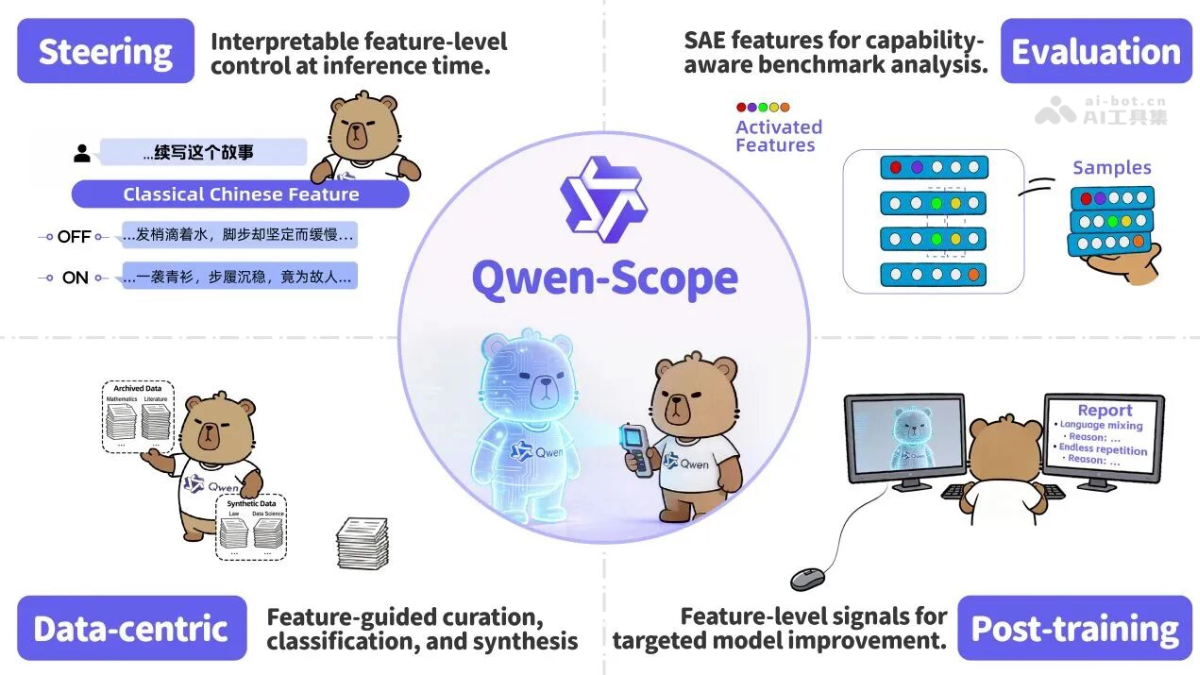
Main Features of Qwen-Scope
-
Steering: Without explicit natural language instructions, by enabling or disabling specific SAE features, achieve targeted modification of language, entities, and style, as well as badcase repair.
-
Data Classification and Synthesis: Based on a small amount of seed data, discover toxicity/safety-related features to achieve classification without an additional trainer; identify inactive features and synthesize supplementary samples in a targeted manner to cover long-tail capabilities.
-
Model Training Optimization: Locate abnormal activation features such as language mixing and repetitive generation, assisting in optimizing model behavior during supervised fine-tuning (SFT) and reinforcement learning (RL) stages.
-
Evaluation Redundancy Analysis: Compute feature activation patterns across different evaluation sets, determine the degree of evaluation set redundancy and capability coverage, and guide the selection of high-coverage, low-cost test samples.
Technical Principles of Qwen-Scope
-
Sparse Autoencoder (SAE): Insert SAE into the residual stream of each Transformer layer of Qwen, and by imposing sparsity constraints, decompose high-dimensional activation vectors into sparse, interpretable feature dictionaries.
-
Top-k Activation and Reconstruction: Train SAE separately for each layer; the encoder maps activations into an overcomplete latent representation, retaining only the largest k activations (k=50/100) for reconstruction, ensuring highly disentangled features.
-
Contrastive Feature Identification: Construct positive and negative sample sets, compare their average SAE activation differences, and identify the feature directions most relevant to target attributes (such as toxicity, Chinese, classical writing style).
-
Feature Intervention Formula: During inference, modify the residual stream via h′ ← h + αd, where d is the SAE feature direction and α controls the intervention strength; a positive value enhances and a negative value suppresses that feature.
How to Use Qwen-Scope
-
Visit the Experience Platform: Visit the Hugging Face online space.
-
Select Model Weights: Load the corresponding SAE weights according to the target model (such as Qwen3-8B, Qwen3.5-27B).
-
Input Prompts to Observe Activations: Input prompt words to view the SAE feature activation heatmap and rankings.
-
Identify Target Features: Locate abnormal or target feature IDs (such as Chinese feature 6159, classical Chinese feature 36398).
-
Adjust Intervention Strength: Set the feature intervention coefficient α to positively enhance or negatively suppress specific features.
-
Verify Control Effect: Compare the model output before and after intervention to confirm successful badcase repair or style transfer.
-
Integrate Training Process: Connect SAE signals to the SFT/RL loss function to enable targeted model optimization.
Key information and usage requirements of Qwen-Scope
-
Publisher: Alibaba / Tongyi Qianwen Team
-
Covered models: Qwen3-1.7B/8B, Qwen3-30B-A3B, Qwen3.5-2B/9B/27B/35B-A3B (7 in total)
-
Model types: Dense models + Mixture-of-Experts (MoE) architecture
-
SAE weights: 14 sets, covering all Transformer layers
-
Training data: 0.5B tokens sampled from each model's pretraining data
-
Feature dimensions:32K / 64K / 80K / 128K
-
Number of reconstruction features: 50 or 100
-
Online experience: Available on both Hugging Face and ModelScope
Core advantages of Qwen-Scope
-
From "understanding" to "improvement": Goes beyond traditional post-hoc analysis, turning interpretability into a core engine that drives model evolution.
-
Zero-weight-modification intervention: Directly manipulates feature directions during inference, changing output behavior without fine-tuning or updating model parameters.
-
Data-efficient and low-dependency: Only a small amount of seed data (about 200 pairs) is needed to discover highly discriminative features, with classification F1 reaching 0.90+, significantly reducing annotation costs.
-
Targeted and precise optimization: Precisely locates abnormal features for low-frequency bad cases such as language mixing and repetitive generation. During SFT, it can reduce the Chinese mixing rate from 0.81% to 0.22%.
-
Evaluation cost optimization: Identifies redundancy in evaluation sets through feature coverage analysis, helping select high-coverage samples and reducing evaluation overhead.
Qwen-Scope project addresses
- HuggingFace model repository:https://huggingface.co/collections/Qwen/qwen-scope
- Technical paper:https://qianwen-res.oss-accelerate.aliyuncs.com/qwen-scope/Qwen_Scope.pdf
Comparison of Qwen-Scope with similar competitors
| Comparison dimension | Qwen-Scope | Gemma Scope |
|---|---|---|
| Publisher | Alibaba / Tongyi Qianwen | Google DeepMind |
| Covered models | Qwen3 / Qwen3.5 series (7 models) | Gemma 2 / 3 series |
| Architecture support | Dense models + MoE | Dense models |
| SAE architecture | Top-k SAE | JumpReLU SAE |
| Open-source scale | 14 sets of SAE weights | 400+ SAEs, 30 million+ features |
| Core applications | Reasoning control, evaluation analysis, data synthesis, training optimization | Mechanistic interpretability, safety analysis, circuit tracing |
| Data synthesis | Feature-driven synthesis, improving data efficiency by about 15x | Mainly relies on traditional synthesis approaches |
| Evaluation analysis | Supports benchmark redundancy and coverage analysis | Focuses on feature visualization and interactive exploration |
| Chinese support | Native support, including distinctive stylistic features such as classical Chinese | Mainly oriented toward English scenarios |
| Interactive platform | Hugging Face / ModelScope | Neuronpedia |
Application scenarios of Qwen-Scope
-
Reasoning control and repair: Fixing language-mixing issues such as unexpected mixing of Chinese under English prompts; enabling style transfer such as converting modern Chinese into classical Chinese.
-
Safety data governance: Feature-based discovery for multilingual toxic content classification; targeted synthesis of safety training data, where 4k synthetic data can approach the safety alignment effect of 120k real data.
-
Model training assistance: In the SFT stage, SAE auxiliary loss helps suppress anomalous activations; in the RL stage, manipulating repetition-related features increases the sampling frequency of anomalous responses and accelerates convergence.
-
Evaluation set optimization: Analyzing the feature overlap matrix among benchmarks such as GSM8K, MATH, and MMLU-Pro, removing redundant evaluation sets, and improving evaluation efficiency.
-
Model interpretability research: Providing an open-source SAE foundation for academia and industry, supporting mechanistic interpretability, circuit tracing, and root cause analysis of hallucinations and bias.