
What is Qwen-AgentWorld
Qwen-AgentWorld is the first language world model launched by the Tongyi Qianwen team, simulating 7 major agent environments—MCP, search, terminal, software engineering, Android, Web, and operating system—through long chain-of-thought reasoning. The model is built on over 10 million real interaction trajectories and trained through a three-stage pipeline (CPT→SFT→RL), and the AgentWorldBench evaluation benchmark has also been launched to verify its leading performance in environment simulation and agent training.
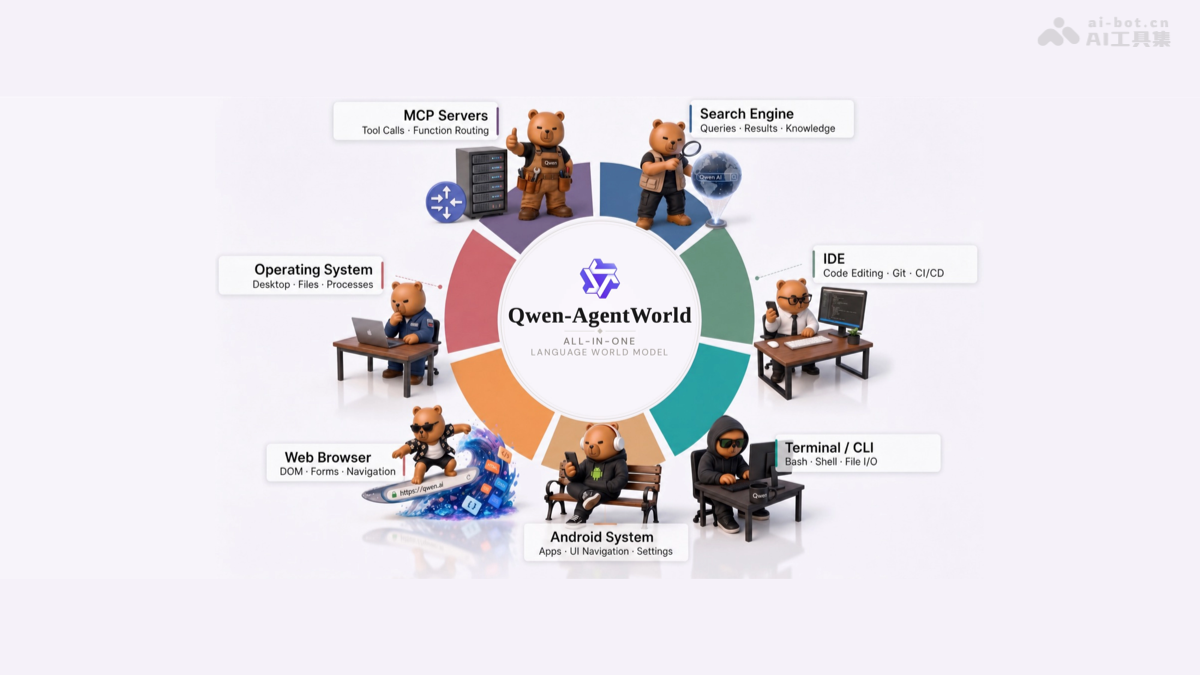
Main features of Qwen-AgentWorld
- Unified seven-domain environment simulation: Covers 7 major interaction environments—MCP tool calling, search engines, Linux terminals, software engineering (SWE), Android GUI, Web browsers, and operating systems—using a unified text format to represent state transitions.
- Long chain-of-thought state prediction: Given the current state and agent action, the model predicts precise environment feedback through long CoT reasoning, such as the next screen UI, terminal output, error messages, etc.
- Controllable adversarial simulation: Supports injecting specific simulation instructions, such as "hide some search results" and "simulate a disk full error", to systematically generate edge cases that are rare in real environments.
- 4. Agent reinforcement learning training: Can serve as a decoupled environment simulator to support Sim Agentic RL, enabling scalable episode-level training in 4000+ real OpenClaw environments.
- Unified agent foundation model: World model training can serve as a "warm-up" for agent training, internalizing a forward-thinking mode similar to "reflection" to improve downstream task performance.
Technical principles of Qwen-AgentWorld
- Unified trajectory schema: Unifies the state representations of 7 heterogeneous environments into
(system_prompt, action, observation)sequences, where system_prompt contains five parts: task description, action space, initial state, demonstration examples, and simulation instructions. - Three-stage training pipeline:
-
CPT (continual pre-training): Injects state transition dynamics and enhanced specialized corpora to establish general world modeling capabilities.
-
SFT (supervised fine-tuning): Activates the reasoning chain-of-thought mode for "next-state prediction".
-
RL (reinforcement learning): Uses hybrid rubric-based rewards and rule-based rewards to refine simulation fidelity.
-
- Hybrid reward framework: For verifiable deterministic capabilities, such as terminal command execution and file system changes, rule verifiers are designed; for open-domain simulation quality, a five-dimensional rubric is used for evaluation.
- Environment representation strategy: The text domain directly predicts text output; the GUI domain represents states using accessibility trees and UI view hierarchies rather than raw pixels.

Follow WeChat and reply "open source" to joinAI open-source project exchange group
How to use Qwen-AgentWorld
- As an environment simulator (Decoupled): Deploy the model to replace the real environment, receive
(state, action)through the API and returnnext_state, for large-scale episode-level RL training without a sandbox or virtual machine. - As an agent foundation model (Unified): Using Qwen-AgentWorld directly as the agent backbone, its built-in world modeling capability can assist action selection, and it works out of the box on benchmarks such as Terminal-Bench, SWE-Bench, and Claw-Eval.
- Model acquisition: Download the weights from HuggingFace / ModelScope (
Qwen-AgentWorld-35B-A3B, etc.)
Core advantages of Qwen-AgentWorld
- The first native multi-domain language world model: From the CPT stage onward, environment modeling is treated as an explicit objective and trained end-to-end, rather than being a post-hoc adaptation of a general-purpose large language model.
- Significantly surpasses frontier baselines: On AgentWorldBench, the 397B-A17B version (58.8 points) surpasses Claude Opus 4.8 (56.6), GPT-5.4 (58.2), Gemini 3.1 Pro (54.6), DeepSeek-V4-Pro (53.0), and Qwen3.6-Plus (50.8).
- Scalable and controllable It can scale environments at the turn level without real infrastructure, and supports precise perturbation to generate adversarial samples; controllable simulated RL significantly outperforms RL trained only in real environments.
- Cross-domain generalization and warm-up transfer: LWM training serves as agent warm-up and can transfer to 7 benchmarks (3 of which never appear in the training set), showing strong generalization without RL fine-tuning on agent tasks.
- Plain text covers visual environments: In the GUI domain, states are represented by accessibility trees / HTML / UI hierarchy markup, so plain-text world modeling can encompass visual interactive environments.
Project addresses of Qwen-AgentWorld
- Project homepage:https://qwen.ai/blog?id=qwen-agentworld
- GitHub repository:https://github.com/QwenLM/Qwen-AgentWorld
- HuggingFace model library:https://huggingface.co/collections/Qwen/qwen-agentworld
- arXiv technical paper:https://arxiv.org/pdf/2606.24597
Comparison of Qwen-AgentWorld with similar competing products
| Dimension | Qwen-AgentWorld | WebWorld |
|---|---|---|
| Positioning | Seven-domain unified language world model (native LWM) | World model dedicated to large-scale Web agent training |
| Environment coverage | 7 major domains: MCP, Search, Terminal, SWE, Web, Android, OS | Single domain: Web browser environment |
| State representation | Unified text mode: accessibility tree XML, HTML, UI hierarchy markup, Shell output, code execution results | Multi-format states: A11y tree, HTML, XML, Markdown, natural language (adaptively retaining 5 formats) |
| Training method | CPT → SFT → RL three-stage end-to-end native training, 10 million+ real trajectories | Two-stage curriculum: broad pre-training (raw Web dynamics) + causal reasoning activation (explicit state transition reasoning) |
| Model scale | 35B-A3B / 397B-A17B | 14B / 32B |
| Context window | Supports long context (the specific length is not specified, but it covers multi-turn long trajectories) | 256K tokens |
| Simulation depth | Long chain-of-thought (CoT) reasoning predicts the next state, supporting controllable adversarial simulation | Supports multi-turn simulation of 30+ consecutive steps, with consistent state tracking |
| Action space | Native action formats for each domain (Shell commands, tool calls, UI operations, etc.) | Unified Python-style function calls (click(bid)、fill(bid, text)、goto(url) , etc.) |
| Evaluation benchmark | Self-built AgentWorldBench (2170 samples / 7 domains / 5-dimensional scoring + rule verification) | Validated based on Web agent benchmarks such as WebArena and Mind2Web |
| Core advantages | Unified cross-domain, native to seven domains, controllable adversarial, dual paradigms of Sim Agentic RL + unified foundation model | Web domain specialization, multi-format compatibility, standardized action space, 256K long context |
Application scenarios of Qwen-AgentWorld
- Agent training infrastructure: Provides a low-cost, scalable, and controllable virtual training ground for AI Agents, replacing expensive sandboxes and real API calls.
- Edge cases and adversarial testing: Generates error states rarely seen in real environments, such as network timeouts, permission denials, and insufficient resources, to test agent robustness.
- Software engineering assistance: Simulates code execution, test feedback, and Git operation results to help developers rehearse the consequences of operations.
- Automated UI testing: Simulates Android/Web/desktop application interactions, predicts page state changes after clicks/input, and is used for automated test script generation.
- Tool invocation and the MCP ecosystem: Simulates MCP server responses and multi-toolchain orchestration, helping developers debug complex invocation logic without deploying real services.