
What Is WebWorld
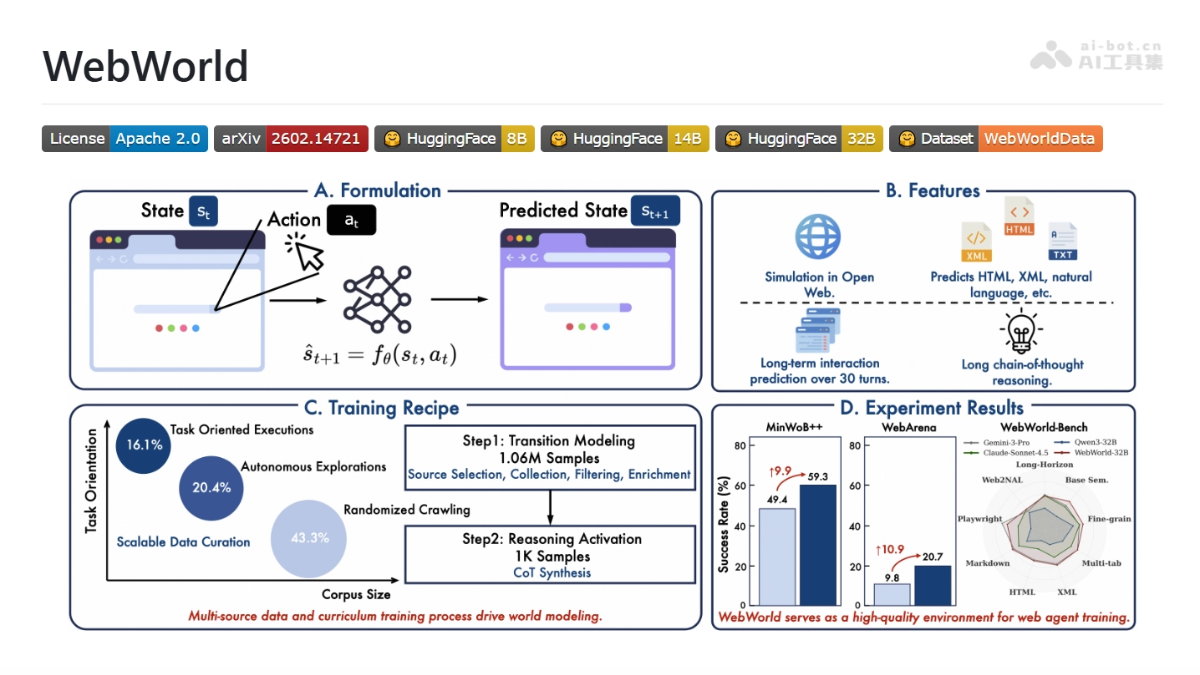
WebWorld is a large-scale web world model series open-sourced by Alibaba's Qwen team. Trained on the Qwen3 foundation, it includes three versions: 8B, 14B, and 32B. By predicting web page state transitions in a simulated browser environment, the model provides Web Agents with high-quality training data and an inference environment, avoiding network latency, rate limits, and security risks in real web page training. The model supports multiple state representations such as A11y Tree, HTML, XML, Markdown, and natural language, enabling long-horizon consistent simulation of 30+ steps, and possesses explicit chain-of-thought reasoning capabilities.
WebWorld's Main Features
-
Web Page State Prediction: Given the current page state (A11y Tree/HTML/XML, etc.) and an Agent action, it predicts the complete page state at the next moment, simulating real browser behavior.
-
Long-Horizon Multi-Turn Simulation: It supports continuous interaction simulation of more than 30 steps, maintaining state consistency, and is suitable for complex multi-step web tasks.
-
Multi-Format State Representation: It natively supports A11y Tree, and can also process HTML, XML, Markdown, and natural language descriptions, enhancing the model's generalization ability.
-
Activation of Reasoning Ability: Through two-stage curriculum training, it first injects large-scale web dynamics knowledge, and then uses a small amount of CoT data to activate explicit causal reasoning.
-
Cross-Domain Generalization: It demonstrates good transfer ability in code environments, GUI desktops, and game scenarios.
-
Trajectory Data Synthesis: It can serve as a data synthesizer to generate large-scale high-quality training trajectories for downstream Agents, improving performance on real tasks.
WebWorld's Technical Principles
- Autoregressive Browser Simulator Modeling: WebWorld formalizes the browser environment as an autoregressive sequence generation task, and based on a causal language model learns the conditional probability distribution Pθ(st+1∣I,ht) . Given a task instruction I and interaction history ht=(s0,a0,…,st,at) , it predicts the next page state at after executing action st+1 , and is trained end-to-end on complete trajectory data through maximum likelihood estimation.
- Three-Layer Hierarchical Data Collection Pipeline: To break through the data bottleneck of closed environments, WebWorld builds a scalable three-layer collection strategy: the first layer, "random crawling", performs random actions on websites corresponding to the pretraining corpus, obtaining 43.3% broad data; the second layer, "autonomous exploration", deploys LLM Agents to generate goals on their own and explore websites, producing 20.4% real long-horizon trajectories; the third layer, "task-oriented execution", synthesizes diverse variants based on seed tasks and has Agents execute them, obtaining 16.1% high-quality task trajectories. The three layers total more than 1.06 million real open web interaction data entries.
- A11y Tree Primary State Representation and Multi-Format Enhancement: The model uses the A11y Tree extracted by Playwright as the primary state representation, because it has generality across web pages and GUIs, high information density, and an LLM-friendly structure; at the same time, through post hoc transformation, trajectories are expanded into multiple formats such as HTML, XML, and Markdown, and natural language page descriptions are introduced to build a five-dimensional instruction fine-tuning dataset, avoiding overfitting by the model to a single representation and preventing catastrophic forgetting.
- Two-Layer Data Filtering and Quality ControlData cleaning employs a dual-layer mechanism combining rule-based heuristics and LLM scoring: first, scripts verify website reachability and filter sensitive keywords, retaining only 15.7% of the original URLs; subsequently, the LLM scores from four dimensions—accessibility, content suitability, interactivity, and engineering quality—removing low-scoring sites. At the trajectory level, invalid transitions without state changes are further pruned, and overly long samples exceeding 30 rounds or 30K tokens are discarded, without introducing any model-specific inductive bias throughout.
- Two-Stage Curriculum Training Strategy
- Training follows a curriculum design of "inject knowledge first, activate reasoning later": the first stage performs large-scale dynamic modeling on 1.06 million trajectories, enabling the model to grasp a wide range of web state transition patterns; the second stage fine-tunes with only 1,000 synthetic CoT samples, requiring the model to first output an explicit analysis of page structure, user intent, and state changes before prediction, thereby externalizing implicit reasoning capability into an interpretable chain-of-thought pattern.
- Multidimensional Evaluation System WebWorld-Bench
- To comprehensively measure simulation quality, the team built an intrinsic benchmark comprising nine evaluation dimensions: the Factuality score uses an LLM to judge point by point whether the predicted state correctly reflects the functional causal effect of the action; the Web Turing score adopts adversarial pairwise comparison to test the indistinguishability between simulated states and real web pages. Together, they quantify world model capability from two levels: objective correctness and subjective realism.
How to Use WebWorld
- Environment Setup: After cloning the repository, run
pip install -r requirements.txtand extract the data package. - Model Loading: Load the model via HuggingFace (e.g.,
Qwen/WebWorld-8B), useAutoModelForCausalLMwithtrust_remote_code=Trueto initialize. - Single-Step Prediction: Construct a conversation containing a system prompt (declaring it as a web world model) and a user message (initial page state + action), and call
model.generateto predict the next page state. - Multi-Turn Simulation: The first turn provides the initial state and the first action; each subsequent turn uses a fixed continuation prompt
CONTINUE_PROMPT, taking the predicted state from the previous turn as history, passing in the new action to continue generation, and can loop for 30+ turns. - Agent Training: Use WebWorld to synthesize trajectory data, generate diverse task trajectories through the Abstract-and-Instantiate strategy, and fine-tune the base model to improve downstream Agent benchmark performance.
- Benchmark Evaluation: Use WebWorld-Bench for intrinsic evaluation, or verify Agent training effectiveness through external benchmarks such as MiniWob++ and WebArena.
Core Advantages of WebWorld
-
Leading Scale: Trained on 1 million+ real open web trajectories, with a data volume 100 times that of prior work, covering diverse domains such as e-commerce, social media, and news.
-
Open Source and Open: Model weights and training data (WebWorldData) are both open-sourced under the Apache 2.0 license, providing a complete and reproducible technical roadmap.
-
Comprehensive Evaluation System: The self-developed WebWorld-Bench intrinsic benchmark comprehensively evaluates simulation quality from dual dimensions of Factuality and Web Turing, across nine sub-dimensions.
-
Outstanding Training Efficiency: Only 1,000 CoT samples are needed to activate strong reasoning capability, demonstrating the high efficiency of large-scale dynamic pretraining for reasoning activation.
-
Significant Agent Training Gains: After fine-tuning on WebWorld synthetic data, Qwen3-8B improves by 10.9% on WebArena, and the 14B version approaches GPT-4o level.
WebWorld project address
- GitHub repository:https://github.com/QwenLM/WebWorld
- HuggingFace model hub:https://huggingface.co/datasets/Qwen/WebWorldData
- arXiv technical paper:https://arxiv.org/pdf/2602.14721
Comparison of WebWorld with similar competing products
| Comparison dimension | WebWorld | WebEvolver | UI-Simulator |
|---|---|---|---|
| Development team | Alibaba Qwen Team | Fang et al. | Wang et al. |
| Technical route | Large-scale open web pretraining + two-stage curriculum fine-tuning | Co-evolution (alternating fine-tuning of world model and Agent) | Retrieval-augmented simulation (RAG + prompting proprietary LLM) |
| Environment scope | Real open web (millions of domains) | Closed benchmark environment | Closed/controlled environment |
| Data scale | 1.06 million+ real trajectories | Depends on data returned by Agent, limited scale | No proprietary training data, real-time API calls for generation |
| Model form | Open-source specialized world model (8B/14B/32B) | Specialized world model for training | Prompting a general LLM as the world model |
| Long-horizon simulation | Supports 30+ step consistent simulation | Limited | Limited |
| Explicit reasoning | CoT activated, interpretable state transitions | No explicit reasoning | Relies on implicit reasoning of the base model |
| Open-source status | Apache 2.0 (model + data) | Not open-sourced | Not open-source (depends on proprietary API) |
| Core difference | Rooted in the open web, data-driven scaling | Optimized through a co-evolution loop, limited environment | Targeted synthesis via retrieval augmentation, cost limited by API |
Application scenarios of WebWorld
-
Web Agent training and evaluation: Provides a low-cost, high-throughput simulated training environment for automated web operation Agents, replacing expensive real web interaction.
-
Data augmentation and synthesis: Generates large-scale synthetic trajectories for web tasks lacking annotated data, used for supervised fine-tuning or reinforcement learning.
-
Planning and search at inference time: Acts as a "world model" during Agent execution for action lookahead simulation, assisting in selecting the optimal action sequence.
-
Cross-domain world model research: Its technical paradigm can be transferred to broader digital world modeling tasks such as GUI automation, code environment simulation, and game state prediction.
-
Browser automation testing: Simulates user interaction paths for web functionality testing, compatibility verification, and user experience rehearsal.