
What is QoderWake
QoderWake is the industry's first secure, controllable, and continuously evolving production-grade AI digital employee platform launched by Alibaba. It adopts a Harness-First architecture and can take on roles such as software engineer, operations, and analyst in real work. The platform features a multi-dimensional self-evolution system. After each execution, it distills experience into five dimensions: memory, skills, strategies, validation rules, and workflows, solving the problem of general Agents "forgetting once done." It has currently launched digital programmers, who can autonomously complete tasks such as code review, error diagnosis, and alert triage 24/7, reducing root cause analysis time from 30 minutes to 2 minutes. QoderWake has officially opened global public beta, with the Mac version launched first.
QoderWake 1.0 upgrades from a desktop Agent to "digital employees" that can be recruited, trained, authorized, and managed, supporting Mac/Windows and cloud host deployment, enabling humans and digital employees to collaborate within the same organization.
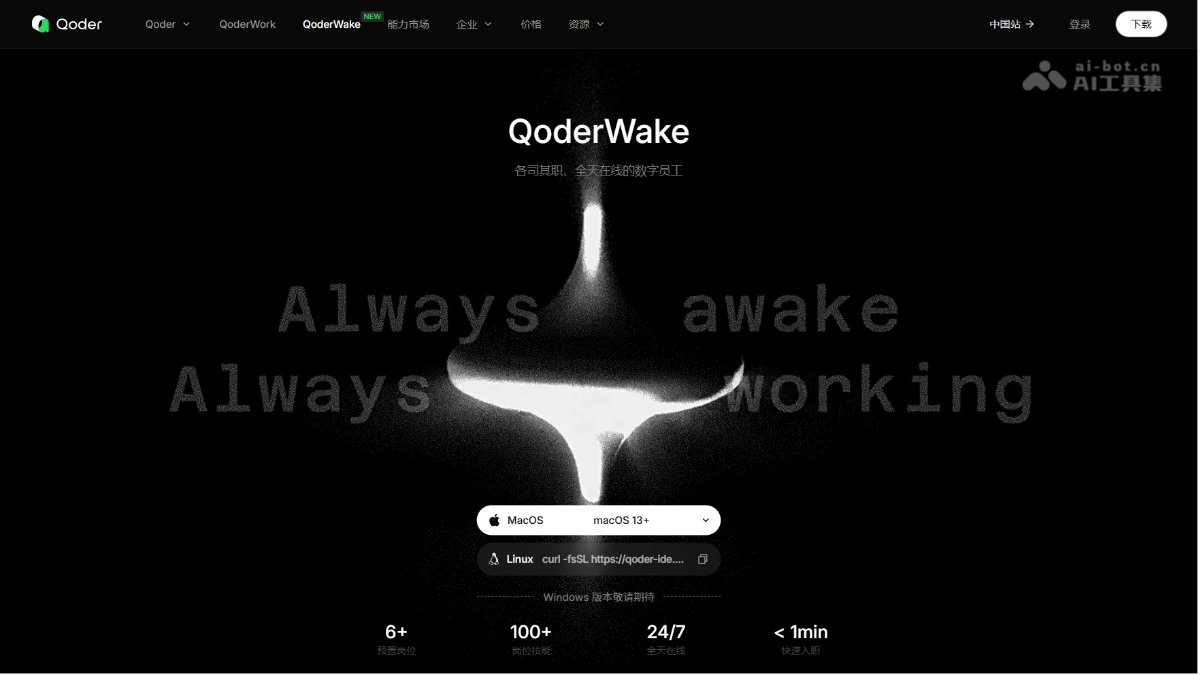
Main Features of QoderWake
- Digital Programmer: Automatically organizes code change briefs, diagnoses error outputs with preliminary reports, and triages alerts to determine severity.
- Preset Job Roles: Provides six systematically trained built-in positions: Backend Engineer, Frontend Development Engineer, Test Engineer, Product Manager, Data Analyst, and Content Operations Specialist, ready to use out of the box.
- Autonomous Task Execution: Automatically starts after task conditions are set, autonomously plans, executes, and escalates to humans when needed.
- Work Record Tracking: Visually displays data such as onboarding days, number of triggers, completed tasks, and created projects.
- Skill Marketplace Expansion: Built-in 100+ job skills, supporting custom addition of new skills based on business needs.
- Seamless Workflow Integration: Connects with existing development collaboration tools such as GitHub, Slack, and Linear.
- QoderWake 1.0:
-
MCP Ecosystem Connection: Access DingTalk Docs, internal Wiki, knowledge bases, and business systems through MCP connectors, connecting existing enterprise toolchains.
-
Position and Recruitment Management: Preset 10 professional positions, supports one-sentence intelligent position creation with customizable responsibilities and style, saved as templates for reuse.
-
Permission and Security Management: Each Waker independently configures four-dimensional permissions for tools, files, capabilities, and models. Sensitive data is stored locally, and high-risk operations require human authorization.
-
Deep Group Chat Collaboration: Waker continuously stays in group chats, understands context in real time, and automatically takes on or reassigns tasks, supporting @mentions, scheduled, and keyword triggers.
-
Task Execution and Dashboard: Supports multiple trigger sources such as group chat, scheduled, events, and API. A unified dashboard aggregates all task statuses, and long-running tasks can run autonomously.
-
Process and Skill Distillation: Multi-step processes can be saved as WakerFlow templates, team practices can be packaged as skills for upload and sharing, and the memory timeline supports version comparison and rollback.
-
Four-Layer Context System: Through a four-layer architecture of position profiles, on-site collaboration, confirmed memory, and reusable skills, it ensures digital employees accurately understand business context.
-
Underlying Architecture: Based on the Harness-First architecture and the Qoder CLI foundation, experience is automatically accumulated into a five-dimensional knowledge base, with a built-in Anti-Rot Governance mechanism for continuous optimization.
-
How to use QoderWake
- Visit the official website: Visit the official website https://qoder.com/qoderwake,完成账户登录和注册。
- Hire a digital employee: After approval, enter the platform and select the desired type of digital employee from the preset positions (such as a backend engineer).
- Configure position skills: According to actual business needs, configure or expand professional skills and working methods for the digital employee.
- Set trigger rules: Define task trigger conditions and keywords so that the digital employee automatically wakes up and executes in specific scenarios.
- Issue work instructions: Assign specific tasks to the digital employee through natural language or trigger words.
- Track the execution process: View work records, task history, execution trajectories, and contribution statistics in the management backend.
- Optimize memory strategy: View, correct, or forget the digital employee's memory content, guiding its continuous evolution.
Key information and usage requirements of QoderWake
- Product name:QoderWake
- Publisher: Alibaba / Qoder
- Product positioning: Production-grade AI digital employee platform
- Preset positions:6+
- Position skills:100+
- Service hours: Online 24/7
- Onboarding speed: < 1 minute fast onboarding
- Official website address:https://qoder.com/qoderwake
- Mobile entry point:https://qoder.com/mobile
Core advantages of QoderWake
-
Continuous evolution and value growth: Not a one-time Agent; experience continuously compounds, becoming more accurate the more it is used.
-
Production-grade security and controllability: Built-in validation, fault recovery, and state persistence ensure enterprise-grade reliability.
-
Fully unattended throughout the process: From planning to execution to exception escalation, it runs automatically once conditions are met.
-
Deep role specialization: Systematically builds skills, methods, and judgment for each position, not a generic model wrapper.
-
Two-way memory management: Users can view, correct, or forget any memory, enabling two-way co-growth between humans and machines.
Comparison of QoderWake with similar competitors
| Comparison dimension | QoderWake | Devin(Cognition) | OpenAI Codex |
|---|---|---|---|
| Product positioning | Multi-position production-grade digital employee platform | Full-stack AI software engineer | Cloud-based AI programming agent |
| Core capabilities | Multi-role autonomous execution + five-dimensional experience accumulation for continuous evolution | End-to-end autonomous planning, coding, debugging, and deployment | Code understanding, generation, refactoring, and debugging |
| Autonomy | High (trigger-based automatic wake-up, 24/7 unattended) | High (autonomously decomposes the entire process after receiving requirements) | Medium (executed step by step under user instructions, requires more confirmation) |
| Memory and Evolution | Five-dimensional accumulation + Anti-Rot mechanism, the more it is used the more accurate it becomes | Task-level context and session history learning | Single-session context + codebase retrieval |
| Role Coverage | 6+ preset roles (programmer/analyst/operations/editor, etc.) | Single software engineer role | Software development scenarios only |
| Security and Controllability | Harness-First architecture, built-in validation, fault recovery, and state persistence | Cloud sandbox execution | Isolated sandbox, enterprise-level task governance is relatively weak |
| Deployment and Integration | SaaS platform + mobile, integrates with GitHub/Slack/Linear | Cloud Agent, integration methods are relatively closed | Integrated into platforms such as ChatGPT |
| Release Status | Invitation testing stage | Already commercially available to some enterprises | Officially released |
QoderWake Application Scenarios
-
Software Development: Automatically completes code change summary organization, error diagnosis and preliminary diagnosis report output, alert triage and severity assessment, and supports PR Review and architecture design.
-
Operations Monitoring: Autonomously executes feedback classification, log analysis, fault root cause localization, and automatically generates fix code, achieving fully unattended end-to-end processes.
-
Data Analysis: As a digital analyst, automatically handles business report generation, data trend analysis, and insight extraction to assist business decision-making.
-
Customer Management: As a digital customer manager, automatically follows up on customer needs, handles feedback classification and response, improving the efficiency of customer relationship maintenance.
-
Content Operations: As a digital content editor, completes content creation, multi-platform publishing, and operations process automation, reducing manual repetitive labor.