
What is Qoder Rules
Qoder Rules is a complete open-source code specification and template system that helps developers use Qoder for more efficient and standardized development. Qoder Rules follows Alibaba Cloud AI architecture and best practices, covering key specifications such as development requirements, testing, security, and error handling, and provides comprehensive code quality and consistency assurance. Developers can clone it via Git and directly use these rules, or carry out secondary development. Qoder Rules supports both Chinese and English and is suitable for various project types such as Web applications, CLI tools, and libraries, helping developers quickly build standards-compliant applications.
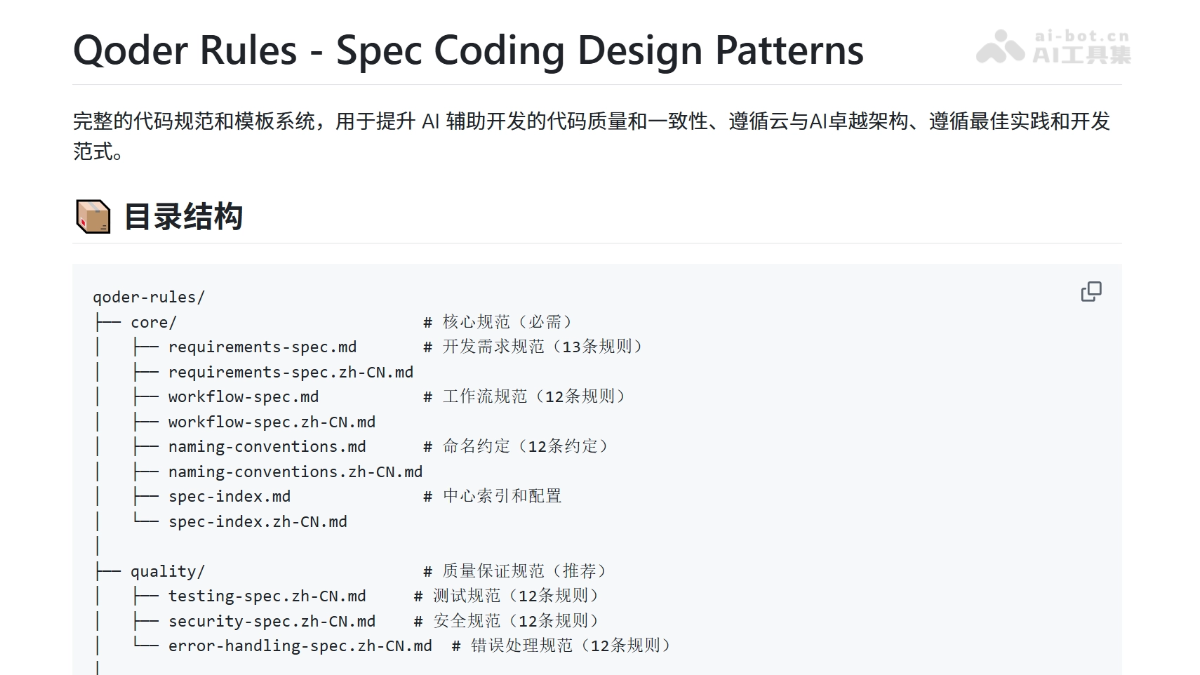
Main features of Qoder Rules
-
Development requirement specifications: Ensure that generated code is complete and runnable, with no placeholders, reuses existing code, and reduces new dependencies.
-
Testing specifications: Provide detailed testing standards, including test coverage targets, layered testing, and Mock specifications.
-
Security specifications: Protect against common vulnerabilities, such as input validation, authentication and authorization, and sensitive data protection.
-
Error handling specifications: Define error classification, custom error classes, and global error handlers.
-
Architecture design specifications: Support Alibaba Cloud AI architecture and provide API design and database specifications.
-
Tool support: Provide specification checking tools and compliance report generators to help developers verify whether code complies with the specifications.
-
Quick start templates: Provide scaffolding templates for Web, CLI, and libraries, making it convenient for developers to quickly start projects.
-
IDE integration: Support Qoder IDE and other mainstream development tools, such as VS Code.
How to use Qoder Rules
- Clone the Qoder Rules repository: Directly visit the Qoder Rules repository in your browserhttps://github.com/lvzhaobo/qoder-rules,点击页面右上角的 “Code” button, select “Download ZIP”, and download the entire repository as a ZIP file.
- Extract and copy the rule files
-
After the download is complete, extract the ZIP file.
-
Find the
core、qualityandarchitecturedirectories in the extracted folder. -
Copy the
.mdfiles in these directories (such asrequirements-spec.zh-CN.md、testing-spec.zh-CN.md, etc.) to the.qoder/rulesfolder in your Qoder project directory. If the.qoder/rulesfolder does not exist, create it manually.
-
- Use the rules in Qoder IDE
-
Open Qoder IDE or another supported AI development tool.
-
When entering requirements in the tool, reference rule files through the
@symbol. For example:-
@core/requirements-spec.zh-CN.md
Reference the development requirement specifications. -
@quality/testing-spec.zh-CN.md
Reference the testing specifications. -
@architecture/alibaba-cloud-ai-spec.zh-CN.md
Reference the Alibaba Cloud AI architecture specifications.
-
-
- Generate content: In Qoder IDE, after directly entering requirements and referencing rule files, Qoder generates content that complies with the specifications based on the rules (such as documents, design descriptions, etc.), without the need to manually write code.
Qoder Rules project address
- GitHub repository:https://github.com/lvzhaobo/qoder-rules
Application scenarios of Qoder Rules
-
Web application development: By referencing development requirements, security, and testing specifications, quickly generate high-quality, secure web application code, improving development efficiency and user experience.
-
CLI Tool Development: Use CLI scaffolding and testing specifications to quickly build stable and reliable command-line tools, reducing development and maintenance costs.
-
Library or SDK Development: Follow library development specifications and high-quality testing standards to ensure code reusability and low coupling, enhancing developers' trust in the library.
-
AI Application Development: Based on Alibaba Cloud AI architecture specifications, optimize performance and security, achieve data security and cost optimization, and enhance the competitiveness of AI applications.
-
Team Collaborative Development: With the help of standardized development processes and specifications, unify team development standards, improve collaboration efficiency, and reduce code quality issues.