
In today's rapidly evolving artificial intelligence technology, how to precisely guide large language models to complete complex tasks has become a key challenge. This report provides an in-depth analysis of the core concepts from basic instructions (Prompts) to advanced task decomposition techniques (Prompt chains). As the core interface for user-model interaction, the design quality of a Prompt directly determines the output effect. Prompt chains, through a "divide and conquer" strategy, break down large tasks into manageable step chains, significantly improving the transparency, reliability, and efficiency of AI when handling complex problems. Mastering this evolution is the cornerstone for unlocking the potential of next-generation intelligent applications.
Core Concept Analysis: From Prompt to Prompt Chain
Prompt
- Basic Definition and Role of Prompt
A Prompt is a text instruction input by the user to an AI model, used to guide the model to generate output of a specific type, style, or content. Its core role lies in activating the massive knowledge and capabilities learned by the model during pretraining through carefully designed language, enabling it to perform a series of complex tasks ranging from text generation, translation, and summarization to question answering and code writing. A good Prompt can clearly convey the user's intent, provide the model with necessary contextual information, constraints, and the expected output format, and significantly improve the quality and relevance of the generated results. For example, a vague Prompt such as "write something" will cause the model to produce random text with no structure; a specific Prompt, such as "Please write a 500-word popular science article for middle school students on the theme of 'Future Cities,' requiring lively and interesting language and including three ideas about future transportation," can guide the model to generate an article with a complete structure, focused content, and compliance with specific requirements.
The design of Prompts is a comprehensive technique that integrates language art, logical thinking, and domain knowledge. It requires users to clarify their core needs, anticipate the model's behavioral patterns, and guide the model through clever wording. For example, adding a Role-playing instruction to the Prompt, such as "You are now a senior financial analyst," helps the model switch to a specific knowledge domain and language style and generate more professional and insightful content. By providing examples (Few-shot Prompting), that is, giving several input-output examples in the Prompt, it can intuitively tell the model the expected format and logic, and is especially effective for tasks involving specific formats or styles. By "programming" or "guiding" the model through Prompts, the threshold for applying AI technology is greatly lowered, enabling users without a deep machine learning background to use the powerful capabilities of LLMs to solve practical problems.
- The Core Position of Prompt in AI Interaction
Prompt occupies a core position in human-AI interaction and is the carrier of information transmission and a key tool for shaping AI behavior and controlling output quality. In the architecture of large language models (LLMs), the Prompt is the only external interface for activating the model's internal knowledge. All of the model's capabilities, including language understanding, logical reasoning, and knowledge generation, depend on precise guidance from the Prompt to be effectively invoked. The quality of the Prompt directly determines the upper limit of AI interaction. A well-designed Prompt can transform a general-purpose, broadly capable LLM into a highly reliable "expert system" focused on a specific task. For example, in an intelligent customer service scenario, by designing a complex Prompt that includes multiple steps such as user intent recognition, knowledge base retrieval, and answer generation, the model is guided to accurately understand the user's question, find the most relevant answer from massive documents, and finally generate a polite, professional, and informative reply. This makes Prompt Engineering an essential part of AI application development, with importance even no less than the training and fine-tuning of the model itself.
Prompt Chaining: The "Task Decomposition Technique" That Simplifies the Complex
- Definition and Core Concept of Prompt Chaining
Prompt Chaining, also known as prompt chaining, is an advanced Prompt engineering technique. Its core idea is to decompose complex, multi-step tasks into a series of smaller, more manageable subtasks, and execute the subtasks sequentially through a series of interrelated Prompts (i.e., a "chain") to ultimately complete the entire complex task. The core concept of this method lies in "Divide and Conquer," which improves the accuracy, controllability, and reliability of the entire task execution by reducing the complexity of a single Prompt. In Prompt Chaining, the output of the previous Prompt serves as the input or context of the next Prompt, forming a pipeline in which information is progressively transmitted and processed. The chain structure makes the goal of each step clearer, making it easier for developers to independently debug and optimize each link in the process, significantly improving the quality of the final output.
The essence of Prompt Chaining is a method of externalizing and structuring the complex reasoning process. It simulates the way humans think when solving complex problems: they do not try to solve all problems at once, but break them down into a series of logical steps and proceed step by step. The advantage of this method is that it transforms a "black box" complex generation process into a transparent, traceable, and intervenable "white box" process. Developers can clearly see the intermediate results of each step, judge whether they meet expectations, and quickly locate the specific link to modify when problems arise, without needing to redesign the entire Prompt.
- The Necessity of Task Decomposition
As the core foundation of Prompt Chaining technology, task decomposition is necessary because of the inherent limitations of large language models when handling complex tasks. By breaking down grand goals into a series of focused subtasks, it can effectively reduce the cognitive load of a single step, significantly improve output accuracy and completeness, and reshape the development ecosystem of AI applications through modular design. This structured method avoids the logical confusion and model hallucinations caused by "spaghetti-style" prompts, and establishes a maintainable, iterable system architecture through clear interface protocols, ultimately building a crucial balancing bridge between task complexity and solution reliability.
- The Combination of Prompt Chaining and Task Decomposition
The combination of Prompt Chaining and task decomposition is a core strategy for building efficient and reliable AI applications, bringing the concept of "simplifying the complex" to its extreme. The essence of this combination is to break down macro, complex task goals through systematic analysis and planning into "small tasks" that are logically interrelated and functionally independent, and use Prompt Chaining, a structured execution framework, to connect the small tasks in series, forming a coordinated whole. It is analogous to assembly line operations in industrial production: each worker (Prompt) is responsible for only one simple, repetitive process, but when all processes are combined, they can efficiently manufacture complex products.
- Main Types and Structures of Prompt Chaining
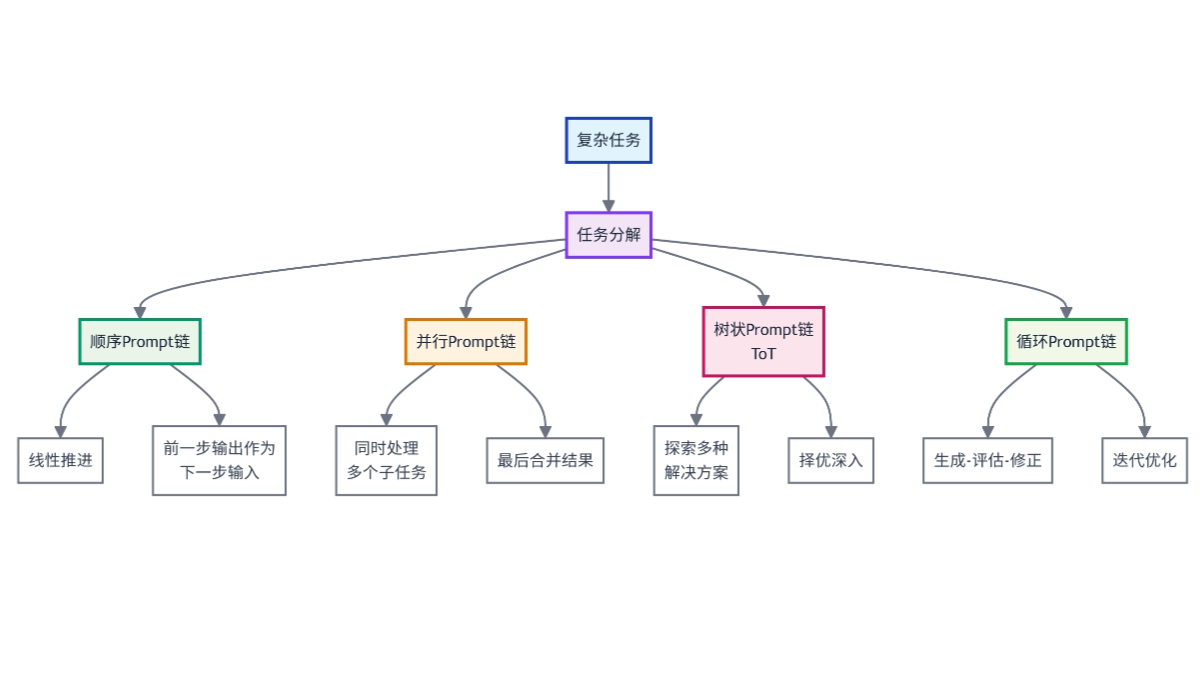
Prompt Chaining is not a single, rigid pattern; it can be designed into a variety of flexible structures according to the characteristics and needs of the task. Understanding different structural types is crucial for designing efficient and reliable AI applications. The main Prompt Chaining structures include sequential chains, parallel chains, tree-like chains, and cyclic chains, which are suitable for different scenarios and have different emphases in efficiency, exploration capability, and optimization capability.
Sequential Prompt Chaining: A Linear, Step-by-Step Task Flow
Sequential Prompt Chaining is a technique that decomposes complex tasks into a series of serial steps through a linear, unidirectional workflow. Its advantages lie in a simple and controllable process, ease of tracking and debugging, and the ability to effectively ensure the coherence and reliability of outputs for tasks with sequential dependencies, such as document question answering and content creation. However, its rigid structure can easily lead to insufficient flexibility, inability to process in parallel or dynamically adjust paths, and the risk of a "single point of failure," where an error in any link may cause the entire chain to be interrupted. It is like a factory assembly line, where each workstation is responsible only for a specific process, and together they ultimately complete product assembly. Although efficiency is considerable, it lacks the ability of a flexible production system to respond to changes, and it appears inadequate when handling complex scenarios that require multi-path exploration or real-time decision-making.
Parallel Prompt Chain: Process independent subtasks simultaneously to improve efficiency
Parallel Prompt Chaining is a chain structure that improves efficiency by simultaneously processing multiple mutually independent subtasks. It can decompose complex tasks into multiple parallel branches executed at the same time, and form the final result through aggregation and integration. The core advantage of this pattern lies in significantly improving processing efficiency and expanding the breadth of information coverage. It is suitable for task scenarios that can be decomposed into independent modules, such as market analysis and comprehensive report generation. It also faces the challenge of output integration, requiring the design of a powerful aggregation mechanism to resolve possible logical conflicts and content duplication among branches. Its consumption of computational resources is relatively high, seeking a balance between efficiency and integration difficulty.
Tree Prompt Chain (Tree of Thoughts ToT): Explore multiple solutions and choose the best
Tree Prompt Chaining (represented by Tree of Thoughts ToT) is an advanced chain structure that simulates the human deep decision-making process. By constructing a tree-shaped thought network for multi-path exploration, it systematizes the problem-solving process into four key stages: thought decomposition, multi-path generation, state evaluation, and intelligent search. The core advantage of this structure lies in its ability to break through the limitation of a single thought path. By generating multiple solutions in parallel and dynamically evaluating and selecting the best, it significantly improves the success rate of complex reasoning, strategic planning, and creative problem solving. The architecture also faces challenges such as high computational complexity and difficulty in designing evaluation criteria. Its implementation requires sophisticated heuristic evaluation mechanisms and search strategy support, and it is regarded as an advanced intelligent reasoning paradigm that seeks the optimal balance between solution complexity and resource consumption.
Loop Prompt Chain: Iteratively optimize based on feedback until standards are met
Loop Prompt Chaining is an advanced chain structure that introduces an iterative feedback mechanism, continuously optimizing output quality through a closed-loop process of "generation-evaluation-correction." The core value of this structure lies in simulating the human process of reflection and correction. Through multiple rounds of self-improvement, it can significantly enhance the completeness and reliability of complex tasks such as code generation and academic writing. The architecture requires carefully designed evaluation criteria and termination conditions. It must strike a balance between iteration depth and output quality, while avoiding falling into the resource-consumption dilemma of infinite loops. It is an intelligent refinement system that seeks a balance between autonomy and controllability.
Implementation Methods: How Prompt Chaining Improves AI Performance
Strategic Level
- Principles and Methods of Task Decomposition
Task decomposition, as the core part of Prompt Chain design, has its effectiveness built on the basic principle of "high cohesion, low coupling." Each subtask should have an independent and complete functional boundary while minimizing dependencies between modules to ensure the system's maintainability and fault tolerance. The criterion for determining decomposition depth should be based on model capability. When the complexity of a subtask drops to the threshold that the current large language model can handle stably, the ideal decomposition state is reached.
Choose among four types of decomposition paths according to task characteristics:
-
- Decomposition by process steps: Suitable for tasks with a clear sequential order.
- Decomposition by functional modules: Suitable for tasks that can be divided into different functional components.
- Decomposition by input data: Commonly used when processing long texts or large datasets.
- Decomposition by logical levels: First background knowledge retrieval, then core problem analysis, and finally conclusion generation.
- Design techniques for subtask Prompts
Designing high-quality Prompts for each subtask is the core part of building an efficient Prompt chain. The key lies in constructing each Prompt as a precise instruction set. It is necessary to guide the model to invoke relevant knowledge by clarifying role positioning and specific tasks, and to provide detailed contextual information to ensure execution accuracy; on this basis, constraining the output to structured formats such as JSON can significantly improve the stability and parseability of the chain. Introducing a few examples can effectively calibrate the model's understanding boundaries for complex tasks. All techniques need to undergo continuous testing and iterative optimization in order to gradually refine precise Prompt instructions that can reliably drive a single module and seamlessly connect upstream and downstream.
- Planning and selection of chain structures
After completing task decomposition and subtask Prompt design, the planning and selection of chain structures becomes the key to determining system performance. It is necessary to comprehensively evaluate task dependencies, complexity, and resource constraints to match the best structure: for strongly dependent linear tasks, use a sequential chain; for independent subtasks, use a parallel chain to improve efficiency; for complex reasoning with multi-path exploration, use a tree-structured chain for systematic optimization; for creative tasks requiring continuous optimization, use a cyclic chain for iterative refinement. The choice is essentially a trade-off among performance, cost, and real-time responsiveness. Simple chains have advantages in response speed and resource consumption, while complex chains are superior in output quality and solution completeness. Precise judgments need to be made according to the core demands of specific application scenarios.
Technical level
- Chained invocation based on large language models (LLM)
Chained invocation based on large language models is the core technical implementation of Prompt chains. Its essence is to transform complex tasks into orderly multiple calls to the LLM API through a programmatic process. In a typical sequential chain, the system submits the first subtask Prompt to the LLM, obtains the output, parses and processes it, and embeds it as key context into the Prompt of the subsequent task, repeating this cycle until the entire chain is completed. The key to this mechanism lies in building a reliable data pipeline to pass intermediate states, and ensuring the stability of the chained process through forced structured output and strict error handling. The implementation method is relatively direct, providing a solid foundation for building complex AI workflows, enabling developers to precisely control the logic and data flow of each stage and realize highly customized intelligent applications.
- Using frameworks such as LangChain to implement Prompt chains
The emergence of specialized frameworks such as LangChain has greatly simplified the process of building Prompt chains. The core value lies in abstracting various components in LLM applications into reusable "chain" structures through modular and standardized design ideas, so that developers do not need to pay attention to the cumbersome details of underlying API calls and data transfer and can focus on business logic and Prompt design. The framework encapsulates implementations from simple sequential chains to complex structures such as dynamic routing and parallel processing, and integrates a rich set of external tools and APIs, significantly lowering the development threshold and improving the overall efficiency of building complex AI agents and applications.
- Structured output control and model behavior constraints
In the implementation of Prompt chains, structured control over model outputs is the technical key to ensuring the stable operation of the chain. This is mainly achieved by mandating data formats such as JSON and setting clear role boundaries and response scopes to constrain model behavior, transforming free-text outputs into standardized data that can be programmatically parsed. To further improve reliability, self-evaluation and correction mechanisms are introduced to let the model perform output validation, or with the help ofLangChainspecialized output parsers from frameworks such as these automatically convert data structures. Together, these multi-layered control methods form the core technical safeguard that guides model behavior and ensures the smooth operation of chained workflows.
The Value, Applications, and Advantages of Prompt Chains
Through structured reasoning methods, Prompt chains demonstrate enormous value in a variety of general AI application scenarios, significantly improving the quality and efficiency of task completion.
Value in General-Purpose AI Applications
- Intelligent Customer Service: In intelligent customer service, Prompt chains break down complex inquiries into a standardized process of "intent recognition -> entity extraction -> information query -> answer synthesis," ensuring precise execution at each step, accurately handling multi-factor user questions, and providing answers based on reliable data, significantly improving resolution success rates and user experience.
- Content Generation: In content generation, Prompt chains modularize the writing process into "outline planning -> section drafting -> polishing and integration," enabling AI to follow the creative logic of human authors and systematically produce well-structured, substantive articles, effectively avoiding the logical confusion and empty content commonly seen in long-text generation.
- Document Question Answering: When faced with information retrieval from long documents, Prompt chains build a pipeline of "question parsing -> precise retrieval -> information integration," capable of understanding complex query intents, locating, extracting, and synthesizing relevant information from different passages, and ultimately generating precise answers, overcoming the limitations of traditional keyword matching in deep question answering.
Application Cases in Specific Domains
- Finance: Improving Stability and Accuracy in Risk Control Models
In the field of financial risk control, Prompt chains decompose the complex credit approval process into serialized steps of "information verification -> credit assessment -> risk identification -> decision generation," building a stable and auditable decision-making system. This enables AI to process multi-source data in stages (such as bank statements and transaction behavior), with each step undergoing independent verification and optimization, significantly improving the accuracy of fraud detection and credit risk assessment. The generated decision reports with supporting evidence greatly enhance the model's interpretability and compliance.
- Healthcare: Assisting Diagnosis and Medical Record Analysis, Improving the Accuracy of Information Extraction
In the healthcare field, Prompt chains simulate expert physicians' clinical reasoning paths (such as "collect symptoms -> preliminary diagnosis -> recommend tests -> interpret results -> formulate a plan"), providing a structured analytical framework for assisted diagnosis. The step-by-step method forces the model to reason progressively, effectively improving the accuracy of extracting key information from complex medical records and analyzing it. Furthermore, comprehensive strategies such as MedPrompt, by dynamically selecting examples, guiding the model to generate reasoning chains, and performing ensemble judgment, can raise AI accuracy in professional medical examinations to a level surpassing humans, demonstrating enormous potential in enhancing diagnostic reliability and supporting decision-making.
- Code Testing: Significantly Improving Code Test Coverage Through Program Slicing
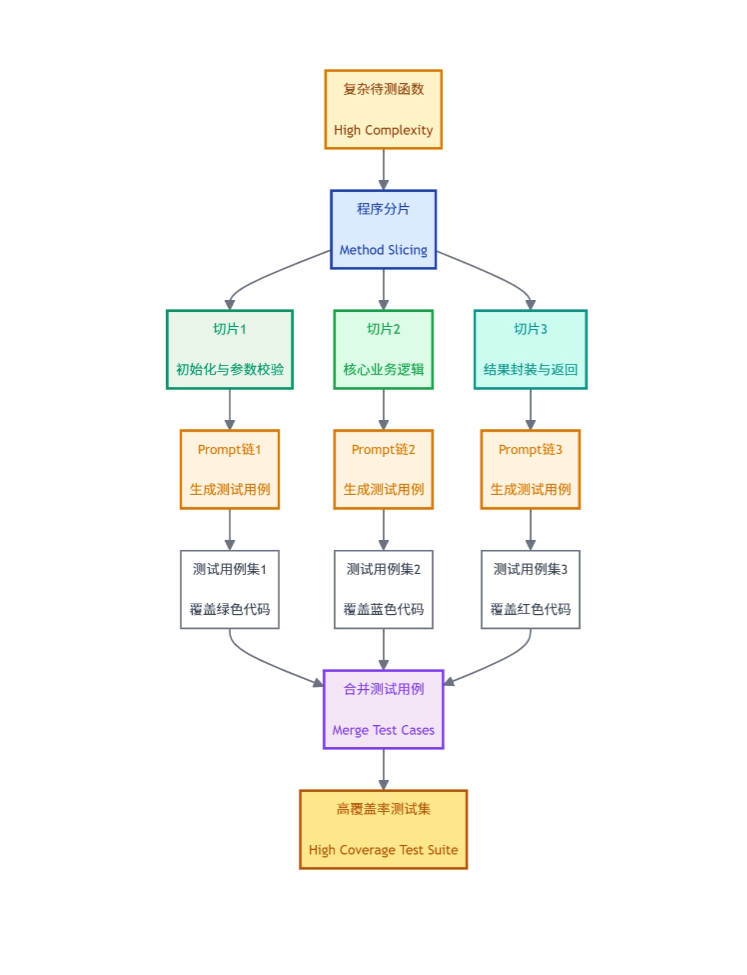
In the field of code testing, when facing complex functions (high cyclomatic complexity), the coverage of traditional methods and direct test case generation by large models is often poor. To address this, the HITS method innovatively combines program slicingideas withPrompt chainingto achieve a breakthrough. The core is to guide the large model to execute a two-step chain: decompose complex functions according to their internal logic into multiple simple code slices with a single function; generate targeted high-coverage test cases for each slice separately. By reducing the complexity of each subtask, the large model can precisely cover various paths and boundary conditions within each slice. By merging the test cases of all slices, a comprehensive test of the original complex function is formed, significantly improving overall code coverage.
Core advantages of Prompt chaining
- Improve the transparency and controllability of AI applications: Prompt chaining makes AI's reasoning process visible and auditable by showing the intermediate output of each step. It completely changes the "black box" mode of a single prompt, allowing developers to precisely locate error links and intervene, laying a foundation of trust for the reliable application of AI in high-risk fields such as finance and healthcare.
- Enhance the reliability and robustness of models in complex tasks: Prompt chaining decomposes complex tasks into modular steps that can be independently verified. It supports setting checkpoints at key links to correct errors in time and prevent them from propagating and amplifying in subsequent processes. Even if a subtask fails, the impact is limited to the local part, ensuring that the entire system remains stable and reliable in the face of uncertainty.
- Reduce dependence on large-scale annotated data: Through ingenious prompt design (such as embedding domain knowledge and Few-shot examples), general models are guided to complete professional tasks, shifting the focus of adaptation from expensive "data-driven" fine-tuning to efficient "instruction-driven" approaches. This greatly reduces development costs and barriers, and provides strong support for rapid prototype validation and the application of AI in data-scarce scenarios.
Challenges and future trends
Currently, Prompt chaining technology faces three core challenges: first, the design process is complex and highly dependent on expert experience, lacking systematic methodologies and tools; second, chain invocation leads to cumulative response delays and significantly increased operating costs, affecting real-time applications and economic feasibility; third, the overall performance evaluation and optimization system is missing, making it difficult to quickly diagnose bottlenecks and iterate effectively.
Looking ahead, development trends will unfold around three major directions. Automated prompt engineering will significantly lower the threshold for use through AI self-optimization and generated chains; next-generation models will natively integrate task decomposition and reasoning capabilities, improving the efficiency and reliability of handling complex problems from the architectural level; more importantly, Prompt chaining will go beyond the current scope of text processing and develop into a core framework for coordinating multimodal tasks and driving autonomous agents. Through structured workflow management, it will enable collaborative processing of multimodal information such as images, speech, and text, provide systematic support for agents' planning and decision-making and tool invocation, and drive AI applications toward a higher level of autonomy and intelligence.