
What Is PixVerse Game
PixVerse Game is the first real-time video game engine launched by AIsphere, built on a PixVerse R1 real-time world model, building a complete game experience on a single real-time interactive video stream, allowing creators to generate interactive game worlds in real time by defining rules and worldviews.
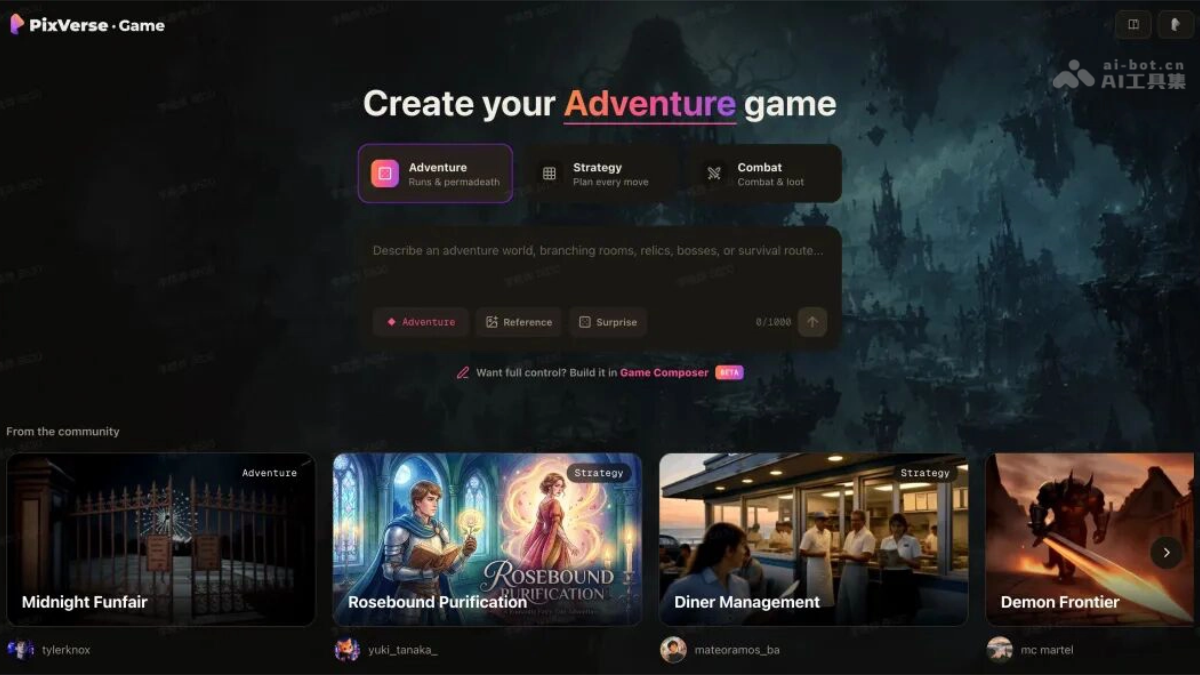
Main Features of PixVerse Game
-
Real-Time Video Stream Game Rendering: Replaces traditional modeling and animation pipelines with continuously generated dynamic visuals.
-
Natural Language World Building: Players participate directly in world generation, character creation, and plot rewriting through text input.
-
Genre-Based Game Templates: Built-in playable prototype templates such as adventure, strategy management, and action combat.
-
Visual Toolchain: Low-threshold building of game mechanics and narrative logic through tools such as Game Composer.
-
AI Agent Orchestration: Drives NPCs and events to respond in real time based on player input while maintaining consistency.
Technical Principles of PixVerse Game
-
Real-Time World Model: Continuously generates frames based on PixVerse R1 with low latency, continuously receiving user input and providing instant feedback.
-
MED (Mechanism-Expression Decoupling): Separates abstract game rules from visual presentation, enabling independent iteration of gameplay and visuals.
-
GGL (Generative Game Loop): The model generates subsequent visuals and events in each frame based on player actions and mechanism states.
-
LCO (Real-Time Consistency Orchestration): Ensures that character appearances, scene styles, and narrative logic remain coherent across multiple rounds of interaction.
-
Multimodal Interaction Understanding: Integrates text, images, and real-time feedback signals to drive the dynamic evolution of world states.
How to Use PixVerse Game
PixVerse Game is still in an early closed beta stage, open only to some creators, and is not yet fully open to the public.
Core Advantages of PixVerse Game
-
Extremely Low Creation Barrier: No modeling, programming, or art background is required, and non-technical users can also make games independently.
-
Greatly Shortened Development Cycle: A traditional 3-6 month pipeline can be compressed to complete an early playable version in a few weeks.
-
Dynamic Infinite Content: The game world does not rely on preset assets and can grow and change in real time with player behavior.
-
Natural Language Driven: Conversational interaction replaces complex engine operations and scripting.
-
Strong Character Consistency: LCO technology ensures stable and unified characters and visual styles in long-form games.
PixVerse Game Project Address
- Project Official Website:https://pixverse.ai/en/blog/pixverse-game-engine-deep-dive
Comparison of PixVerse Game with Similar Competitors
| Dimension | PixVerse Game | Oasis (Decart) | Genie 2 (Google DeepMind) |
|---|---|---|---|
| Positioning | Real-time video stream game engine | Real-time interactive world system | Interactive world generation model |
| Interaction Method | Natural language + real-time input | Real-time keyboard action control | Text/image prompt driven |
| Latency Performance | Low-latency real-time feedback | Real-time streaming generation | Single-frame generation, non-real-time stream |
| Game mechanics | Built-in abstraction mechanism engines (MED/GGL) | Focus on physics and action simulation | Focus on open-world exploration |
Application scenarios of PixVerse Game
-
Independent game prototype validation: Small teams use a weeks-long cycle to rapidly build playable versions of vertical categories such as otome, adventure, and management, replacing the traditional 3-6 month pipeline.
-
Interactive narrative and visual novels: Creators use natural language to build dynamic story worlds rich in branching plots, where player choices immediately affect visuals and the direction of events.
-
AI virtual streamers and livestream interaction: Creators without a technical background can build virtual characters that respond in real time to bullet comments, gifts, and scene changes, enabling instant-feedback performances.
-
Education and immersive simulation: Build interactive historical scenes, language environments, or business decision sandboxes, allowing learners to explore and practice in real-time generated worlds.
-
Community-driven UGC game ecosystem: Ordinary players participate in setting world rules and co-creating content, forming a collectively created game that continuously evolves and expands without limit.