
What is PilotDeck
PilotDeck is an agent operating system jointly open-sourced by Tsinghua University's THUNLP Lab, ModelBest, OpenBMB, and AI9stars. PilotDeck takes WorkSpace as its core design paradigm, establishing an independent file system, memory storage, and skill set for each project to achieve multi-task parallelism and physical isolation. The system supports memory white-boxing, intelligent routing for dynamic model allocation, and 24-hour Always-on resident tasks, with measured cost savings of over 70%. It also supports device-cloud collaboration and automatic deployment of on-device models, enabling AI to evolve from a conversational toy into a true productivity tool.
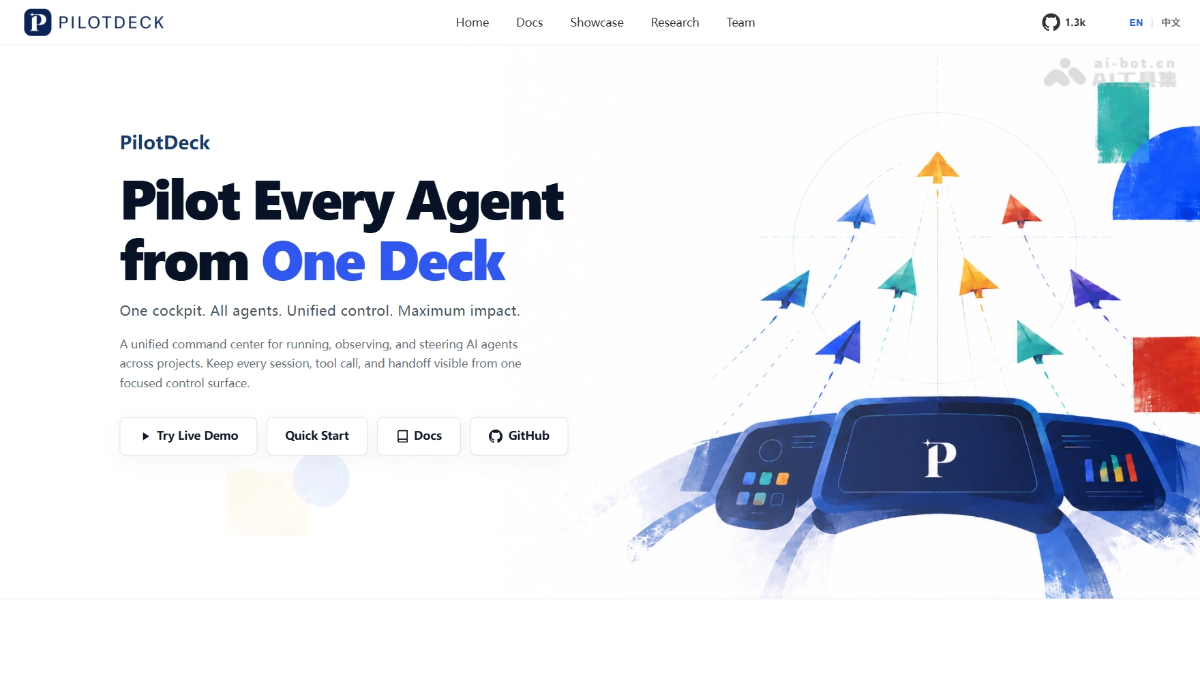
PilotDeck's main features
-
WorkSpace: Establishes an independent living space for each project, including a dedicated file system, memory, and skills, achieving project-level physical isolation.
-
Memory white-boxing: The entire memory chain is visible, controllable, and traceable. Users can view, precisely locate, and one-click correct or delete erroneous memories at any time.
-
Intelligent routing: Automatically identifies task difficulty and dynamically allocates models, calling lightweight on-device models for simple tasks and top-tier cloud models for complex tasks.
-
Always-on resident tasks: The Agent proactively discovers unfinished tasks and advances them autonomously without the need for continuous manual triggering, achieving 24-hour online operation.
-
Device-cloud collaboration: Supports calling on-device models as sub-agents to execute specific tasks, and can automatically deploy on-device models (such as VoxCPM) to complete tasks like speech generation.
PilotDeck's technical principles
-
Three-layer WorkSpace architecture: Each WorkSpace consists of a dedicated file system, dedicated memory storage, and a dedicated skill set, achieving project-level resource boundary isolation.
-
Memory white-box mechanism: Adopts full-chain memory storage and visual traceability, supports task-based Dream automatic organization and optimization, and features one-click rollback to prevent memory contamination.
-
Intelligent routing algorithm: Automatically grades tasks based on complexity, and achieves dynamic scheduling of strong and weak models through the orchestration of a main Agent and sub-agents, optimizing the balance between cost and effectiveness.
-
Resident task engine: Grants the Agent proactivity, enabling it to autonomously scan project status, discover to-dos, execute operations, and generate output files.
-
Cross-project knowledge transfer: Supports skills accumulating and evolving as tasks progress, achieving controllable knowledge transfer and reuse across different WorkSpaces.
How to use PilotDeck
- One-click installation: Run the official curl command in the macOS or Linux terminal to complete installation.
- Start the service: Execute the
pilotdeckcommand to start, and visithttp://localhost:3001in the browser to enter the console. - Create a WorkSpace: Create a new WorkSpace in the Web interface, and set the project name and file boundaries.
- Configure skills: One-click install the skill packages required by the project, and the Agent will automatically accumulate dedicated capabilities as tasks progress.
- Issue instructions: Enter natural language tasks in the dialog box, and the Agent will automatically plan, execute, and continuously advance them. Users can view memory and progress at any time.
PilotDeck's project address
- Project website:https://pilotdeck.openbmb.cn/pilotdeck.github.io/
- GitHub repository:https://github.com/OpenBMB/PilotDeck
Comparison of PilotDeck with similar competing products
| Dimension | PilotDeck | OpenClaw |
|---|---|---|
| Architecture Core | WorkSpace Work Cabin = Project-level OS | Gateway = Message Channel Hub |
| Permission Model | Free operation within the work cabin, physical isolation between cabins | System-wide permissions, risk and capability coexist |
| Memory Strategy | White-box memory + automatic organization + one-click rollback | Black-box vector memory, long-term persistent |
| Proactivity | Agent proactively discovers tasks and pushes them forward | Heartbeat scheduled triggering + message-driven |
| Cost | Built-in intelligent routing automatically saves money | Depends on users to manually select models |
| On-device | Native automatic deployment of on-device models | Requires manual configuration of Ollama |
| Security | Clear boundaries, controllable scope of impact from misoperations | Excessive permissions, requires self-hardening |
PilotDeck Application Scenarios
-
Game Development: Generate an interactive 3D open-world game (such as a Zelda style) within one day using on-device models, including rich elements and physical interactions.
-
Multilingual Podcast Generation: Integrates with the VoxCPM large speech model to generate multilingual podcast content supporting 30 languages with one click.
-
Mobile Application Development: Rapidly develop lightweight application prototypes such as mobile gyroscope mini-games.
-
AI Model Training: Automatically execute model training workflows, supporting continuous background operation and progress tracking for long-cycle tasks.
-
Long-cycle Content Creation: Used for complex document projects requiring continuous iteration and memory accumulation, such as industry white paper writing and script creation.