
What is OpenScience
OpenScience is an open-source AI research workbench launched by Synthetic Sciences, aimed at machine learning, biology, physics, and chemistry research. The platform supports the complete research cycle from literature review, hypothesis generation, code writing, experiment execution to result analysis and paper writing. It supports switching to any large model per request, and includes more than 250 editable skills and about 30 scientific databases as agent tools. Users can bring their own API keys to run it for free on local infrastructure, install it with one npm command, and do not need to register an account.
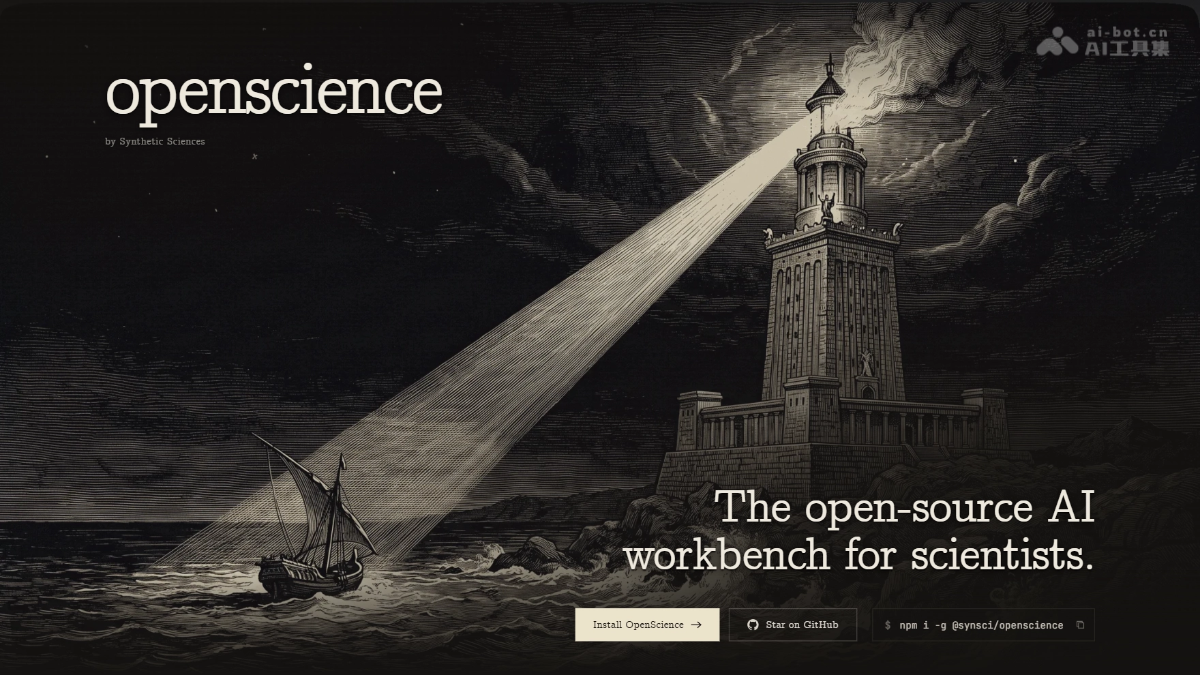
Main features of OpenScience
-
Complete research cycle: covers literature search, hypothesis generation, code writing, experiment execution, data analysis, and paper writing.
-
Model-agnostic routing: supports Claude, GPT, Gemini, GLM, Kimi, DeepSeek, and local fine-tuned models, with free switching per request.
-
250+ editable skills: covers training (DeepSpeed, PEFT, TRL), evaluation, dataset processing, cheminformatics, LaTeX, charts, and cloud computing.
-
Scientific database tools: integrates about 30 databases including UniProt, PDB, Ensembl, ChEMBL, PubChem, arXiv, OpenAlex, Semantic Scholar, and more.
-
Professional agents: research, biology, physics, and machine learning agents, as well as critical review and literature review sub-agents.
-
Built-in workspace: file tree, editor, terminal, session history, with inline rendering of molecules, structures, genomes, and charts.
-
Extensible architecture: supports LSP integration, MCP servers, plugins, and TypeScript SDK.

Follow WeChat and reply "open source" to jointhe AI Open Source Project Exchange Group
How to use OpenScience
-
Install: globally install the npm package
npm install -g @synsci/openscience。 -
Launch: run the
opensciencecommand to open the workspace in the browser. -
Select a model: on first run, choose an Atlas hosted model, bring your own provider key, or use the free demo model.
-
Set a goal: enter a research goal in the workspace, and the agent automatically advances the literature, hypothesis, code, experiment, and writing workflows.
-
Switch models: in the model selector, switch to any provider or local model per request without changing the configuration.
-
Extend and customize: customize skills and agents through LSP, MCP servers, plugins, or the TypeScript SDK.
Core advantages of OpenScience
-
Fully open source and auditable: licensed under Apache 2.0, with all code and skills open and readable, and the scientific reasoning chain transparent and reproducible, completely avoiding black-box risks.
-
Model-agnostic with zero lock-in: supports free switching per request among Claude, GPT, Gemini, DeepSeek, and local models, with seamless access as soon as new models are released, without being tied to a single vendor.
-
Data localization compliance: runs on your own infrastructure, with private datasets and API keys kept entirely local, meeting compliance requirements for sensitive domains where data must not leave the domain; bring your own key is free and has no call limits.
-
Industry-leading tool coverage: Built in with over 250 editable skills and about 30 scientific databases, its tool breadth far exceeds similar closed-source products and supports continuous expansion.
-
Deeply integrated professional workspace: A complete browser workspace including a file tree, editor, and terminal, supporting inline rendering of molecular structures and genome maps, seamlessly integrating scientific research workflows with the coding environment.
OpenScience project address
- Project official website:https://www.openscience.sh/
- GitHub repository:https://github.com/synthetic-sciences/openscience
Comparison of OpenScience with similar competitors
| Dimension | OpenScience | Claude Science |
|---|---|---|
| License | Apache 2.0 open source | Proprietary product |
| Model support | Any provider or local models | Anthropic Claude only |
| Model switching | Switch freely per request | Fixed to Claude |
| Cost | Free with your own key, no restrictions | Requires a paid Claude subscription |
| Skills/tools | 250+ editable and extensible | 60+ curated skills |
| Runtime location | Own infrastructure, browser workspace | Lab machine (macOS/Linux beta) |
| Databases | About 30 (UniProt, PDB, ChEMBL, arXiv, etc.) | UniProt, PDB, ChEMBL, GEO, etc. |
OpenScience application scenarios
-
Machine learning research: ML agents pull arXiv papers, use PEFT and TRL skills to write training scripts, perform fine-tuning, and generate reports.
-
Computational biology: Biology agents query UniProt and PDB, render protein structures inline, propose candidate mutation plans, and record sources.
-
Cheminformatics: Agents query ChEMBL and PubChem for bioactivity data, run screening filters, and return ranked candidate molecules with charts.
-
Model comparison under budget constraints: Teams run the same task on Claude, GLM, and local models, switching with one click to compare cost and quality.