
What is Claude Science
Claude Science is an AI research workbench launched by Anthropic, positioned as an AI work platform for scientists. The platform is a research-specific environment based on Claude Opus 4.8, integrating literature search, data analysis, code execution, chart generation, and paper writing into a single interface. The product includes more than 60 preconfigured scientific skills and connectors, covering fields such as genomics, proteomics, and cheminformatics, and supports local macOS/Linux operation or remote HPC cluster access, equipped with a Reviewer Agent to automatically check citations and calculation errors.
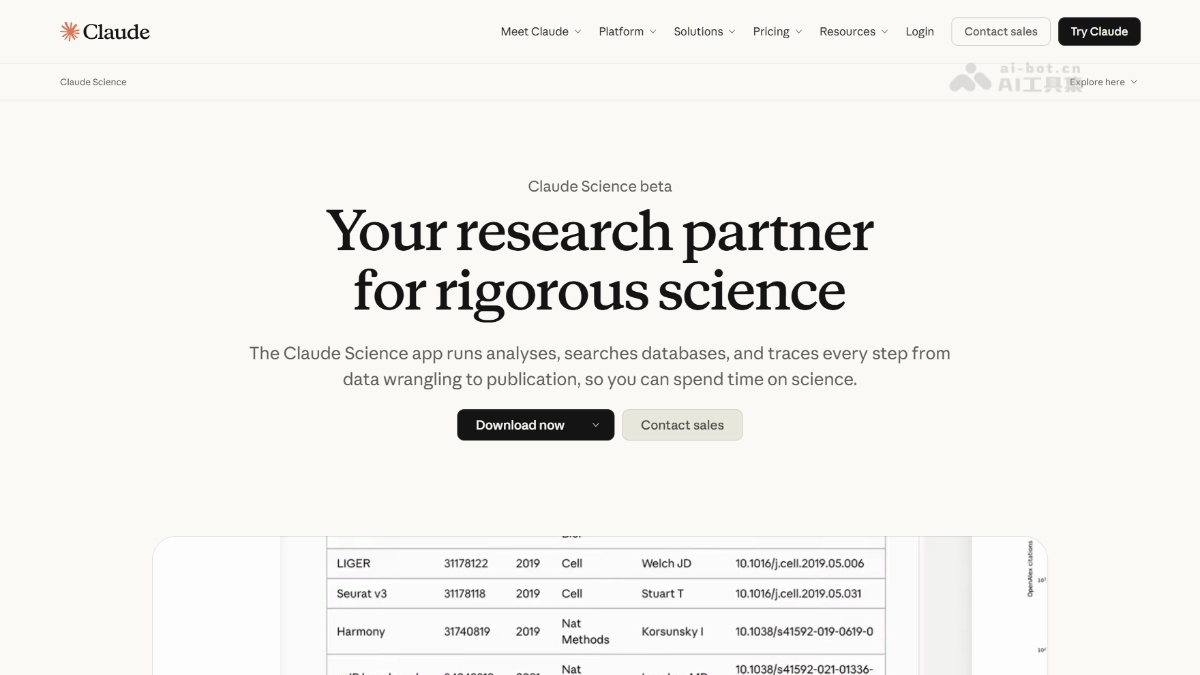
Main features of Claude Science
-
Literature review and multi-source search: Searches databases such as PubMed, bioRxiv, and OpenAlex in parallel, and automatically generates review reports.
-
Data analysis and code execution: Supports languages such as Python and R, and can directly run and iterate data analysis workflows.
-
Scientific chart generation: Natively renders 3D protein structures, genome browser tracks, chemical structures, etc., with complete generation code attached.
-
Paper writing and editing: Generates LaTeX documents and PDFs, and supports modifying charts and text in natural language.
-
Multi-agent collaboration: The main Agent coordinates sub-agents to process tasks in parallel, and users can connect custom expert Agents.
-
Fact-checking: The Reviewer Agent automatically checks citations, calculations, and chart consistency, and marks and corrects errors.
How to use Claude Science
- Visit the official website: Visit the Claude Science official website https://claude.com/product/claude-science。
- Obtain access: Subscribe to a Claude Pro, Max, Team, or Enterprise plan, and apply for Claude Science Beta access.
- Installation and deployment: Install the client on a local macOS or Linux device, or connect via SSH to a remote HPC login node to integrate with an existing computing environment.
- Create a research project: Create a new project and select the corresponding scientific field (such as genomics, proteomics, cheminformatics, etc.), and the system will automatically load the relevant preconfigured skill packages.
- Describe research needs: Present research questions to the general coordination Agent in natural language, and the Agent will automatically plan the analysis workflow and split it into subtasks.
- Execution and collaboration: The coordination Agent dynamically creates sub-agents to process data analysis, literature search, or code execution in parallel, and users can view progress and intermediate results in real time.
- Iteratively revise results: Provide modification suggestions in natural language for generated charts, code, or paper paragraphs, and the Agent will automatically adjust the underlying code and re-render the output.
- Checking and verification: Enable the built-in Reviewer Agent to check citation sources, calculation logic, and chart consistency, mark errors, and prompt the Agent to self-correct.
- Scale computing resources: When tasks require large-scale computing power, submit jobs to a laboratory HPC cluster or Modal cloud GPUs to achieve elastic scaling from a single GPU to hundreds of GPUs.
- Audit and export: All outputs include complete generation code, runtime environment configuration, and natural language explanations, and support export as reproducible, auditable research result packages.
Core advantages of Claude Science
- Full-process integration: unify scattered research tools such as literature retrieval, data analysis, code execution, chart generation, and paper writing into a single auditable research environment.
- Reproducibility assurance: each output comes with complete generated code, runtime environment configuration, and natural language creation instructions, ensuring that research results can still be verified and reproduced months later.
- Multi-agent collaboration: a general coordination Agent can automatically split complex tasks and dynamically create sub-Agents for parallel execution, and users can also connect custom expert Agents to participate in collaboration.
- Data security and localization: supports running on local laptops, Linux servers, or laboratory private HPC clusters, so sensitive datasets do not need to leave existing infrastructure.
- Deep domain coverage: built in with more than 60 preconfigured scientific skills and connectors, with native support for core life science domains such as genomics, single-cell analysis, proteomics, and cheminformatics.
Comparison of Claude Science with similar competitors
| Comparison dimension | Claude Science | Gemini for Science |
|---|---|---|
| Developer | Anthropic | Google DeepMind |
| Product positioning | AI research workbench (Workflow-first) | Research platform + proprietary model toolbox (Model-first) |
| Underlying model | Claude Opus 4.8 (general-purpose model) | Gemini + AlphaFold + AlphaGenome and other proprietary models |
| Core capabilities | Multi-agent collaboration, full-process research integration, literature review, code execution, chart generation, paper writing | Protein structure prediction, genomic analysis, molecular modeling, multi-database querying |
| Degree of openness | Available with a subscription (Pro / Max / Team / Enterprise) | Some tools are open (such as AlphaFold), while the core platform and proprietary models are restricted |
| Data security | Local / private HPC operation, sensitive data does not leave laboratory infrastructure | Mainly cloud deployment, hybrid architecture |
Application scenarios of Claude Science
- Genomics and single-cell analysis: supports cross-species single-cell RNA sequencing data integration, differential expression analysis, and cell type annotation, such as processing large-scale COVID-PBMC datasets for scVI hyperparameter screening and visualization.
- Protein structure research: natively renders 3D protein structures, supports structure comparison, visualization of folding prediction results, and protein language model embedding analysis.
- Cheminformatics and new drug discovery: draws molecular structure diagrams, calculates compound properties, screens candidate drug molecules, and accelerates target validation and germline variant analysis workflows.
- Literature review and knowledge integration: performs parallel retrieval from databases such as PubMed, bioRxiv, OpenAlex, and CELLxGENE, and automatically generates LaTeX-format review reports with citations, charts, and statistical data.
- Multi-omics data integration: integrates genomics, proteomics, and transcriptomics data to build cross-species, cross-platform multi-omics bioinformatics analysis workflows.