
What is OpenGame
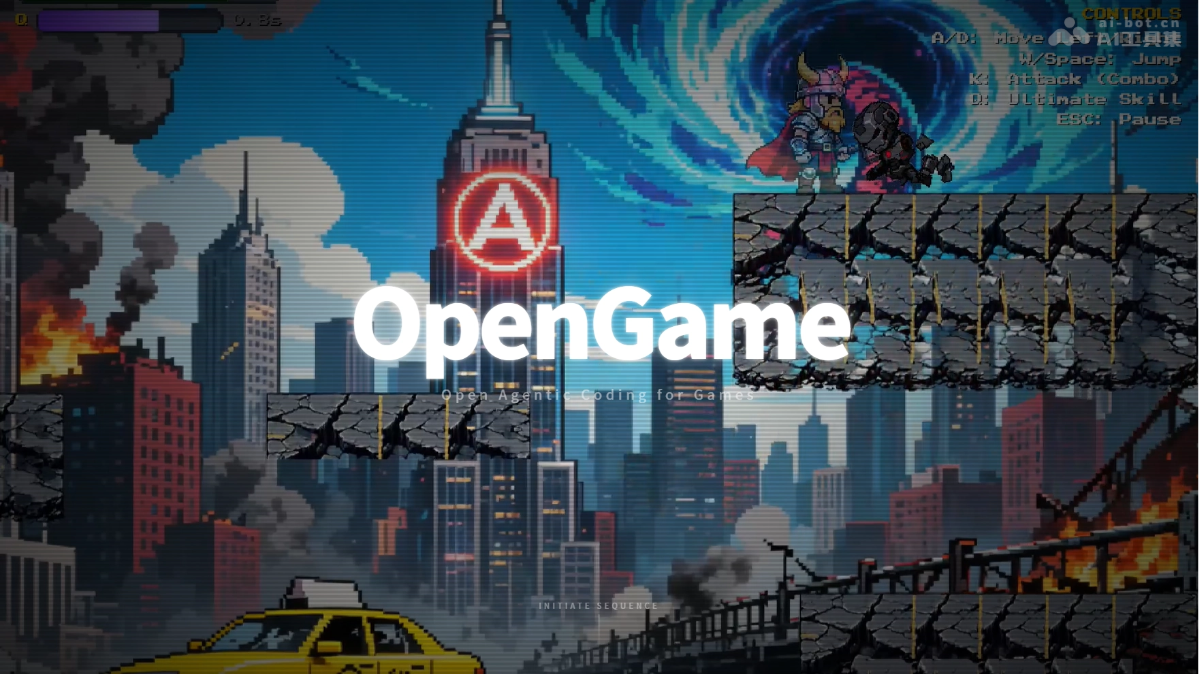
OpenGame is the first end-to-end web game agent framework open-sourced by CUHK MMLab, which automatically generates playable web games through natural language prompts. The framework's core Game Skill consists of Template Skill (a project skeleton template library) and Debug Skill (a dynamic debugging protocol), equipped with GameCoder-27B, a three-stage code model trained specifically for game engines, and paired with the OpenGame-Bench dynamic evaluation benchmark, systematically solving the challenges of cross-file inconsistency and logic defects.
OpenGame's Main Features
- End-to-End Game Generation: Accepts natural language design requirements and automatically outputs a complete, buildable, and runnable web game project, covering the entire process from concept to finished product.
- Game Skill System (Game Skill)
-
Template Skill: Based on physics mechanism classification (such as side-scrolling gravity, top-down continuous movement, discrete grid, etc.), automatically selects and instantiates a stable project template family, ensuring cross-file structural consistency.
-
Debug Skill: Maintains a dynamic debugging protocol, accumulating error signatures, root causes, and verified fix solutions, achieving systematic integration error fixes rather than isolated syntax patches.
-
- Game Design Document (GDD) Auto-Generation: Transforms natural language requirements into a technical GDD, dynamically loading engine API constraints to ensure mechanisms are feasible under the selected framework.
- Multimodal Asset Generation: Calls image, audio, and video generation models to automatically synthesize backgrounds, character animations, sound effects, tilemaps, and other resources based on the GDD asset list.
- Three-Tier Reading Strategy Code Implementation: Through progressively loading API summaries, target source code, and implementation guides, combined with the template method pattern (Hook-Driven) to inject game logic, avoiding context overflow.
- Verification and Self-Correction Loop: Executes builds and tests through a headless browser, parses compilation output, and iteratively fixes until the game is playable.
OpenGame's Technical Principles
- GameCoder-27B Three-Stage Training: Based on the Qwen3.5-27B backbone, through continuous pre-training (CPT, Phaser/JS game code and documentation), supervised fine-tuning (SFT, GPT-Codex generating complex design prompts and MiniMax synthesizing high-quality solutions), and execution reinforcement learning (RL, single-file module-level unit test feedback), establishes game engine architecture priors and API usage patterns.
- Physics-First Classification Mechanism: Classifies game requirements into prototypes based on physical constraints and spatial mechanisms (such as "falling without ground support" mapped to the platformer prototype), guiding subsequent template selection.
- Template Method Pattern (Hook-Driven Implementation): The agent copies template files and overrides specified hook methods (such as
setupCustomCollisions), injecting specific logic while preserving the determinism of basic lifecycle management. - Dynamic Agent Evolution: Template Skill evolves from a single meta-template M0 through accumulated experience into a template library L containing five families (gravity side-view, top-down continuous movement, discrete grid, path wave, UI-driven). Debug Skill records error signatures, root causes, and verified fixes from execution failures, forming a Living Debugging Protocol P, which includes pre-execution validation for high-frequency inconsistency categories.
- OpenGame-Bench Dynamic Evaluation: Generates games by executing them through a headless browser, combined with VLM (Vision-Language Model) judging, scoring across three dimensions—Build Health, Visual Usability, and Intent Alignment—surpassing static unit tests.
How to use OpenGame
- Environment Setup: Install Node.js 20+, clone the repository and run
npm install、npm run build、npm link, register theopengamecommand to the system path. - Configure API Keys: Set
OPENAI_API_KEYand optionallyOPENAI_BASE_URL、OPENAI_MODEL; also configure multimodal provider keys (image, video, audio, reasoning), such as DashScope, Doubao, etc., refer to.env.example。 - Generate a Game: Create an empty directory, run
opengame -p "Build a Snake clone with WASD controls and a dark theme." --yolo, the agent will automatically complete the end-to-end build. - Run Locally: Enter the generated project directory, run
npm installandnpm run dev, openhttp://localhost:5173in the browser to play. - Advanced Configuration: Behavior can be adjusted via
settings.json(user-level~/.qwen/settings.jsonor project-level.qwen/settings.json) and CLI parameters; settingGAME_TEMPLATES_DIRandGAME_DOCS_DIRallows creating games anywhere using absolute paths.
Key information and usage requirements of OpenGame
-
Open Source License: Open source project, built as an extension based on qwen-code.
-
Operation Mode: Currently in command-line Headless mode, one-click prompt-driven generation.
-
Model Dependency: Supports OpenAI-compatible APIs, with optional backends such as GameCoder-27B (locally deployed) or Claude Sonnet 4.6.
-
Multimodal Requirements: You must configure API keys for image, video, and audio generation services yourself; the framework does not include default providers.
-
Node.js Version: Requires Node.js 20 or above.
Core advantages of OpenGame
-
First game-specific agent framework: Unlike general-purpose code agents, it is designed specifically for complex multi-file engineering and real-time interactive systems of end-to-end web games.
-
Structural Stability: Template Skill significantly reduces cross-file inconsistencies and scene connection errors through physical prototype classification and template family instantiation.
-
Cumulative Debugging: Debug Skill's Living Protocol makes fix experience reusable, avoiding repeated discovery of the same integration errors.
-
Domain-Specific Model: GameCoder-27B, trained in three stages on game code, masters engine APIs and multi-file game logic, outperforming general-purpose LLMs.
-
Dynamic Playability Verification: OpenGame-Bench evaluates actual interaction quality through a headless browser and VLM, rather than only checking static code compilation.
-
SOTA Performance: On 150 diverse game prompts, when equipped with Claude Sonnet 4.6, it achieves Build Health 72.4, Visual Usability 67.2, and Intent Alignment 65.1, surpassing baselines such as Cursor.
OpenGame's project addresses
- Project Website:https://www.opengame-project-page.com/
- GitHub Repository:https://github.com/leigest519/OpenGame
- arXiv Technical Paper:https://arxiv.org/pdf/2604.18394
Comparison of OpenGame with similar competing products
| Comparison Dimension | OpenGame | Cursor + Claude Sonnet 4.6 | Claude Sonnet 4.6 direct generation |
|---|---|---|---|
| Product positioning | Purpose-built agent framework for end-to-end web games | General-purpose AI programming IDE + agent backend | General-purpose large language model zero-shot code generation |
| Project scaffolding | Template Skill automatically matches a multi-file template family based on the physical prototype, enforcing Hook-Driven code organization | No game-specific scaffolding, relies on general file navigation and manual initialization | Easily degrades into single-file Vanilla HTML5/JS, lacking cross-file state synchronization |
| Debugging mechanism | Debug Skill dynamically accumulates an integrated error-fixing protocol, pre-execution validation + runtime iterative repair | General-purpose compilation error fixing, with no dedicated accumulation for game runtime and scene connection errors | No systematic debugging loop, requires repeated manual prompts for correction |
| Evaluation method | OpenGame-Bench: headless browser + VLM dynamic playability evaluation | Static unit tests or manual inspection | Static code inspection or manual playtesting |
| Build Health (BH) | 72.4 | 66.8 | 59.8 |
| Visual Usability (VU) | 67.2 | 61.4 | 61.3 |
| Intent Alignment (IA) | 65.1 | 58.9 | 55.2 |
| Core gap | Structural advantage: template-based scaffolding + dynamic debugging protocol systematically resolve cross-file inconsistency | General-purpose tools lack solidified game-domain knowledge, and complex projects are prone to logic drift | Bare models lack engineering constraints, with frequent global state loss and scene connection errors |
OpenGame application scenarios
-
Independent developer prototype validation: Quickly turn game ideas into playable demos, lowering the early-stage technical barrier and engine learning cost.
-
Educational interactive content development: Teachers can integrate curriculum knowledge points (such as physics and mathematics) into game mechanics, generating quiz-based fighting or level-clearing games to assist teaching.
-
Marketing and social media viral content: Bloggers or brands can quickly generate customized interactive mini-games based on trending memes or IP for social media distribution.
-
Game design concept validation: Designers can quickly generate interactive prototypes through natural language descriptions to validate the feasibility of core gameplay and visual style.
-
AI game generation research: Provides academia with a standardized end-to-end game generation framework and evaluation benchmark (OpenGame-Bench), driving code agents to evolve toward complex interactive applications.