
What is OpenBioMed
OpenBioMed is an open-source platform jointly launched by the Institute for AI Industry Research (AIR) at Tsinghua University and Shuimu Bio, focusing on AI-driven biomedical research. It is a multimodal representation learning toolkit capable of processing various biomedical data such as molecules, proteins, and single cells. The platform provides more than 20 tools and deep learning models, such as the BioMedGPT series, supporting a wide range of applications from traditional drug discovery tasks to multimodal challenges.
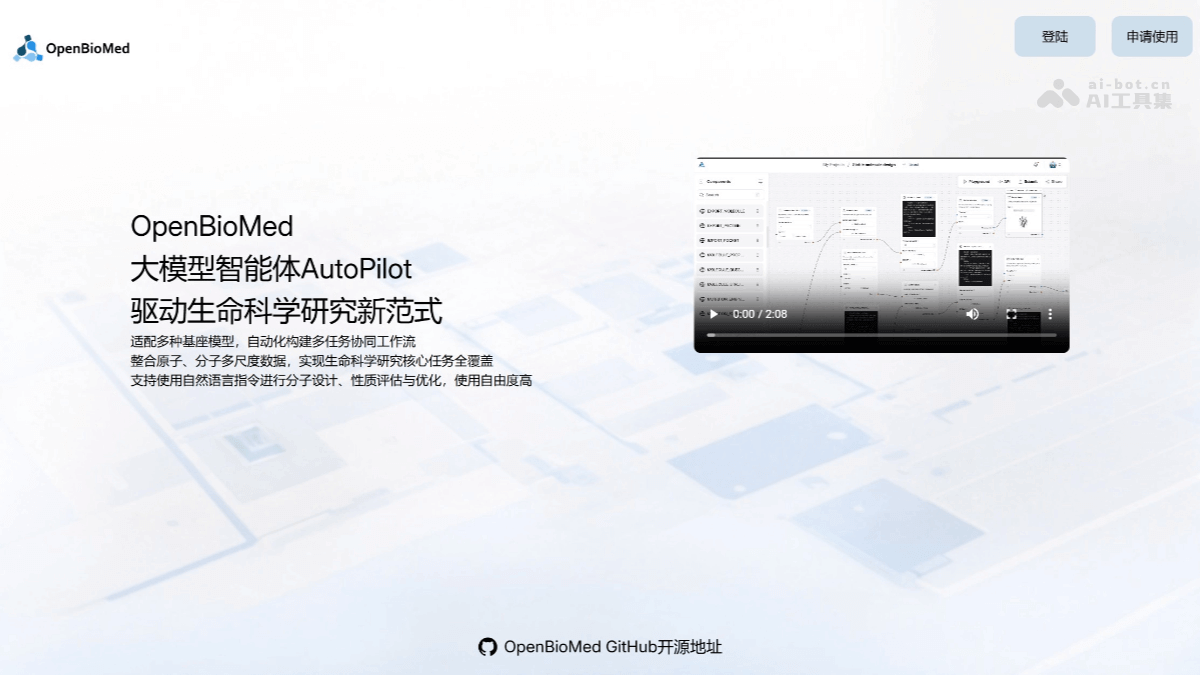
Main features of OpenBioMed
- Multimodal data support: Supports various biomedical data such as molecular structures, transcriptomics, knowledge graphs, and biomedical texts of small molecules, proteins, and single cells.
- Unified data processing framework: Easily loads data of different biomedical entities and different modalities, and converts them into a unified format.
- Rich pretrained models: Includes more than 20 deep learning models, such as BioMedGPT-10B, MolFM, CellLM, etc., which can be used for various biomedical tasks.
- Diverse computational tools: Built more than 20 computational tools, covering molecular property and structure prediction, molecular retrieval, molecular editing, molecular design, etc.
- Model prediction module: Releases the parameters of pretrained models and provides use cases, making it easy to transfer to other data or tasks.
- Drug development: Can predict drug-target binding affinity, molecular properties, and drug response, accelerating new drug development.
- Multimodal understanding: Through cross-modal retrieval, helps scientists find textual descriptions related to molecules or proteins.
- Precision medicine: Based on CellLM for cell type classification and single-cell drug sensitivity prediction, promoting personalized treatment.
- Intelligent question answering: BioMedGPT can answer complex questions about molecules and proteins.
- Agent design: With a visual editing mode, researchers can easily invoke cutting-edge AI algorithms and tools by drag-and-drop, completing the design and development of agents.
Technical principles of OpenBioMed
- Multimodal data processing: OpenBioMed provides flexible APIs for processing multimodal biomedical data, including molecular structures, transcriptomics, knowledge graphs, and biomedical texts of small molecules, proteins, and single cells.
- Deep learning models: OpenBioMed integrates more than 20 deep learning models, such as BioMedGPT-10B, MolFM, CellLM, etc. Through advanced neural network architectures, it can handle tasks ranging from traditional AI drug discovery to emerging multimodal challenges.
- Pretrained models and inference: OpenBioMed provides ready-to-use pretrained models and inference demos, trained on large-scale biomedical data, and can quickly transfer to users' own data or tasks.
- Tools and applications: OpenBioMed has built more than 20 computational tools, covering downstream tasks from molecular property prediction to protein folding, cell type classification, etc. These tools support a wide range of scenarios from basic research to clinical applications, for example, generating molecular descriptions through the MolFM model, or using the CellLM model for cell type classification.
- Agents and workflows: OpenBioMed provides an easy-to-use interface for building workflows that connect multiple tools and developing agents based on large language models (LLMs). The agents can simulate a trial-and-error process, helping researchers gain scientific insights in complex biomedical tasks.
OpenBioMed's project address
- Project official website:openbiomed.pharmolix.com
- Github repository:https://github.com/PharMolix/OpenBioMed
OpenBioMed's application scenarios
- Drug discovery: With OpenBioMed's powerful data processing capabilities and advanced machine learning algorithms, researchers can quickly screen out potentially effective drugs.
- Multimodal understanding: OpenBioMed supports cross-modal retrieval, helping scientists find textual descriptions related to molecules or proteins and enhancing the understanding of biomedical entities.
- Precision medicine: In the field of precision medicine, OpenBioMed uses the CellLM model for cell type classification and single-cell drug sensitivity prediction, driving progress in personalized treatment.
- Knowledge graph construction: OpenBioMed provides tools for building knowledge graphs, helping researchers organically organize elements such as genes, proteins, drugs, and clinical symptoms to form a vast and finely detailed knowledge network.