
What is OpenAI Privacy Filter
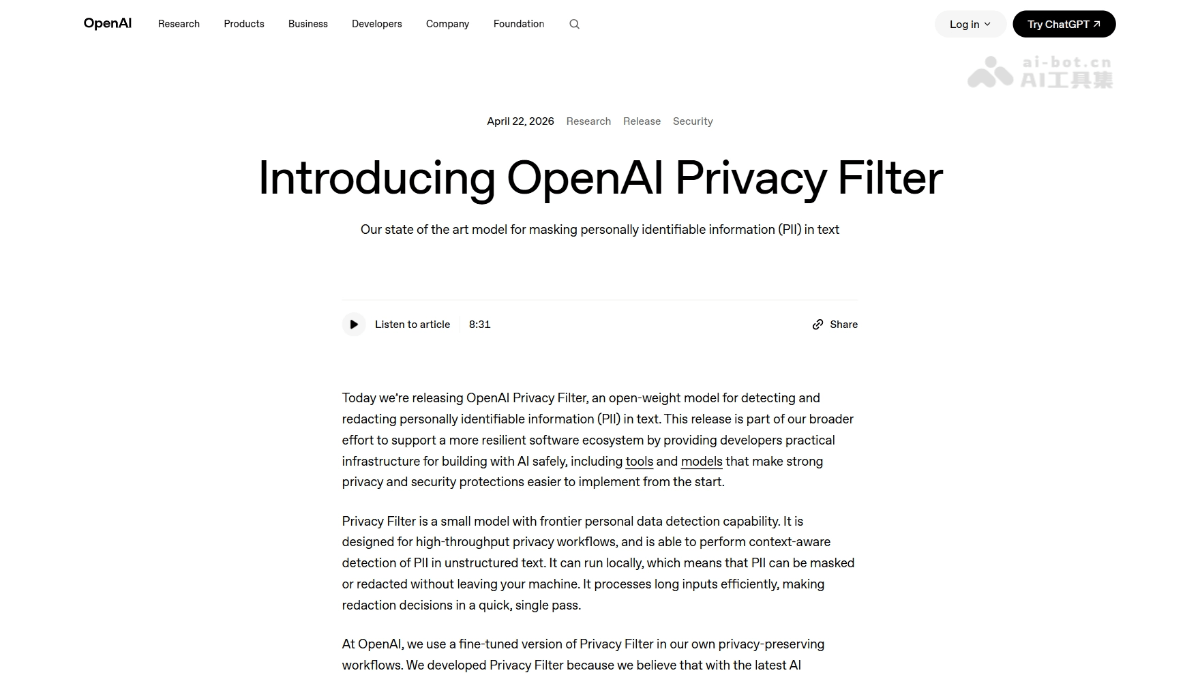
OpenAI Privacy Filter is OpenAI's open-source privacy filtering model, designed specifically to detect and redact personally identifiable information (PII) in text. The model is based on gpt-oss The architecture is adapted into a bidirectional token classifier, with 1.5 billion total parameters and 50 million active parameters, supporting an ultra-long context of 128,000 tokens, and can run locally in a browser or notebook without uploading sensitive data to the cloud. The model achieves a 96% F1 score on the PII-Masking-300k benchmark (97.43% after correction).
Main features of OpenAI Privacy Filter
-
Eight categories of PII detection: Identifies sensitive information such as private names, addresses, emails, phone numbers, URLs, dates, account numbers (including bank cards/credit cards), and keys/passwords.
-
Context-aware redaction: Distinguishes public information from private information based on deep language understanding, avoiding false positives or missed detections caused by simple rules.
-
Local high-throughput processing: Completes full-sequence labeling in a single forward pass, supporting uninterrupted processing of 128k long texts.
-
Configurable precision/recall: Provides multiple operating point presets at runtime, allowing adjustment of redaction boundaries and strictness as needed.
-
Supports fine-tuning: Can quickly adapt with a small amount of domain data to improve detection accuracy in specific scenarios (such as healthcare and finance).
Technical principles of OpenAI Privacy Filter
-
Bidirectional token classification architecture: Uses an autoregressive pretrained model as the base, replaces the language modeling head with a token classification head, and performs post-training with a supervised classification loss.
-
BIOES span decoding: The model outputs 33 token-level categories (8 privacy labels × 4 boundary labels + background class), and converts independent predictions into coherent span boundaries through a constrained Viterbi decoder.
-
Banded attention mechanism: The model uses banded attention (bandwidth 128, effective window 257 tokens), balancing long context and computational efficiency.
-
Sparse mixture of experts: 8-layer Transformer, each group query attention is equipped with 14 query heads and 2 KV heads, and the FFN layer uses a sparse MoE structure with 128 experts and top-4 routing.
-
Constrained sequence decoding calibration: Controls background retention and span entry/continuation/closure through linear-chain transition scores and six transition bias parameters, achieving global path optimization.
How to use OpenAI Privacy Filter
-
Environment preparation: Via
pip installAfter installation, obtainopfCLI tool; on first run, if there is no local model, it will automatically pull from Hugging Face. -
Single-item redaction: Enter on the command line
opf "待处理文本", supports--device cputo switch to CPU operation, or--checkpointto specify a custom model path. -
Batch file processing: Use
opfto process files directly, or combine with pipeline commands such ascat file | grep pattern | opfto implement complex workflows. -
Interactive mode: Starts interactive mode when there is no input, outputting a structured JSON preview with ANSI colors.
-
Model evaluation: Run
opf eval dataset.jsonlto test precision and recall on an annotated dataset. -
Domain fine-tuning: Execute
opf train train.jsonl --output-dir ./checkpointYou can fine-tune with your own data to adapt to enterprise-specific privacy policies.
Key Information and Usage Requirements of OpenAI Privacy Filter
-
License: Apache 2.0, commercially usable, modifiable, and auditable.
-
Runtime Environment: Supports GPU/CPU, can be deployed on laptops, browsers, and local servers.
-
Language Limitations: Primarily trained on English; performance may degrade for non-Latin scripts, low-resource languages, and specific cultural naming patterns.
-
Static Label Policy: Detection categories cannot be dynamically modified at runtime; label policies must be adjusted through fine-tuning.
Core Advantages of OpenAI Privacy Filter
-
Privacy-First Local Deployment: Sensitive text in the model does not need to leave the device, reducing cloud leakage risks.
-
Small Size, Big Capability: 1.5B/50M parameters achieve cutting-edge detection performance, suitable for edge devices.
-
Native Long-Text Support: 128k context avoids boundary information loss caused by traditional chunking.
-
Auditable and Customizable: Open-source weights and code support independent enterprise review, adapting to internal data governance requirements through fine-tuning.
Project Addresses of OpenAI Privacy Filter
- Project Official Website:https://openai.com/index/introducing-openai-privacy-filter/
- GitHub Repository:https://github.com/openai/privacy-filter
- HuggingFace Model Library:https://huggingface.co/openai/privacy-filter
- Technical Paper:https://cdn.openai.com/pdf/c66281ed-b638-456a-8ce1-97e9f5264a90/OpenAI-Privacy-Filter-Model-Card.pdf
Comparison of OpenAI Privacy Filter with Similar Competitors
| Dimension | OpenAI Privacy Filter | Microsoft Presidio | Google Cloud DLP |
|---|---|---|---|
| Open-Source License | Apache 2.0, fully open-source and commercially usable | MIT/Apache, open-source | Closed-source commercial service |
| Deployment Method | Local/edge/browser, no internet connection required | Local/container/self-hosted | Cloud API, data upload required |
| Model Architecture | Bidirectional Transformer, context-aware | Rule-based + optional ML models | Enterprise-grade hosted models |
| Context Length | 128,000 tokens | Depends on specific configuration, usually requires chunking | Depends on quotas and API limits |
| Fine-Tunability | Native support, can adapt with a small amount of data | Supports custom recognizers and regex | Adjusted through configuration templates |
| Core Advantages | Open-source and auditable, long text, local operation | Mature multilingual ecosystem, broad community | High enterprise integration, comprehensive governance tools |
| Target Users | Technical teams, enterprises focused on data residency | Small and medium teams, multilingual scenarios | Large enterprises, those already in the GCP ecosystem |
Application Scenarios of OpenAI Privacy Filter
-
AI Training Data Cleaning: Desensitize user conversations and documents before model training to prevent PII leakage into training sets.
-
Log and Index Desensitization: Perform real-time or batch desensitization on system logs and search engine indexes to meet the principle of data minimization.
-
Customer service and medical record processing: Automatically masks sensitive patient or customer information in ticket and medical record analysis workflows.
-
Code repository secret scanning: Detects secrets such as API keys and passwords in code to prevent accidental commits to version control.
-
Compliance pre-review assistance: Serves as an automated initial screening layer in compliance processes such as GDPR and CCPA, reducing the manual review burden.