
What is gpt-oss
gpt-oss is an open-source reasoning model series released by OpenAI, including two versions: gpt-oss-120b and gpt-oss-20b. gpt-oss-120b has 117 billion parameters, with about 5.1 billion active parameters, and can run on a single 80GB GPU; gpt-oss-20b has 21 billion parameters, with about 3.6 billion active parameters, and can run on consumer devices with 16GB of memory, such as laptops or phones. Both are based on the MoE architecture, support a 128k context length, and their performance is close to the closed-source o4-mini and o3-mini, performing excellently in tool calling, few-shot function calling, chain-of-thought reasoning, and health question answering. The models are open-sourced under the Apache 2.0 license, support free commercial use, and provide developers with powerful local reasoning capabilities.
gpt-oss-safeguard isOpenAI's latest new open safety reasoning model that supports custom safety policies, including two versions, gpt-oss-safeguard-120b and gpt-oss-safeguard-20b. It is a model specifically used for content reasoning, classification, and labeling, and is a fine-tuned version of the gpt-oss model. Both models support complete "chain-of-thought" output, can display the reasoning process, and can quickly adapt to new rules without retraining, offering strong flexibility and being suitable for scenarios such as emerging risks, complex domains, and insufficient samples.
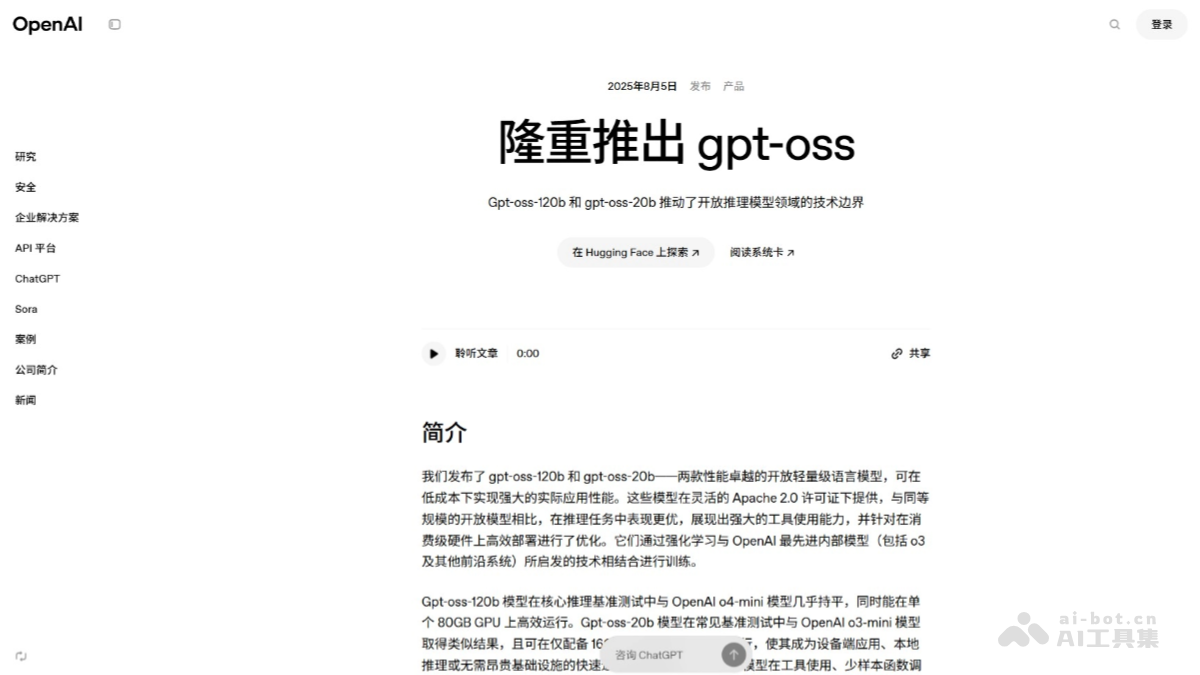
Main features of gpt-oss
- Tool calling: Supports calling external tools, such as web search and Python code interpreter, to solve complex problems and enhance problem-solving capabilities.
- Chain-of-thought: Breaks down complex problems step by step and solves them gradually, suitable for multi-step reasoning tasks.
- Low resource requirements: gpt-oss-20b can run on devices with 16GB of memory, suitable for consumer devices; gpt-oss-120b can run on an 80GB GPU, suitable for high-performance needs.
- Fast inference: Inference speed can reach 40-50 tokens/s, suitable for scenarios requiring fast responses.
- Open-source weights: Provides complete model weights and code, supports local fine-tuning and customization, and meets specific task requirements.
- Reasoning intensity adjustment: Supports three reasoning intensities: low, medium, and high, which can be adjusted according to needs to balance latency and performance.
- gpt-oss-safeguard:
-
Content reasoning and classification: According to the policies provided by developers, reasons about, classifies, and labels user messages or AI-generated content.
-
Dynamic policy application: Directly interprets and applies developer-defined safety policies during the inference stage, without hardcoding rules during the training stage, and can quickly adapt to new rules.
-
Complete "chain-of-thought" output: Displays each step of the model's reasoning process for reaching a conclusion, improving transparency and usability, and making it convenient for developers to trace and understand the model's judgment logic.
-
Technical principles of gpt-oss
- Model architecture: Based on the Transformer architecture, it uses Mixture of Experts (MoE) technology to reduce the number of active parameters required to process input and improve inference efficiency. Based on alternating dense and locally banded sparse attention patterns, similar to GPT-3, it further optimizes memory and computational efficiency. It uses grouped multi-query attention with a group size of 8 to further improve inference efficiency. It uses RoPE for positional encoding and supports a context length of up to 128k.
- Pre-training and post-training: Pre-training uses high-quality plain text datasets, focusing on STEM, programming, and general knowledge domains. Post-training uses a training pipeline similar to o4-mini, including supervised fine-tuning and a high-compute reinforcement learning stage. The training goal is to make the model conform to the OpenAI model specification and possess chain-of-thought reasoning and tool-calling capabilities.
- Quantization and Optimization: Quantized using the MXFP4 format, the model adapts to a low-precision environment during the training stage, ensuring high performance while reducing model size. After quantization, the gpt-oss-20b model is about 12.8GB in size and can run on devices with 16GB of memory. After quantization, gpt-oss-120b can run in 80GB of memory. Collaboration with hardware manufacturers such as NVIDIA and AMD ensures performance optimization of the model across various systems.
- Safety Mechanisms: During the pre-training stage, harmful data related to chemical, biological, radiological, and nuclear (CBRN) domains is filtered. Through deliberate alignment and instruction priority evaluation, the model is trained to refuse unsafe prompts and resist injection attacks. Adversarial fine-tuning is conducted in specific domains (such as biology and cybersecurity) to evaluate and optimize the model's safety.
gpt-oss Performance
- Benchmark Performance:
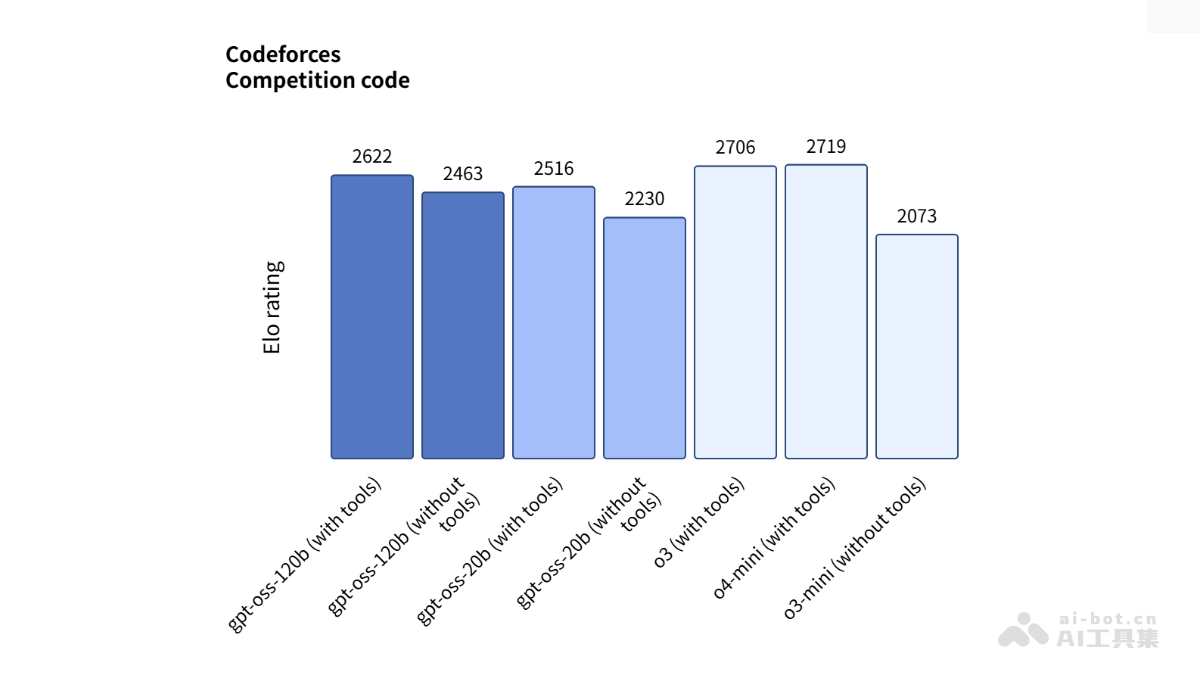
- Competitive Programming: In the Codeforces competitive programming test, gpt-oss-120b scored 2622 points and gpt-oss-20b scored 2516 points, performing better than some open-source models and slightly worse than the closed-source o3 and o4-mini.
- General Problem Solving: In the MMLU and HLE tests, gpt-oss-120b performed better than OpenAI's o3-mini and approached the level of o4-mini.
- Tool Calling: In the TauBench agent evaluation suite, both gpt-oss-120b and gpt-oss-20b performed better than OpenAI's o3-mini and reached or exceeded the level of o4-mini.
- Health Q&A: In the HealthBench test, gpt-oss-120b outperformed o4-mini, and gpt-oss-20b reached a level comparable to o3-mini.
gpt-oss Project Address
gpt-oss:
- Project Official Website:https://openai.com/zh-Hans-CN/index/introducing-gpt-oss/
- GitHub Repository:https://github.com/openai/gpt-oss
- HuggingFace Model Repository:https://huggingface.co/collections/openai/gpt-oss-68911959590a1634ba11c7a4
- Online Experience Demo:https://gpt-oss.com/
gpt-oss-safeguard:
- Project Official Website:https://openai.com/index/introducing-gpt-oss-safeguard/
- HuggingFace Model Repository:https://huggingface.co/collections/openai/gpt-oss-safeguard
- Technical Paper:https://openai.com/index/gpt-oss-safeguard-technical-report/
gpt-oss Application Scenarios
- Local Inference and Privacy Protection: In privacy-sensitive fields (such as healthcare and finance), gpt-oss can run on local devices, ensuring data security while providing strong reasoning capabilities.
- Programming Assistance and Code Generation: Developers use gpt-oss with tool calling to generate and verify code snippets, significantly improving programming efficiency and reducing debugging time.
- Intelligent Customer Service and Customer Support: Enterprises deploy gpt-oss as intelligent customer service to quickly respond to customer inquiries, provide accurate answers, and reduce labor costs.
- Education and Learning Tutoring: Students use gpt-oss to assist learning, answer questions, and provide writing suggestions, improving learning efficiency and comprehension ability.
- Creative Content Generation: Writers, screenwriters, game developers, and others use gpt-oss to generate creative content, inspire ideas, and improve creative efficiency.