
What is Open Deep Research
Open Deep Research is an open-source AI agent, and is anDeep Researchopen-source reproduction project that completes complex multi-step research tasks based on reasoning over large amounts of web data. Open Deep Research uses the search and extraction capabilities of Firecrawl and does not rely on OpenAI's o3 fine-tuned model. Open Deep Research supports multiple language models (such as OpenAI, Anthropic, Cohere, etc.), provides a unified API and Next.js application framework, and features real-time data input, structured data extraction, server-side rendering, and more.
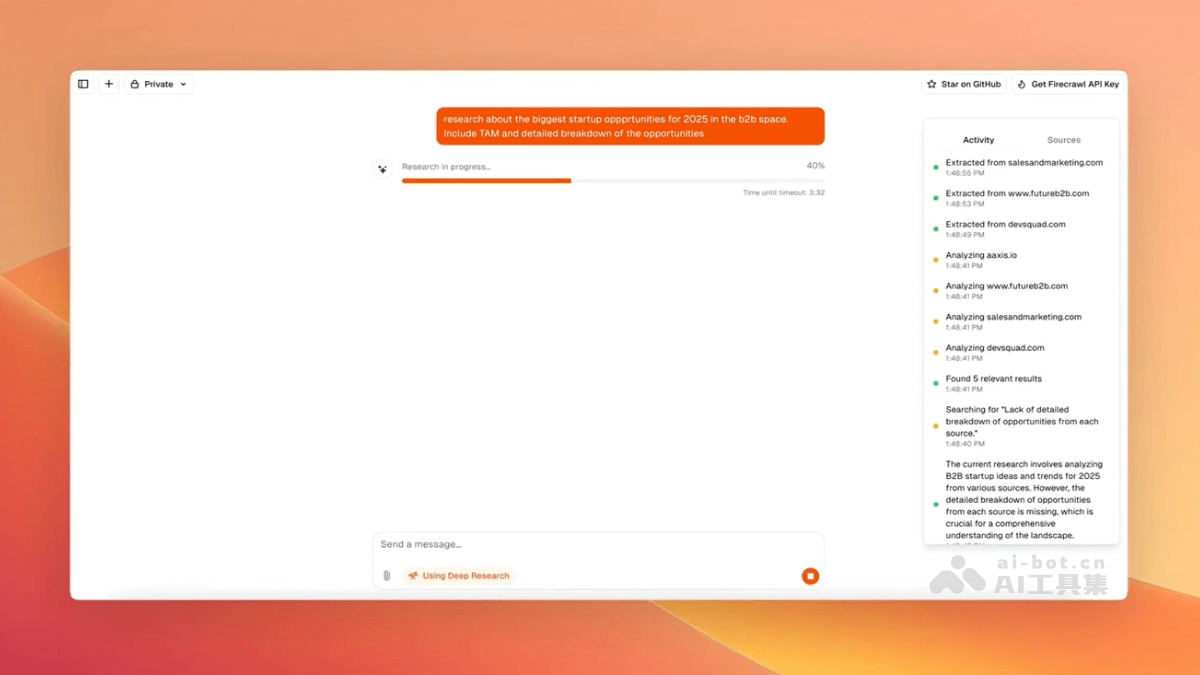
Main features of Open Deep Research
- Data extraction and search
- Firecrawl integration: Retrieves data from multiple websites in real time, structures it, and provides basic information for subsequent reasoning.
- Multi-source data integration: Extracts key information from different types of web pages, supports multiple data formats, and ensures the diversity and richness of the data.
- Reasoning and analysis
- AI reasoning engine: Based on powerful reasoning models (such as OpenAI's GPT-4o or other LLMs), it conducts in-depth analysis and reasoning on the extracted data to generate comprehensive conclusions.
- Multi-dimensional analysis: Conducts multi-dimensional analysis of data, including text content understanding, data correlation analysis, trend prediction, and more.
Technical principles of Open Deep Research
- Data extraction and search technology:
- Firecrawl: Based on Firecrawl, it quickly crawls data from multiple websites, simulates browser behavior, accesses target websites and extracts web page content, and structures it into JSON or other formats.
- Real-time data stream: The extracted data is transmitted to the AI model in real time via API, ensuring the timeliness of the analysis.
- AI reasoning model:
- Language model: Uses advanced language models (such as OpenAI's GPT series) as the core reasoning engine.
- Model invocation: Based on the AI SDK, users can flexibly invoke different language models and choose the appropriate model for reasoning according to their needs.
- Frontend and backend integration:
- Next.js framework: Next.js serves as the frontend framework, combined with React Server Components and Server Actions, to achieve efficient server-side rendering and dynamic user interfaces.
- API interface: Based on the unified API interface provided by the AI SDK, the frontend can conveniently call the backend AI models and services.
- Data persistence and storage:
- Vercel Postgres: Uses Vercel Postgres as the database, supporting the storage and querying of structured data.
- Vercel Blob: Used for storing file data, supporting efficient storage and access of large files.
Project address of Open Deep Research
- GitHub repository:https://github.com/nickscamara/open-deep-research
Application scenarios of Open Deep Research
- Literature review: Helps researchers quickly collect and organize literature materials in related fields, and generate literature review reports.
- Industry analysis: Quickly collects and analyzes information such as market dynamics, competitive landscape, and development trends in a specific industry, and generates industry analysis reports.
- Investment research: Analyzes information such as company financial statements, industry dynamics, and market sentiment to provide data support for investment decisions.
- Policy Research: Collect and analyze relevant domestic and international policies, regulations, and cases to provide reference for policy formulation.
- News Reporting: Quickly collect and organize information related to news events, and generate a preliminary draft of news reports.