
What is Oliva
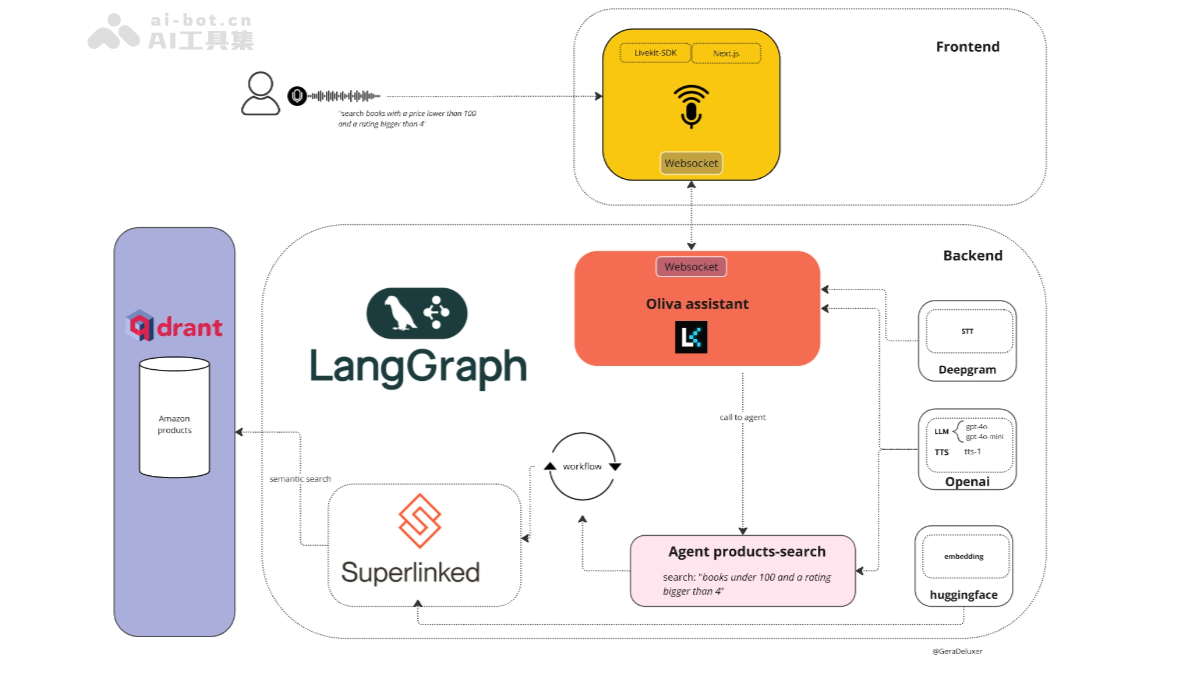
Oliva is an open-source voice RAG assistant that combines Langchain and Superlinked technology, based on a voice-driven RAG (Retrieval-Augmented Generation) architecture, helping users search information in real time in the Qdrant vector database. Users ask questions based on natural voice, and Oliva usesspeech-to-textand real-time voice communication technology to convert voice commands into queries to the database and return structured results. Oliva supports multi-agent collaboration, breaking down complex problems into multiple subtasks handled by different agents.
Main features of Oliva
- Real-time voice search: Users ask questions based on voice, and the AI responds in real time.
- Multi-agent collaboration: Break down complex problems into multiple subtasks, handled separately by different agents.
- Semantic search: Based on the Qdrant vector database, understands semantics and provides precise search results.
- Flexible integration: Supports connecting local documents, API data sources, online web pages, etc. as a knowledge base.
Technical principles of Oliva
- Speech recognition and synthesis: Based on the speech-to-text service provided by Deepgram , converts the user's voice commands into text for further processing. Converts the system-generated text answers into voice output and provides them to the user.
- Vector database: Stores and retrieves data based on the Qdrant vector database. Qdrant is an efficient vector database that can quickly handle similarity search of vector embeddings and supports semantic search functionality.
- Langchain multi-agent architecture: Based on the Langchain framework, builds a multi-agent system. Each agent is responsible for a specific task, such as retrieval, generating answers, or executing operations. Based on dynamic task routing, agents collaborate to complete complex query requirements.
- Retrieval-Augmented Generation (RAG): The RAG architecture combines two technologies: retrieval and generation. The retrieval module obtains relevant information from the vector database, and the generation module integrates the retrieved information into natural language answers.
- Real-time communication: Integrates the Livekit real-time communication platform to support real-time voice interaction. Users interact with Oliva using voice, and the system processes voice commands in real time and returns voice answers.
- Semantic understanding: Based on natural language processing (NLP) technology, understands users' natural language commands. Using vector embedding technology, converts users' voice commands into vectors, performs similarity comparison with vectors in the database, and provides precise search results.
Oliva project address
- GitHub repository:https://github.com/Deluxer/oliva
Application scenarios of Oliva
- Enterprise knowledge base search: Enterprise employees use voice commands to quickly query internal documents, technical manuals, FAQs, and other knowledge base content, improving work efficiency.
- Intelligent customer service assistant: As the voice interaction front end of a customer service system, it helps customers quickly solve common problems and provides 24-hour uninterrupted voice support.
- Smart home control: Use voice commands to control smart home devices, such as lighting, temperature adjustment, appliance switches, etc., enhancing the smart home experience.
- Data analysis and reporting: Users ask questions by voice to obtain data analysis results, such as querying sales data, market trends, etc., and the system feeds back the results in voice form.
- Mobile voice assistant: Integrated into mobile devices, as a personal voice assistant, helping users query information, set reminders, navigate, etc.