
What is NeoHorse-1
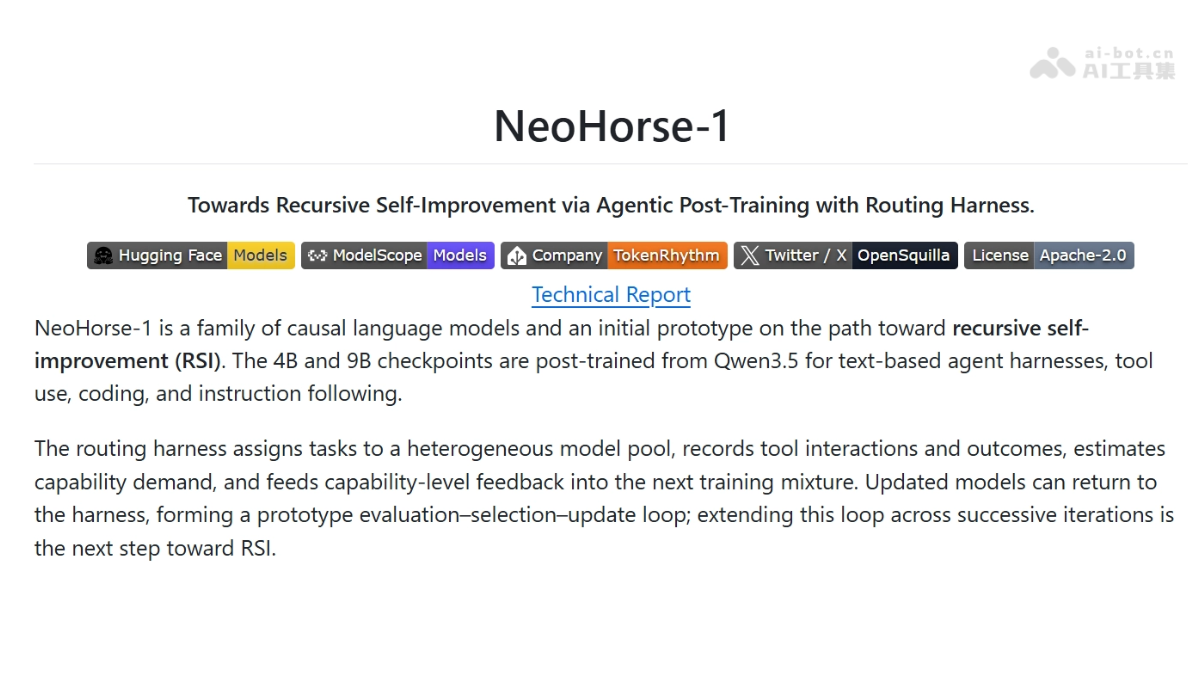
NeoHorse-1 is an open-source Agent model jointly launched by Jiyuan Lvdong, Infinigence, Tsinghua University, Peking University, CUHK, Alibaba, and others, including two versions, 4B and 9B. The model adopts Agent-Native post-training, uses the real execution trajectories of Routing Harness as training data, and reuses routing signals as the basis for training curriculum ordering, achieving a closed loop of evaluation feedback -> data mixture -> model update. The model covers tool calling, task planning, deep search, and code generation. The 9B version has an average score of 69.04, exceeding the base model by 3.44 points, natively supports a 260K token context, and can be deployed locally.
Main features of NeoHorse-1
-
Tool calling: Automatically select and call external tools according to task requirements to complete multi-step operations.
-
Task planning: Break down complex tasks into executable substeps, and perform long-horizon planning and scheduling.
-
Deep search: Actively retrieve and integrate information across multiple rounds of interaction to support the evidence chain for conclusions.
-
Code generation: Generate usable code and debug and fix it based on environment feedback until the task is completed.
Technical principles of NeoHorse-1
- Harness trajectory-driven Agent-Native training: The training corpus is centered on structured trajectories generated by real execution of Routing Harness, covering requests, routing, tool calls, environment feedback, and error recovery, with three more dimensions than traditional question-answering corpora: capability requirements, execution decisions, and environment results. Both successful and failed trajectories are retained and selected after structural checks and six-dimensional quality assessment, so that the training objective directly points to task completion.
- Capability-guided data mixture: The router divides tasks into four tiers, C0-C3, according to capability requirements, and the signals are reused offline as the basis for training: routing records are split into three segments, "prediction-action-result," using the prediction segment to order the curriculum and the result segment to locate capability weaknesses, based on which the next round of data mixture is adjusted, forming a closed loop of evaluation feedback -> data mixture -> model update.
- Single-round verification of recursive self-improvement (RSI): It is divided into two parts, Data-RSI and Model-RSI: the former means the model continuously executes to generate new trajectories, which are filtered and naturally accumulated as subsequent training material; the latter means updating the model according to evaluation weaknesses and placing it back into the Harness model pool. Currently, only a single closed loop has been verified, and the signal and reward design are still set by humans.

Follow WeChat and reply "open source" to join theAI open-source project exchange group
How to use NeoHorse-1
-
Install the download tool: Execute
pip install -U modelscopeto install the ModelScope command-line tool. -
Download the model: Run
modelscope download --model TokenRhythm/NeoHorse-1-9B --local_dir ./NeoHorse-1-9Bto pull the weights (the same applies to the 4B version; choose as needed). -
Deploy the service: Use SGLang (
pip install "sglang==0.5.17") or vLLM to start the inference service, configure--context-length 262144、--reasoning-parser qwen3and--tool-call-parser qwen3_coder。 -
API call: Use the OpenAI SDK to point
base_urlto the local service address (such ashttp://localhost:8000/v1), you can send requests just like calling the OpenAI API. -
Note on resources: The actually available context depends on GPU VRAM; when VRAM is insufficient, you can first reduce the context length before deploying.
Core advantages of NeoHorse-1
-
Agent-Native training: The training data comes directly from real execution trajectories rather than traditional question-answer corpora, with the goal aimed directly at task completion, rather than post-hoc adaptation of a general-purpose model.
-
Utilization of failed trajectories: The training set retains both successful and replaced failure records, enabling the model to learn "where errors are likely and how to recover after an error."
-
Reuse of routing signals: The C0-C3 capability tier signals of online routing are converted offline into training criteria, realizing the closed loop of "evaluation feedback -> data ratio -> model update."
-
Small size, high performance: The 4B version's Agent performance has already surpassed multiple larger general-purpose models; the 9B version averages 69.04 and exceeds the base by 3.44 points, with lower deployment cost.
-
Ultra-long context: Natively supports 262,144 tokens and can be extended to about 1.01 million tokens, adapting to long-horizon Agent tasks.
Project address of NeoHorse-1
- GitHub repository:https://github.com/TokenRhythm/NeoHorse
- HuggingFace model library:https://huggingface.co/collections/TokenRhythm/neohorse-1
- arXiv technical paper:https://arxiv.org/pdf/2609.08183
Comparison of NeoHorse-1 with similar competitors
| Comparison dimension | NeoHorse-1-9B | Qwen3.5-9B |
|---|---|---|
| Average score across ten benchmarks | 69.04 | 65.60 (+3.44 points) |
| QwenClawBench(Harness Agent tasks) | 48.73 | 44.04 |
| PinchBench(standardized workflows) | 82.25 | 74.55(+7.70) |
| BFCL v4(function calling/tool use) | 67.43 | 64.88 |
| tau²-Bench(multi-turn human-machine-tool interaction) | 90.82 | 88.04 |
| HumanEval(code correctness) | 98.17 | 92.68 |
| Training method | Agent-Native post-training: Harness trajectories + routing signal curriculum + on-policy distillation | General four-stage post-training, without Agent execution trajectories |
| Training data | Real execution trajectories (including failure and recovery records), screened by six-dimensional quality evaluation | General corpora + synthetic data |
| Context length | 262,144 tokens (extendable to about 1.01 million) | Long context (relatively shorter) |
| Protocol/ecosystem | Apache-2.0, full framework support such as SGLang/vLLM/Ollama | Apache-2.0, general-purpose model |
| Positioning | Specialized in Agent scenarios (tool calling, planning, deep search, code) | General Reasoning and Conversation |
Application Scenarios of NeoHorse-1
-
Agent Task Execution: As the execution model in harnesses such as OpenClaw, it automatically completes real computer tasks such as file operations and software usage, and autonomously recovers after failures.
-
Tool Calling and API Orchestration: In multi-tool environments, it automatically selects, combines, and calls external APIs, making it suitable for building automated workflow assistants.
-
Deep Search and Research Assistant: Multi-round proactive retrieval, cross-verification of information with evidence chains, supporting the generation of research reports with citations.
-
Enterprise Office Automation: Handles long-horizon, multi-step tasks such as schedule adjustment, data organization, and report generation in multi-domain workplace scenarios like WorkBuddy Bench.